Tarte aux Fraises

Tarte aux Fraises

Tarte aux Fraises

  • Prep  30 min.

  • Cook   45 min.

  • Ready In   4 h

Recipe By:Swede
“French strawberry tart”

Ingredients

  • tarte shell, baked
  • 1 egg
  • 1 egg yolk
  • 1/4 c. sugar
  • 3 T. flour
  • pinch of salt
  • 1 envelope unflavored gelatin
  • 1 t. vanilla extract
  • 1 c. hot milk
  • 1 c. heavy cream
  • 1 to 1 1/2 qts. fresh, whole strawberries
  • Glaze:
  • 1 c. red currant jelly
  • 1 T. hot water
  • 1 T. Kirsch

Directions

  1. Preheat oven to 400 F. Bake tarte shell, about 20 min. then cool.
  2. Beat egg and yolk and sugar until thickened and pale yellow.
  3. Add flour and salt and beat until well blended.
  4. Beat in gelatin and vanilla.
  5. Slowly pour in hot milk, beating constantly.
  6. Cook over medium, stirring until smooth and thick; do not allow to boil.
  7. Pour into large bowl and cool in fridge.
  8. When custard is cold, whip cream and fold it into the custard, beating gently.
  9. Pour into shell.
  10. Arrange berries on custard, stem down so that all of the custard surface is covered with berries.
  11. Spoon warm glaze over berries.
  12. Refrigerate 2 hours.

Creme Catalane

Creme Catalane

Creme Catalane

  • Prep 15 min.
  • Cook 30 min.
Recipe By:Swede
“Catalan version of creme brulee”

Ingredients

  • 1/2 liter milk
  • 1 egg plus 2 yolks
  • 75 g. sugar
  • 15 g. corn starch (2 level T.)
  • 1 stick of cinnamon
  • 1 skin of a lemon
  • 1 vanilla bean

Directions

  1. Boil the milk.
  2. Steep the cinnamon, vanilla, and lemon skin in boiling milk for 15 min.
  3. Work together the eggs, sugar and starch until whitening of the mixture.
  4. Pour, whipping rapidly, the boiling milk into the egg mixture.
  5. Put creme over low heat and mix regularly with a wooden spoon until bubbles appear.
  6. Creme should thicken slowly.
  7. Transfer to a bowl and serve cold.
  8. Or transfer to individual custard dishes and melt sugar on top with a hot custard iron or a torch.

Dill Kott (roast lamb with dill sauce)

Dill Kott


  • Prep  5 min.
  • Cook  3 h
Recipe By:Swede
“Boiled lamb with dill sauce”

Ingredients

  • small leg of lamb (or shoulder)
  • salt
  • dill
  • butter
  • flour
  • sugar
  • 1/2 t. vinegar
  • 1 egg yolk

Directions

  1. Boil lamb in water with salt and dill (trim fat really well) for 2 1/2 to 3 hours.
  2. Cut into pieces for serving.
  3. Put stock in bowl and remove fat.
  4. Make gravy with butter, flour, stock, sugar.
  5. Add vinegar and dill, then taste.
  6. Put yolk of egg in a small cup.
  7. Add a little hot gravy to the egg yolk and mix.
  8. Put egg mixture into gravy and heat.
  9. DO NOT LET IT BOIL.

5. Friendships


Friendships

The spring after our apartment purchase, I was on my way back to our little apartment in the Roussillon, stopping in Iceland along the way. I had written to the hardware store in Banyuls, telling the woman there that I was stopping in Reykjavik on my way to Banyuls and asking if I could give her family any sort of message from her. To my delight, I received a letter from her with address and phone number of her family, and she said they were prepared to receive me! I still didn’t know her name, for sure, but that didn’t seem to matter when I went to lunch at my hotel’s restaurant and found a dish on the menu, cooked in the Roussillon style! Within minutes of my inquiry of the waiter as to why a Roussillon recipe was on their menu, the chef was rushing to my table with a big smile of welcome. He was a friend of the family I was to visit, and, like his compatriot, was a chef from the Roussillon! At that time, he was splitting his year between working as a chef at his home in Iceland and running his own restaurant in Argeles-Plage. I finished my delicious lunch and when I asked for the check, found that the chef had paid my bill! I was not even permitted to leave a generous tip for the waiter!

I spent a wonderful day with that Icelandic-French family, touring around that part of Iceland, stopping for coffee often, then visiting their pate factory. I left for France early the following morning laden with gifts and a letter for my new friend in Banyuls. Over the past 30+ years, my new friend and I have remained fast friends, sharing our love for different cuisines and exploring local wines. All the conversation is always in French and I have learned a lot about French expressions and customs from her and about Catalan culture from her husband.   When my husband and I decided to marry, we were on our way to Banyuls and asked our friend to marry us, as she would have been able to do so through her position in the mairie. Sadly the legal paperwork and long time requirement did not meet with our short Easter vacation that year. But what fun that could have been!

My first meal with this couple was in their apartment above their store. My friend, Judy, had accompanied me to Banyuls that Fall and was with me for this first meal. We had stopped in Iceland on the way over, met with the Icelandic family, and were carrying with us a very large box of pate from their factory to give to the family in Banyuls. We’d had quite a time keeping it cold on the train all the way down from Luxembourg, where our plane landed! Our first meal with my friends was endives stuffed with ham and cheese and covered with béchamel sauce. It was my first taste of endives and I immediately loved this very typical French dish. Judy had spent a year in Salamanca and had a degree in Spanish, so between her Spanish and my high school French, we managed to have a conversation with this delightful couple.

baked endives

During one of our first years of setting up our apartment, we arrived without luggage.   For some reason (known only to baggage handlers), it had not arrived on the train down from Paris. We’d arranged for someone to come install our shower rod and to put up the overhead lights we’d bought and they did not come when scheduled—typical Catalan schedule of “whenever.” Our mailbox didn’t work when we tried it and when we finally got a key that would work we found mail dating back 3 years in it! It was a frustrating beginning to our “vacation.”

So we went off to our friends’ hotel in Cerbere for a nice meal. But it was a Tuesday and the help’s night off, so no meals were served! But the best part about having such wonderful friends, is that they invited us to stay for a special meal with about 10 of their friends. Someone had been able to smuggle a Spanish ham across the border and that meant a special meal to these Catalans! There were 12 of us around the table First we had apero of Scotch on ice. Then the meal consisted of the ham, sausage, sardines, pate, fish pate with tarragon sauce, salad and premier cru red wine. And of course, pain aux tomate.s This was my first experience with this stable of Catalan cuisine. I went with the patron to the kitchen and watched as he toasted the bread, rubbed it with garlic and oil and then rubbed it with a cut tomato. It is most often served topped with anchovies and pimiento strips, but also, as at Chateau de Jau Winery, served with Serrano ham (in the US we use proscuitto).

pain aux tomates

The next part of the meal was cheese and bread, with another, better, red wine. Then coupes with Poire William and glasses of champagne, and finally 50-year old cognac (the bottle was very dusty) and café. So there was a lot to drink and a lot of conversation. Several of the men had been in concentration camps during the war and remembered some German songs and the American songs, so there was much singing also. It wasn’t until several glasses of wine had been consumed that anyone even admitted that they knew a few words of English. There was a doctor who worked at a center doing rheumatism research, an architect, who had been in two concentration camps and had composed a song which he sang for us, and two other couples. It was a lively group and after all those different drinks, it was an exciting drive home at 1 a.m. around all the “snake” curves between Cerbere and Banyuls!

The following week, we were once again in Cerbere and the patron invited us to attend the Rotary Club dinner meeting with him and his wife. The meeting was held in the hotel owned by our mayor, so we had our first introduction to our mayor, who served 12 years, then recently returned for another 6 year term. The meal was not very good and the conversation centered around the new road being planned from Perpignan to Spain that would bypass the coastal villages. What I remember most about the evening was our friend, the patron, pacing around and around the room in frustration, as we all contemplated the loss of business as tourists went around the villages and sped on to Barcelona or up to Paris. Yeats later when the by-pass road was finally built, it stopped at Banyuls, so travellers still have to pass through Banyuls and Cerbere when taking the coastal route. There are so many tunnels to cut for the last bit that I doubt they will ever finish it.

The engineering professor and his family, who rented our apartment for five weeks during his sabbatical, discovered that there was someone at one of the boulangeries who spoke English. Not only did this woman speak perfect English, but it was American English! So when we returned to Banyuls the following Fall, we stopped into the boulangerie and found the woman who was to become my very best friend. She was an artist who had been born in France, but brought up in the US, so spoke both languages with perfect ease. When we first had them come to dinner in our apartment, they arrived with their 17-year old son, which I was not expecting, so the step stool was put into use as a chair for me, as we added another place at the table for their very talented son. That was something I had to learn to expect in France: children come with their parents when invited to dinner. I had a lot of questions that first evening together and one was “What the heck is that in my bottle of red wine vinegar?” My dear friend laughed and explained that I had a “mother” growing in the vinegar. With great excitement that one had grown in a plastic bottle, she promised to take it to her grandmother who would trim it and put in glass, so I could continue to feed it with wine and, thus, always have red wine vinegar in my kitchen!

When our daughter was young, we would often take her to La Pardalere, a restaurant with a swimming pool on the hill above our village. By purchasing a drink or a meal, we had the privilege of swimming in this very lovely pool. One year she made the acquaintance of two British children in the pool, while we sat chatting with their parents. The following year, when we returned to La Pardalere for lunch, the same British family was there! So we had lunch together and this is where I learned about “joues de porc.” Not knowing the meaning of the word “joues,” I asked the waiter. He tapped his cheeks and said “joues.” Ohhh! “pork cheeks!” That was my first taste of this delicacy, cooked in a Banyuls wine sauce. Now I find pork cheeks in our southern markets here in the US, where they are quite common cuisine. I also fell in love with their avocado and salmon salad (Salade Tiede), which we have made many times in both of my kitchens.

Salade Tiede2

We have continued our friendship with this British family who divide their time between their home in England and their family village house in one of the hill villages west of Perpignan, sharing tales of our children as they have grown into adults and sharing fabulous meals emanating from both of our kitchens.

One Fall I saw a notice in the local paper advertising English classes in our village. I decided it was time to make some new friends, so I showed up at the English class and offered my services to the teacher. The teacher was a little taken aback at my offer. She thought she spoke English very well and did not require any assistance! Was I just another pushy American? But she let me stay and I showed up every class, helping the students one-on-one (all adult students) with their assignments. The students seemed to appreciate my assistance, and as the weeks passed, the teacher warmed up to me, and she began to ask me to answer some of the students’ questions.   One day there was a reading of a weather report. I offered to read it so the class could hear it read correctly. Then we discussed the difference between British English and American English, and I ended up reading the passage first in a British accent and then in an American accent. They hadn’t understood that there was a difference! Towards the end of our stay that year, I took a batch of thumbprint cookies to share with the class and we translated the recipe for them. By then, mixes for making chocolate chip cookies were appearing in the French supermarkets. So the French thought all cookies were chocolate chip. That precipitated a whole discussion on the English word “biscuit.” An American cookie is a British sweet biscuit (as in “Do you want a bicky with your cuppa?”). An American biscuit is similar to a British scone. A British savory biscuit is an American cracker. A British cracker is that thing we pull open after Christmas dinner and toys and funny paper hats and jokes go flying around the room! I smile to think that some ladies in our village are still enjoying the making of thumbprint cookies in their homes.

I did keep in touch with several of the ladies in the class and the teacher, inviting a couple of them to our apartment one year for an English afternoon cream tea, with British friends and my best friend to help translate. Sadly, when I went to the library to find the teacher last year, I was told she had recently died of cancer.

Thumbprint Cookies

We have cherished our friendships over the decades. Some friends are our very close friends, like family. Others are the merchants we see and who help us every year.0Yet others are the grown children of our original friends, another generation of our extended family in France. And always, our time together has been spent over a meal, whether in a restaurant or one of our homes, we always discuss the food, try to guess at its recipe, admire its presentation, and then we go home and try to do it ourselves.

I have cooked a Swedish Christmas smorgasbord for my French friends, an American Christmas dinner for our Cerbere family, complete with a small turkey we took from the US, and a 4th of July picnic for the officers of the USS Avenger when it stopped on its way home from Desert Storm. One evening I prepared a typical American salad bar for our French friends from the village. Piling everything up on one plate was completely unheard of and we had quite a time convincing them that this was the way to do it! In recent years, we have served pork ribs and cole slaw in France, and that was also a difficult experience to teach our friends it was okay to pick up the ribs and eat them with their hands; I had to be prepared with finger bowls.

We have explored unusual seafood (like one that looks like a baked potato) with my best friend, and we have discovered new recipes everywhere we go. We learn so very much from each other and from the chefs we have come to know and admire. And when I arrive home in the US, I prepare French and Catalan meals and tapas evenings for my American friends. I introduce them to crème catalane, pain aux tomates, foie gras with gros sel, moules au saffron, our Spanish friend’s pepper salad, and tarte aux fraises. When I figure out where to find squash flowers here in the South, perhaps I’ll be able to serve my stuffed artichokes with fried squash flower, too!

Salade Tiede

Salade Tiede

Salade Tiede

  • Prep  10 min.
  • Cook  1 min.
Recipe By:Swede
“Warm salad with salmon. Source: La Pardalere, Banyuls-sur-Mer”

Ingredients

  • smoked salmon (lox)
  • avocado
  • creme fraiche

Directions

  1. Warm creme fraiche in small saucepan.
  2. Arrange sliced salmon and sliced avocado on individual plates.
  3. Pour warm creme fraiche over the salmon and avocado.
  4. Serve immediately.

Tarte aux Pommes

Tarte aux pommes

Tarte aux pommes

  • Prep 1 h
  • Cook 1 h
Recipe By:Swede
“French apple tarte. Use Tarte Pastry recipe for crust.”

Ingredients

  • tarte pastry
  • 4 Granny Smith Apples
  • 1 T. water
  • 1 t. sugar
  • 4 Granny Smith Apples
  • 1/4 c. apricot preserves
  • 1 T. water

Directions

  1. Make apple sauce by boiling 4 peeled and diced apples in 1 T. water and sugar, then mashing. Cool.
  2. Place pastry in tarte pan and add applesauce. Cover with peeled and sliced apples.
  3. Bake at 400 F. about 45 minutes.
  4. Remove tarte ring and bake 15 min. longer.
  5. Glaze with jam and water or cover hot tarte with vanilla sugar.

Pate Brise

Tarte pastry (Pate Brise)

Tarte pastry (Pate Brise)

  • Prep 5 min.
  • Cook

Recipe By:Swede
“Use this recipe for tartes. Source: Dieppe Cookery School.”

Ingredients

  • 250 gm flour
  • 125 gm butter (1 stick + 1 T.)
  • 15 gm sugar
  • pinch salt
  • 1 egg
  • 3-4 T. water

Directions

  1. Mix flour, sugar, salt.
  2. Make well in middle and add egg and butter.
  3. Mix with hands or cut with two knives.
  4. Add water as needed to make ball of dough.
  5. Fridge for 1 hour, then roll.

4. Furnishings and Repairs

Furnishings and Repairs

Our first years were spent purchasing furnishings. Lights were most important as apartments in France, at that time at least, did not include any lights. We did have one in the WC and one in the bathroom. Often apartments did not include ANY appliances, either. We were lucky to have a 2-burner gas top and an electric oven (although the door did not close properly), and a small fridge below the oven. I never understood the logic of putting a hot oven right over a tiny fridge with even tinier freezer compartment! Overhead lights for the living room and kitchen and two wall sconces for the bedroom completed our lamp purchases.

Then it was time for curtains for the bedroom, as that window was directly on the outside passageway along which everyone walked to get to the elevator. Of course there were no screens in the windows (unheard of in the Roussillon back then). One day when our infant daughter was in her crib, some teenage boys came walking past the window and stood looking in at her in her crib! Buying curtains was quite an ordeal. High school French does not teach you the words for rods and hooks, etc. But we managed to get some nice white sheers, which provided us with a semblance of privacy when the shutter was up on the bedroom window.

The next real necessity was a carpet sweeper. The apartment was covered with a short-nap burnt orange carpet—wall-to-wall carpeting except but the WC and tiny kitchen floors, which were tiled like the balcony. That sweeper never really worked well and we ended up bringing a small electric vacuum with us from the US. Thirty years later it still works, although now all the carpeting is gone and replaced with tile or wood. How I hated that carpeting, always full of sand from the beach and sand fleas, as well!

Before going south from Paris one year, I flew to Quimper to buy dishes! I had fallen in love with a pattern of Quimper dishes years before and had bought a couple of demitasse cups several years before on a stop in Quimper. But now I needed a set of dishes for our new apartment and I knew exactly what I wanted. It took stops in several shops to find exactly the right pattern and quality I wanted. Then after an afternoon of bagpipes piping in the area for a festival, a lovely dinner, and late church service, I went to bed for my early morning train to Paris, then on to Banyuls. The following year I returned to Quimper and bought $400 worth of dishes, so that we would have 4 of each kind of cup and plate. Now I need to return for another 2 of everything, as the family grows! Quimperware is quite “friable”—easy to chip—so over the years, they have picked up a few knicks and one of our renters broke a saucer one year and I broke a pitcher another year. But we have added to collection by scouring the antique stores in Perpignan and picking up some lovely antique Quimperware.

Anne's spaghetti

We purchased a dresser and 2 night stands for the bedroom and a sofa bed at M. Meuble Furniture Store that first year. That sofa bed became not only a guest bed, but also our daughter’s bed, when she outgrew her cot, until our move to a larger apartment. It is still with us and sags a bit, but we still use it for the occasional guest, when both bedrooms are filled, and we had an exciting night on it watching the Super Bowl for the first time on French TV several years ago! One night stand had to be ordered, so we said we’d pick it up the following trip to France. When I called upon our next arrival, they said it should be there, so up I went to the store to fetch it. It wasn’t there but “would arrive in two days” and they’d deliver it. I said I’d fetch it as I was going to Perpignan that day anyway. When I returned, they said that it had never been ordered, the salesman from whom I’d bought it was no longer with them, and they didn’t even know what the furniture looked like and I could I please bring in the one I already had! The following morning I was back at the furniture store with the “chevet” and was told that the factory no long makes them, but they called other branches of their store to look for one. They never did find a second night stand for us and did reimburse our money, and that is how we ended up buying one in Barcelona and transporting it back to Banyuls via taxi, buses, taxi, train, and foot—but that’s another story!

Two years later we decided to take a train trip down to Barcelona to do some shopping. We had a lovely late dinner at Reno’s, our favorite restaurant in the city, and enjoyed walking down Passeig de Gracia, looking at lots of china, crystal, etc. until we found a furniture store that was liquidating stock. There we found several interesting items. An antique mall of 72 stores also piqued our interest; we saw a Soler painting for about $10,000 and a fake Picasso, as well as a lovely art deco hand mirror for $200 and a sterling silver tea strainer for about $100. But we returned to Silva, the furniture store, located in one of the Gaudi buildings, and bought an end table, which we planned to use as our second night stand. Then the fun began!

We got our bags from the hotel and took a taxi to Estacion Francia to await the 4 p.m. train back to Banyuls. The station was very quiet—too quiet! Our taxi driver went into the station to find out what was happening and discovered that all the trains in Spain were on strike! The tourist office said there was a bus to Figueras at 2:30 so we hurried by taxi to Estacion del Norte to catch the bus. The line for tickets was very long, so I investigated taking a London bus which stopped in Perpignan, but it left from somewhere else. So we got tickets to Figueras, leaving at 5:30 p.m. When the bus pulled up to the curb at 5 p.m., everyone pushed and shoved to get on it. My husband quickly put the luggage and the end table in the compartment under the bus as I climbed onboard with the tickets, only to discover that this was NOT the bus to Figueras. So we had to quickly remove the luggage and table from under the bus and transfer everything to another bus that pulled up at 5:30 p.m. That driver said he was only going to Gerona. But he did not fill the bus, so he let some of us going to Figueras onto the bus. By this time, I had struck up an acquitance with a French girl and found out she was trying to get to Montpellier. She’d been told there was a bus from Figueras to Perpignan, so we decided we might be able to do the same, then take a train south to Banyuls.

When we got to Girona, mass confusion followed. A group of us that were headed for Figueras crowded around the bus beside ours because we were told it was going to Figueras. Then the driver told me NO, so we pulled table and luggage once again out of this bus. Shortly the group wondered back to our first bus and there a supervisor told our driver that he was, indeed, going on to Figueras. So we all climbed back on board and my husband once again stored the luggage in the compartment under the bus..

As I’d learned several years before, the “no smoking” signs on Spanish buses mean absolutely nothing, as everyone lights up their cigarettes, including the driver! First the bus had to stop for petrol and then we headed, at last, for Figueras.

When we got to the train station in Figueras, the station was closed and there was no bus to Perpignan. Luckily there were some taxis there and we decided to share a taxi with the French couple as far as the Perpignan train station. Once again we had to first stop for petrol! The taxi took us up the autopista (highway) to the border with France, where we had to stop and get out of the taxi. The taxi driver ran over to the exchange to get some French money, while the rest of us stood around with the French customs officers trying to explain why an American, a Brit, a French couple and a trunk full of luggage with a table roped on top were traveling across the border in a Spanish taxi!

When we got to Perpignan, the taxi driver got lost in the city and I ended up directing him to the train station. We arrived at 9:45 p.m., missing the 9:30 train south, so had to wait until the 11:50 train, the last train to get home. We arrived back in Banyuls at 12:20 a.m. and carefully and quietly walked down the hill, across the village, and up the hill on the other side to our apartment, carrying our luggage and the end table. And that’s how we finally got a second nightstand for the bedroom.


During the second year of ownership, I went to Banyuls with my friend, Judy, traveling on Halloween. We took with us two king-sized pillows for the bed. Knowing that our luggage would not accommodate the pillows, we rigged up ropes through the plastic bags on the pillows, and wore them like knapsacks on our backs. When the stewardess on the plane remarked on them, we said we were dressed as beds for Halloween! I must say they made the trip in coach much more comfortable! When we arrived at the apartment, after a day in Luxembourg and several days in Paris, we found that the gas heater did not work. So no heat in the apartment and no cooking on the stove. We used a loaf pan to heat water in the oven! It took a whole week to get a plumber to arrive and find the problem with the heater.

Meanwhile, I had decided that the one wall in the living room, which was not papered (probably because someone had papered around a large armoire against the wall) really needed to be papered. I arranged for a paperhanger to come and take a look at it. He was very amused and had fun figuring out how to fit the pattern together with the remnant of wallpaper I had found in the closet. The following morning he arrived with a helper and they began to put up the paper. But they were gluing the paper on top of a rough design that had been sprayed onto the wall when the apartment was first built, so the paper was lumpy and then there wasn’t enough paper to finish the bottom of the wall, but they continued their work, grumbling all the time. I told them that was okay because the sofa was going there anyway! All the time they were working, I was in the kitchen making a pate brise for an apple tarte. The paperhanger commented that I needed to be using my hands to mix the dough, not a fork! His father had been a baker, so he knew what he was talking about and offered to put his gluey hands in my dough to show me. No thanks, monsieur! He’s right, of course. One does need to use one’s hands to mix the butter into the flour of a pate brise.

tarte aux pommes

During those first few years of owning our apartment, we rented it out to fellow professors from my university from time to time. One engineer and his family stayed for 5 weeks while he was on sabbatical. One of his requirements was that we have a phone in the apartment. Up to that point, when we wanted to make a phone call, we either went to the phone booth in the street or to the Poste to have the gals there place a call for us (always a thrill for them when it was a call to the US!).

With some help from our realtor, we contacted the phone company and arranged for the workman to come and install a phone. As usual, the schedule was “Tomorrow” and they didn’t arrive until the middle of the afternoon (sometimes a workman will arrive about 6 p.m. after one has waited all day and given up the hope of ever getting the work done, and mostly often it’s really the next day they arrive).   After checking the conduit through which the wires should be threaded, he discovered that the conduit was blocked and he would have to bring along someone else to help him unblock it. Then I waited another long day for him to return. And I was waiting for a plumber to come fix the gas heater yet again. Then it was decided that an electrician was needed to unblock the phone conduit! Throwing up my hands, I took myself out for a nice dinner at Le Sardinal.

The next day I drove to Montpellier to pick up my husband at the train station and we then headed toward Ikea in Vitrolles, outside Marseille. We had a nice stop in Arles along the way and visited the marche the following morning, purchasing an old map of the Pyrenees Orientales.

Ikea was a godsend for us! We could have semi-Swedish food for luncheon in the Ikea restaurant and then luxuriate in the many beautiful items throughout the store. We bought several shelf units, a tall china cupboard, a small dining table and folding chairs, and a “Poem” chair (I think they call it “Pong” in the US these days). Then, of course, there was the inevitable car-top carrier and rope (still sitting in the garage, unused for the past 30 years). We got lost in Nimes, seemingly going around and around in circles until our tempers snapped. Forever in our minds, Nimes will be the city of traffic circles!

Five days after the first visit from the telephone man, an electrician arrived and said that the conduit was broken inside, so we could not have a telephone wire put through it. It took another week or so before it was decided that a telephone wire could be strung up along the top of the wall from the living room to the front door and then out along the outside corridor to the junction box. It finally got installed just before our renters arrived.

Meanwhile we’d bought a washer at our friends’ store and that was delivered and installed in two hours. We started it right up, but I had the oven on at the same time, so the circuit was blown! A quick change of a few wires in the circuit box, and we were okay—for the time being! That would soon change as we added appliances to our tiny apartment!

The following year we noticed the lights flickering, until we unplugged a tiny night light! We decided it was time to check with the electric company. The man was to come in two days to install a new junction box in the outside corridor, but he never did arrive and we had to wait until the following year to get that work done. When he arrived, he was sure that moving our power up one notch would be plenty. It wasn’t until my husband said, “But this is for an American kitchen,” that the electrician laughed and said, “Well, in that case, we better move it up even more!” Finally we had enough power to run the apartment! When we moved into our larger apartment fifteen years later, we had to have the electric company come and increase the power for that apartment, as well. Apparently, we Americans use a lot more electricity in our homes than the French!


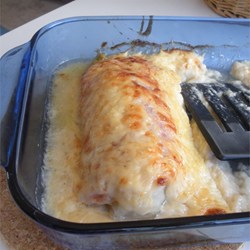
Baked Endives with Ham

Baked Endives with Ham

Baked Endives with Ham

  • Prep 15 min.
  • Cook 40 min.
Recipe By:Swede
“Belgian endives wrapped in ham and smothered in cheese.”

Ingredients

  • 4 Belgian endives
  • 4 slices ham
  • bechamel sauce
  • 2 c. shredded emmentaler cheese

Directions

  1. Trim endives, removing outer leaves.
  2. Boil in salted water for about 20 min., until cooked through.
  3. Drain well, then wrap each with a slice of ham and put into a baking dish.
  4. Cover with bechamel sauce and shredded cheese.
  5. Bake at about 200 C. for 20 min., until cheese is bubbling and browned on top.

3. Settling In


Throughout the Fall of that year, we received numerous communications from our British lady in the Roussillon and finally a “sous-signe prive,” that wonderful pre-sale contract that says you are definitely going to purchase the property. At the time it arrived at my home, we had two French-speaking professors visiting our college, and they agreed to assist me with the language of the documents. So one evening I found myself on my sofa with a Frenchman from Peugeot on one side of me and a Belgian university professor on the other side and together we read through the many-paged document with both of them translating and arguing about the correct word to use until we were all laughing.

We were advised to put our initials on each page, to sign everything with “Lu et approuve” written above our signatures, then get it notarized with as many ribbons and seals as possible, as the French love that sort of formality.   Later, I also had to have our marriage certificate translated into French by a French professor at the university. Nothing could be submitted in English.

Just after Christmas, we headed back to France to take possession of our new apartment in Banyuls. It was a difficult series of flights, with a change in Madrid, where there were several gate changes. Arriving in Barcelona was a chore at that time, as there was only one terminal, with a domestic end and an international end. We arrived from Madrid at the domestic end, but our luggage was at the international end, inside Customs. But the Spanish always have a solution, no matter if it seems correct. We just had to show our luggage tags and enter the Customs “Do Not Enter” exit door! We’d brought along a large trunk full of linens and kitchen items, and that, of course, had to be opened in Customs to be inspected. “Cosas por nuestra apartemiento en Francia,” I tried to articulate. Then a wave of a hand and we were through Customs.

The map from Hertz was very imprecise, so we did our best to drive through Barcelona and up to Gerona and Figueres, before heading to the coast and Port Bou. Up on the top of the cliff between Port Bou and Cerbere was the border control station, a simple cement building that looked like it had been there since long before the war. The Spanish police waved us through, so we proceeded on down the hill on the other side, but a whistle from the French police brought us to a screeching halt! We quickly backed up to the French police who demanded our car papers. I handed them the papers from Hertz, but they wanted the insurance papers. After a thorough and unfruitful search through our papers and looking in the glove compartment, where we saw only an empty folder from a previous renter, we were told to turn around and return to Spain! We stopped to talk with the Spanish police and they were sympathetic, but agreed that we needed the insurance paper. By this time, I could hardly talk, a result of battling bronchitis for the past two weeks. The Spanish police suggested that instead of returning to the airport in Barcelona (a 3 hour drive), we go to the Hertz office at the train station in Girona. I was furious that we couldn’t enter France, but what could we do but comply?

So off we went back down a couple more hours to Girona, stopping for more gas and directions to the train station, and there we found a very nice Hertz agent who actually found the insurance paper at the very bottom of our glove compartment. She advised us that the French police at Port Bou might still not let us cross because they sometimes require original copies, not the carbon copies we had! At her suggestion, we took the autoroute, crossing at Le Boulou, where we got across the border quite easily.

By this time, it was very dark outside. We headed toward Elne, then south along the coast. The streets were decorated with lovely colored lights for Christmas and the New Year, so it was all quite magical as we drove through the coastal villages. We had booked a room in an old hotel in Banyuls, one of the few open during the winter season. There we were led up three flights of stairs on the outside of the hotel to our room. Still weak from bronchitis and suffering from our difficult travels of the last 24 hours, we dragged our bags up all those stairs and collapsed briefly before walking down to a wonderful restaurant on the square, Le Sardinal. There we were very well taken care of with mussel soup, oysters, and homemade noodles, which we were too tired to eat. Thankfully, we were able to enjoy many more wonderful meals at this, our favorite Banyuls restaurant, over the next few years.


The following day, we slept late, then arranged to meet the Banyuls realtor, who met us at the bank in Cerbere to arrange our mortgage. After signing whatever paper they put in front of us at the bank, we were whisked off the notaire in Collioure, when we signed a power of attorney document for our British realtor to sign final papers for us later in the spring. But the best part of the day was when we were told that we could take immediate possession of the apartment and spend New Year’s Eve in our new home. First, we needed some furniture!

Purchasing a bed took the usual route of doing anything in those early days. First you go to a furniture store in Port Vendres only to find it has moved to Argeles sur Mer. There you are happy to find the store immediately, only to discover that it is closed for lunch and siesta. So you go for a not very good lunch, have a siesta in the car, and return to the store.   You discover a whole new world of French mattresses and bases (not really box springs), but then discover you cannot exchange money because all the banks are closed, so you have drive up to the train station in Perpignan. But the “Change” there does not reopen until 5 p.m., so you do a little shopping at the department store down the street, return to the “Change,” and finally get back down to the furniture store in Argeles, just before it closes for the day, to arrange delivery of the bed the following Monday. Buying a bed took an entire day.


The next day, after a day of cleaning in the apartment and food shopping, we had a fantastic dinner a Le Sardinal that evening: foie gras, turbot, sorbet, pigeonneau, cheese, patisserie. Then we were ready for the bed delivery.

New Year’s Eve was a bright, sunny day, with the tramontane wind blowing its usual force. We continued to fix things in the apartment and spent much time in the hardware store, where the owners were very kind to us. They were out of the fluorescent bulb we needed, but said they’d have some by May for sure! The wife noticed my Icelandic mittens (the tramontane was indeed very cold!). “Those look very warm,” she commented. “Yes,” I replied. “I bought them in Iceland.” “Oh,” she said, “I have family in Iceland!” This was the beginning of another wonderful friendship, which we have cherished for over 30 years.

Our New Year’s Eve meal was onion soup, Catalan salad, Janssen’s Frestelse (a Swedish potato dish we usually have on Christmas Eve), artichokes, pork chops, and Muscat mousse cake. At midnight we opened the champagne and the shutter at the window overlooking the bay, so we could toast the village at midnight. I was so ill that I had to go to bed immediately after our toast. But we’d made it to our new home, we had a bed to sleep on and a trunk to use as a table, and, unbeknownst to us at the time, we had already met our best friends in our village.