Out and About
We are often asked, “What do you do when you’re in France?” Frankly, we live! We eat and read and rest and visit with good friends. I spend a lot of time in the kitchen, creating, and my husband watches the boats going in and out of the harbor and the sailboat races on Sundays.
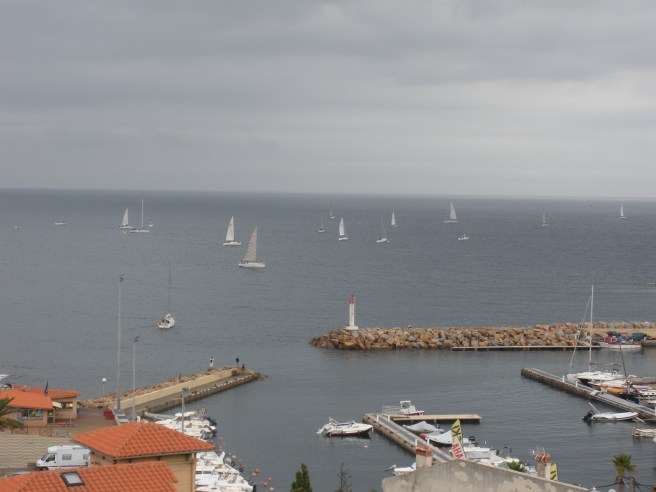
But occasionally, we also do some shopping and wine tasting and even some sight-seeing.
One of our favorite shopping stories is about the purchase of our wedding rings. We were in France for the week of Easter and, during that time, decided to look at wedding rings to see if we could find something beyond the usual band of gold. We had a lovely day in Perpignan, looking through the stores and eventually came upon the street filled with jewelers. Perpignan garnets are highly prized in the area and are now difficult to find as the synthetics flood the market. However, there is a guild of jewelers who are licensed to deal in garnets, and that day we found ourselves in one of those shops. While we were not looking at garnets, we did figure that this jeweler was very reputable, since he was a member of this prestigious guild. What we did find were gold rings that were round on the inside and square on the outside—very unusual, indeed! Getting a ring to fit my finger was no problem at all, but then the jeweler measured my husband’s finger and his eyes grew big. “Oh, la la!” he said. “I’m not sure I have enough gold to make a ring for monsieur!” We explained that we only a few days left of vacation and would need the rings before we left for the US. So the jeweler said to give him a day or so and he would call his colleagues to see if he could gather enough gold to make the ring. We were excited, but a little apprehensive. Would we get the ring in time?
The next day, the jeweler called to say he had the gold and could make the ring by Saturday. We were leaving by train to Paris on Saturday evening. “Well,” he said. “The train stops in Perpignan for 20 minutes before going on to Paris, so I will have my associate meet you on the platform. Look for her when the train pulls into the station.” So, with fingers crossed, we boarded the train in Banyuls and headed for Perpignan. When the train came into the station, I explained to the conductor that we were just getting off the train for a few minutes to meet someone and would return immediately. He watched us carefully as we left the train; I’m sure he thought it was a strange proceeding! Luckily, my husband is tall and very distinguished-looking, so the woman from the jewelry store saw us immediately and handed us the ring in a little box. I said: “Try it on and make sure it fits!” My husband chuckled as he put the ring on and said, “What am I going to do if it doesn’t fit?” What, indeed! But it did fit, and that is how we ended up with French wedding rings. When our daughter was 12 years old, we took her to the same jeweler and bought her a garnet cross to wear for her confirmation at church. I still look in the windows and salivate over their lovely garnet jewelry!
The other memorable shopping experience happened at Christmas when we were in Banyuls for the millennium. We had been looking for a small artificial Christmas tree all week, something not too big and not too small. Every store seemed to have sizes we did not want. Finally, on Christmas Eve, we stopped in a supermarket in Mas Guerido, on the outskirts of Perpignan. There they had a tree that was just the right size, but it was their display tree—no more boxed trees available. “But you can purchase the display tree, madame!” said a clerk when he saw my look of dismay. So with much excitement, I began to undecorate the tree, as it was covered with ornaments provided by different food companies. “Oh, no, Madame! You take the ornaments, too! No need to take them off the tree.” My goodness, I thought. This is wonderful! Then I asked the price and he said 25 francs—the equivalent of about $5. Good heavens! Then the clerk picked up the tree and carried to our car for us! Unheard of! That tree still sits in our garage, covered with a tree bag, and the additional ornaments we made for it are carefully stored, ready for the next time we decide to spend Christmas in Banyuls. We will never forget our $5 tree!
Every year I plan at least one shopping trip with my best friend, who now lives in Perpignan. Sometimes I drive up and sometimes I take the train, but always we meet for coffee and pastry at L’Espi, a delightful patisserie and restaurant.

We always spend a good 30 or 40 minutes of conversation over coffee and pastry before feeling well enough fortified to face a morning of shopping. Then we head for the shop where I purchase my annual santon. Santons are figurines of various sizes—the best are made by Claude Carbonel in Marseille. Each figure is a typical person from a French village and is dressed with provencal cloth.. Santons are placed around the crèche at Christmas time as if all have come to worship the Christ Child. It makes a nice display, and I enjoy choosing a new santon every year, a man one year and a woman, the next.

Then we head for Sephora, where I find products not found in the American Sephora stores. A stop in the tea shop to look at the unusual tea pots and a stop in the embroidery shop for supplies are usually on the list, as well as the required stop in the little Arab store on the edge of the Arab section of Perpignan. There I buy my pate de coing, which comes in a block. This is pate de fruit, which is the consistency of gum-drops. Coing is quince in English. A familiar Spanish dish is slices of manchego cheese topped with slices of pate de coing and drizzled with honey. This is served as either an appetizer or as a cheese course or dessert. At Christmas we purchase large boxes of pate de fruits, which are like rectangular gum-drops in all different flavors and are really delicious!
And then my friend and I head to a restaurant for lunch. We have tried many different ones over the years, but we still have our favorites. At Café de St. Jean, we sit in the open air under the ramparts of the cathedral. One of my favorite dishes served there over the years was a foie gras salad with strawberries, which I am always pleased to make at home.
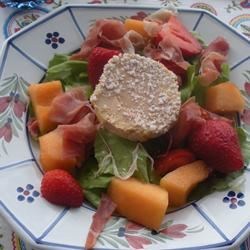
Always there is a new restaurant to try, once a quiche café, once a seafood restaurant. Then there was Le Devil, the tapas restaurant we visited for a book-launch one night! Perpignan is full of restaurants to explore. I also squeeze in a quick look through the fabulous Catalan store, Maison de Quinta and a shopping spree at the department store, Nouvelle Gallerie. We wander through the little streets, visit an antique store where we sometimes find antique Quimper dishes, and, of course, peer into the windows of our jewelers’ shop—he who made our wedding rings. The last stop is always the Belgian chocolate shop for an assortment of candies to take home to my family.
Having a husband who likes to pour over the annual Guide Hachette des Vins means that we frequently have a list of local wineries to visit and prized wines to try. They might be wineries in Banyuls or they might be further afield north to Maury or Cases de Pene or Tautavel or even on to Tavel.
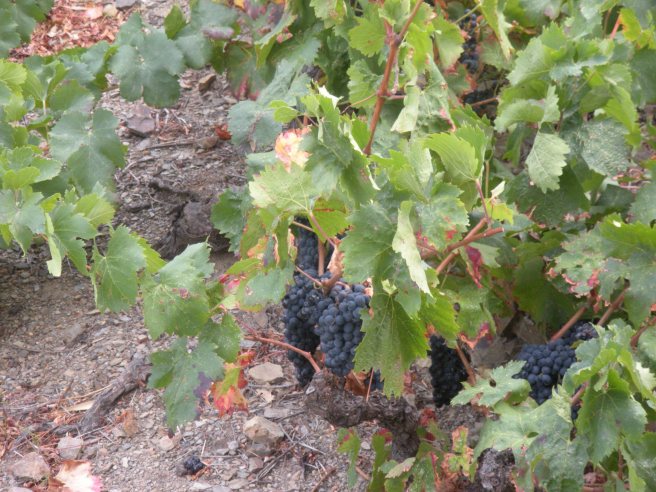
We have had several wonderful wine-tasting experiences. Of course the usual one is at Chateau de Jau, where we have the dejeuner degustation, which is a luncheon with about nine wines to taste throughout the courses, served under a very large, old tree on an open-air patio. When it’s cold or rainy, blankets are passed around! The menu stays basically the same: fougasse with olives or bacon, pain au tomate and Serrano ham, lamb chops,

Catalan sausage, Roquefort cheese,

ice cream and cake (except one year when they experimented with orange rice pudding) and then coffee. We have been eating this meal there for about 25 years. The meats are grilled on an open fire of sarments (grape vines), and we eat beside a pool full of carp, which have grown to mammoth sizes over the years (due to diners feeding them their bread, and sometimes the sausage, by mistake!).

We have enjoyed tasting many of their wines over the years, but particularly the new vintages from their vineyards in Chile. When our daughter was small, she would enjoy wandering around the pond while we lingered over the wine and her father enjoyed all the Roquefort cheese for himself. When our daughter was about 14, the one of the owners told us very seriously that our daughter should be tasting the wines so she would learn what a to taste in a wine and would learn to respect wine as a pairing with food, not as just another alcoholic beverage. So whenever we were in France, we let her taste the wines, and she learned very quickly. We realized very quickly that she was a “nose,” someone who can smell all the different nuances in a wine (much like a perfume “nose” is used in the perfume industry). This made her tasting experiences so much more meaningful.
For a few years, Chateau de Jau also hosted an evening concert and dinner during the Tour de France Music Festival. We enjoyed hearing some wonderful British singers, as well as pianist, Clive Lythgoe, who used to be on the faculty of our daughter’s institute in the States. The concerts began about 8:30 p.m., then there was a break for dinner at 10 p.m., then the other half of the concert, which ended about 1:15 a.m., so we would get home about 2:30 a.m. It is over an hour drive for us to get up to Cases de Pene.
Beside the restaurant (Le Grill) is a large building which has become an art gallery for annual summer shows of very esoteric and eclectic art. One of my favorite works of art was a completely flattened Citroen car, hung vertically on the end wall. The title was “Citroen Presse,” which is a play on words or a double entendre, as a citron presse is lemon squash, or what we Americans call lemonade! Another wonderful piece was a piano set up to play wine glasses of water, like a glass harmonica, instead of strings.
Their sister winery, Clos de Paulilles, which is situated just outside Banyuls, , offered evening wine-tasting meals, which we also enjoyed. Their menu included foie gras, Catalan chicken, manchego cheese, and a chocolate dessert. It was one of daughter’s favorite restaurants and where she often chose to eat for her name-day celebration. When she was very small, she collected pine needles from the tile floor and had a great time pretending that these needles were a family, while my husband and I enjoyed tasting all the wines. Those pine needles came home with us, carefully wrapped in a yellow paper napkin, “because they were a family and had to stay together.” Several years ago, during a cleaning spree, I found them, and I hadn’t the heart to throw them away! Clos de Paulilles is now owned by Domaine de Caze, so the meals are not the same, but it is still lovely to sit on the patio and enjoy the views of the sea.
While our daughter was involved in her summer camp, my husband and I often took the opportunity to explore other wineries. One of my favorite adventures was visiting the tiny village of Calce. My husband had been researching local wines and found that the whites from Calce that year were very good. So he directed me through many small roads and lanes and fields, and I thought we’d never find this place! But finally we came upon the village we sought. We passed the winery just as we entered the village, but it looked closed, so we drove through the village and saw only two people—they were sitting on chairs outside their house, watching us go by. It was siesta time, so of course everything was closed. We returned to the winery and, by waiting a bit, were able to call someone and arrange a tasting. They were delighted to sell their wine to Americans!
Another time we’d had our usual lovely meal in Montner at L’Auberge du Cellier and had enjoyed a local wine. Pierre-Louis sent us home by way of the village the wine came from, so we could buy some. There we found some workers along one of the village streets and by mentioning the name of the wine, we were able to find the right vintner. He took us into his garage, and there we tasted the wine again and bought a few bottles. It’s always an adventure, as some wines are made in very small establishments, like personal garages, and others come from cooperatives or from very large wineries. However, there is never a tasting fee, as you find in Napa Valley!
Last year we headed to a new winery, La Toupie, near Perpignan. I dutifully turned on the GPS in our lease car, and we soon found ourselves lost in a maze of streets within a new housing development. We call our GPS lady “Mabl” (Most Annoying British Lady), and she really does annoy us when she gets us lost, often when we’re up in the mountains where she thinks there are not any roads! But this time, we finally did find a sign for the winery and proceeded down a narrow driveway to a large gate. I timidly opened the gate and entered the back garden of a very nice house! But nothing ventured, nothing gained, so I continued past the swimming pool and up to the open back doors of the house, calling out as I went. Two teen-aged girls and their mother arrived and explained to me that the winery was actually in another town. She gave me their card and took my phone number. That evening, her husband called and we arranged a tasting at his winery the next day. He met us in the center of that village and we followed him up the hill to his new building. He’d only been in business a few years but already had won acclimations for several of his wines. And he’d worked in Napa Valley for a while, so could speak to us in English. But the best part was that he had plates of fresh bread and cheeses ready for our wine-tasting at a tiny café table with chairs. It was so elegant and private and the wine really was very good. What an enjoyable experience! We saved a bottle for New Year’s Eve, and when I sent a photo of my husband with this wine to my friend in Banyuls, she responded with a photo of her husband with the same wine, which they also had for New Year’s Eve!
As our daughter grew, I decided that we needed to explore something different every year. It became a groaning joke of what would mother drag us to this year! Sometimes it was simply a drive up to the top of the mountain behind Banyuls to visit the Tour de Madeloc, the watchtower overlooking our part of the coast.
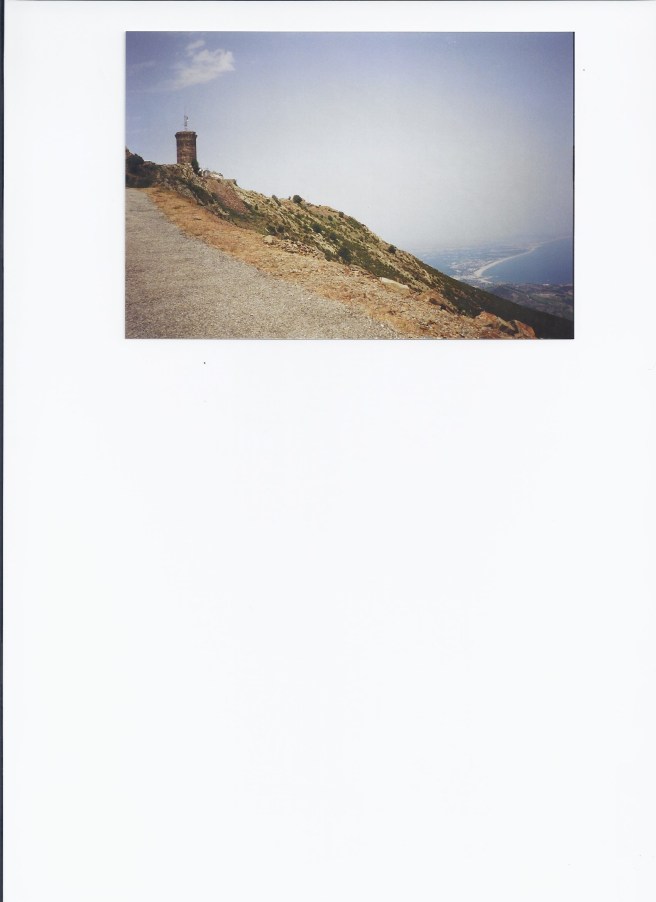
This is a one-lane winding road that is best driven after a wine tasting at the large Templiers winery on the way up! Meeting a car coming down when you are going up, with a stony hill on one side of the car and the steep cliff down on the other side (remember we’re talking ONE-lane here), takes a lot of Dutch courage!

But the views from on top are fantastic and well worth the nail-biting drive up the mountain.
We got to the butterfly exhibit in Elne when it first opened (before they realized that dogs should really NOT be permitted inside the butterfly house!), we visited the ramparts and caves of Villefranche de Conflent, where my daughter and I sang in one of the circular rooms of the towers to test the wonderful acoustics! We took a trip on Le Petit Train Jaune, a tourist train up to the edge of Andorra, and we went to Carcassone several times to visit the walled city, which can be seen from the autoroute as you travel north.

Carcassone is a rebuilt ancient city (rebuilt in the 19th century), which is often described by the French as very Disneyesque. It is full of boutiques and knight-themed exhibits. In the summer, it is quite a lively place, particular for children. One time we went to a restaurant for lunch and had a lovely luncheon on an open patio, where chickens wandered around our feet!
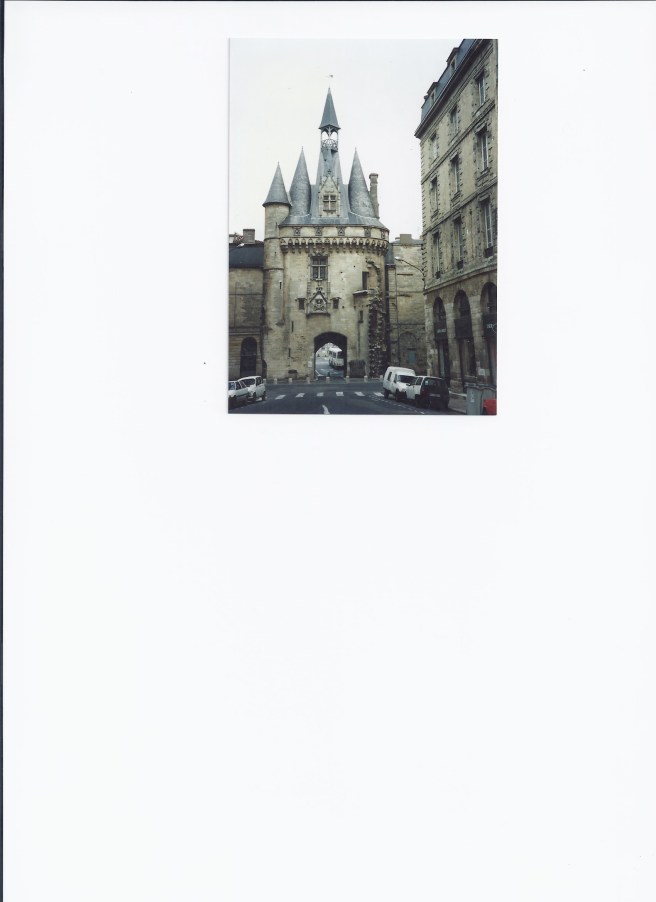
In 2001 a leg of the Tour de France cycling race left Perpignan, headed to Ax les Termes, up in the mountains. We decided this was an opportunity not to be missed, even though the tramontane had been blowing all day, so we drove up toward Marquixanes, near Eus, which was along the route. But we got no further than Thuir, because the road was closed for the race. We finally found a place to park in Thuir, with difficulty, as hundreds of people were there to line the route. Then we stood for two hours in the wind, waiting and waiting, while the parade of sponsor cars came by, throwing gifts to the spectators: flags, coffee, candies, toys. At long last we saw the cyclists, all in a group, then “whoosh!” In 10 seconds they were past us and on their way. I’m not sure my family ever forgave me for having them stand in the tramontane wind for two hours, for ten seconds of “whoosh!,” but it’s an experience they have never forgotten!
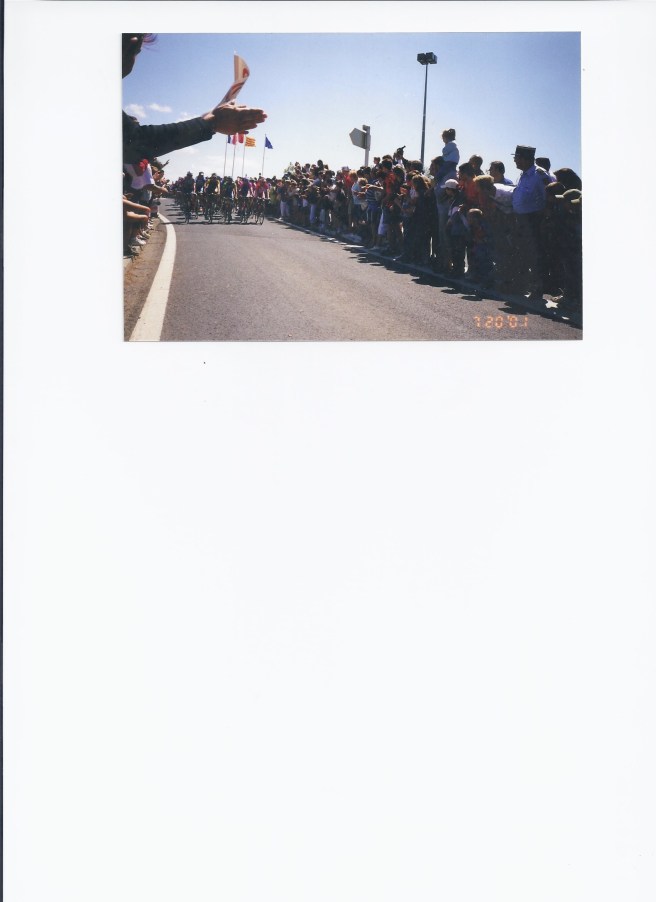
This was the year I also dragged them to Peyrepetouse, a Cahors castle in the Aude. It had been a trip recommended by a friend, and since we’d not visited any of the many Cahors castles in the area, we decided this was a chance to see one. First we had a lovely lunch at Auberge du Vieux Moulin, where we ate under a huge weeping willow tree, then a visit to the source d’amoureux (a water spring with magical powers for lovers).

We then drove up toward the castle as far as we were permitted, paid an entrance fee, and then had a 20 minute climb of very hard walking over slippery rocks up to the fortification. Once we got there, it was all climbing up and down and, did I mention that it was an extremely hot day? We never did get to see the newer part of the castle as we were too hot and tired by then. Our plan for continuing on to Queribus, another Cathar castle, was quickly scrapped, and we returned home to a long rest.

And then there were the trips up to Les Angles in the mountains. Les Angles, a twin village of Banyuls, is a small ski resort town of about 50 habitants. There is an ice skating rink there. and this was important at one stage of our daughter’s life, as she was taking skating lessons during junior and senior high school. We had tried a skating rink in Bompas, near Perpignan, but this had been a bit of a disaster. I should have realized something was odd when there was a fan going as we walked in. No need for our sweatshirts, as the “ice” was wax! “How do you skate on this stuff?” I asked the attendant. “It will warm up after you skate on it for a while,” he answered. “Just tell her to keep skating around the rink!” Hah! No chance of practicing fancy footwork, then! So we took her up to Les Angles several years, spending the week-end to allow her a few days of skating on real ice. The first time we visited, I dragged the family to the nearby animal park. We trekked along the 3.5 km footpath to see the animals amongst the trees. It took two hours to complete the circuit. Unfortunately, it was very foggy that morning and we saw mostly only shadows through the trees!
Our other ritual trip was up to Andorra, the tiny country nestled in the Pyrenees between France and Spain. That is a four-hour trip up mountain roads, through very twisty roads, which we named the “small intestine” and the “big intestine,” because that is what they looked like on the map, then over the border at Pas de la Casa (a shopping mecca), and through the narrow valley of Andorra to the capital, Andorra la Vella. By 1999, they had built a long tunnel through the mountains in order to eliminate the “large intestine.” We were very happy this was done, but one year when we went through this tunnel, we arrived at the other end in a thick cloud where we could not see the road at all! It’s really scary when you can’t see the edge of the road as it winds it’s way up and down the mountains! They are not big on edge-of-road barriers! The cloud lasted all the way through Pas de la Casa, where we couldn’t see the town at all.
Because Andorra la Vella is squeezed between the mountains, we would drive in on one street, park the car in a garage, then take an elevator down several floors and exit on the adjacent street. We had fun shopping, mostly at a jewelers’ , which added Lladro figurines to our expanding collection. At the end of the week-end, we would return to Banyuls with our daughter smushed into a tiny corner of the back seat of the car, practically buried in Lladro boxes—one year she had, literally, 4 inches of space. That is what she remembers most about Andorra!
About ten years ago, our friends in Banyuls asked us what route we usually took to get to Spain. We had two alternate routes: one inland and across the frontier on the autoroute and the other one down the coast on the winding road along the cliffs above the sea. They asked, “Why not go through the Col de Banyuls?” I asked about the kind of road this was and where it went. “Oh, it’s very easy! In 20 minutes you are in Spain! Just follow on out this road and keep going. You’ll have one section of the road that is kind of rough, and then there are some sharp turns, but always you climb up to the top, which is the border between France and Spain. We do it all the time!”
It was through the Col de Banyuls that many refugees escaped France during World War II, some hiding in the bottom of carts full of manure that were being wheeled up the mountain for the vineyards. The Resistance was very active in Banyuls and many of the older generation still have stories to tell. The Col was also the sight of numerous battles between the French and Spanish over the centuries, and a very large painting of one such battle hangs in the town hall.
So one day we decided to give the Col de Banyuls a try. When we got to the “kind of rough” spot, we found that it was like a dry river bed covered with boulders of rock! I don’t know how the car survived going over that patch, but then we had the hairpin turns to look forward to! There are five hairpin turns on the French side, always climbing and often only one-lane until you arrive at the top, where many tourists stop for photos of the views (and often the customs officers are there to inspect the trunk of your car!).
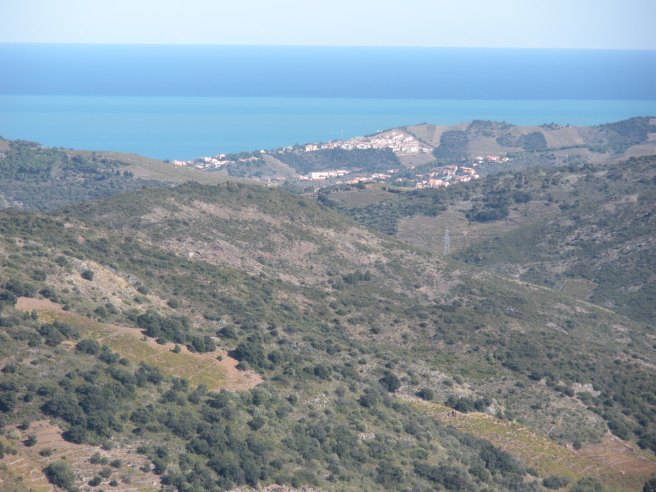
Then one last hair-pin turn and down you go on the Spanish side, over five cattle grates until you arrive, going through a very narrow “luge-run,” into the village of Espolla. Whew! By the time we arrived back in Banyuls the following year, the road on the Spanish side had been resurfaced and the “rough patch” on the French side had been filled in. Since then, we have used this route into Spain whenever we go down for a bit of shopping or sight-seeing in Figueres, and even to head back to Barcelona, as we can pick up the autopista in Figueres.
Last year when we arrived in Barcelona, we picked up our lease car and headed north, as usual. When we got to the top of the Col and headed down into France and around the five hairpin turns, we suddenly realized that we’d forgotten that there had been torrential rains and floods the previous Fall. The road was almost completely washed out! It took a long time to drive over the rough surfaces at very slow speeds before we got into town. So we’ll forgo our shortcut to Spain until the road is all repaired again.
Because Spain is close to our village, we are often traveling over the border for shopping or for eating at favorite restaurants. The opening of the borders between countries in Europe, and the institution of the euro as a common currency, has made it easy to go back and forth, much as we do between States in the US. Although, I must note, that custom police still patrol NEAR the borders. Once, when returning from Andorra, we were stopped by customs just a few kilometers into France. I kept asking the officer if he wanted to see our passports, but no, he just wanted to see what was in our trunk. When he started fussing about the bottles of alcohol we were bringing into France, stating that only so many liters was allowed to be imported into the country, I asked him, yet again, if he didn’t want to see our passports. “No, madame, it’s not necessary, but you cannot bring all of this into France.” At this point, my husband jumped out of the car and explained in halting French that we were Americans and that it was all going to the US. “Oh, then, monsieur, no problem!” Apparently, (according to my husband) my French was too good—the officer didn’t realize we were Americans!
Our adventures in Spain have many and varied, and did not always turn out so delightfully, and for that reason they deserve a chapter all their own.
 2 Country Kitchen