The Roussillon, (Catalan region, where we live,)is very closely related to the Catalunya region of Spain. Historically, the Roussillon has sometimes belonged to Spain and sometimes to France. They share a common language, Catalan, spoken mostly by the older people in our village. Road signs announcing the beginning and the ending of villages are written in both Catalan and French in the Roussillon. The oral tradition of Catalan lives on in the older generation of both the Roussillon and Catalunya, but is gradually dying away, so the schools in Catalunya decided how to make it a written language, and the French schools in the Roussillon are now teaching this written form of Catalan to the children. I hear that French children in our area then come home and try to speak this new Catalan with their grandparents, who haven’t any idea what they are saying. In Barcelona, you will find that the directions on train ticket machines are all in Catalan, not Spanish. And there are always Catalan dishes listed on the menus on both sides of the border. In Catalunya, they have their own Catalan police force and are pushing to separate from Spain. I finally bought myself a large Catalan-French dictionary, as well as a pocket one to carry in my purse. If you see a funny word with an “X” in it, it’s probably Catalan.
Because our village is so close to Spain—only 20 minutes through the Col de Banyuls—we often travel to Spain for our shopping needs and to explore wineries and restaurants, although since Spain joined the Common Market, prices have drifted upwards; we don’t find as many bargains as we used to find. Still, Spain grocery stores often carry many American and British products, which we do not find in France. For many years, we had to go to Spain to buy Philadelphia Cream Cheese and Listerine Mouth Wash; now both of these items are available in the stores in Banyuls. We still have to go to Spain for cheddar cheese, but it’s not worth the trip as it is very mild. There are many Brits between the French border and Barcelona, and this is why we find so many British goods. There’s always corned beef on the shelves, and Jacob’s biscuits, cans of baked beans, and different teas. I shop mainly for the Spanish anchovy-stuffed olives and sugar-free chocolate, Jello, cottage cheese, and paella pans, while my husband searches for wonderful albarino and tempranillo wines from the area.
Traveling through the Col has also given us the opportunity to encounter the local wildlife, mostly boars and goats and cows.

One day we arrived at a restaurant up in the mountains on the Spanish side and found our car surrounded by wild boar! They were headed toward the kitchen door of the restaurant to raid the dog food!
It always gives a giggle when we cross into Spain and see the signs: “Caca privado,” which is Catalan for “No hunting,” but our minds turn elsewhere.
The eight-hour drive down from Paris became tedious after a few years, so we often fly from the US directly into Barcelona. This gives us a fairly easy two and half hour drive up through Spain to Banyuls, while battling our jet lag.
Over the years, we have had many adventures in Spain, some are lovely and some are exciting. But the one that we will always remember with anger and chagrin, is the time we were robbed. I still have nightmares about it. I couldn’t bear to write about it in my diary for three days after it happened, and then it was only a few sentences about how we dealt with the aftermath.
We arrived in Barcelona in late June after a very trying trip up to JFK from the Philadelphia area. We’d decided to take a van up to JFK to ensure that our nine pieces of luggage would actually arrive with us in Barcelona. Unfortunately, the van got a flat tire along the Jersey turnpike. We waited for over 30 minutes for another van to come along and collect all of us and our luggage to get us to JFK in time for our flights. When it arrived, it already had five people in it and was full of luggage! Somehow we all squeezed in and put the luggage in the aisles of the van and off we sped, rocking all over the road, then getting stuck in a traffic jam ten minutes from the airport. Even after all this, we were only 30 minutes late, but an hour-long line at check-in was waiting for us. When we did get all checked in, and all of the luggage was out of our hands, we found we did not have seats together. (Sometimes you just have to accept these foul-ups.) Then the inevitable wait on the JFK tarmac started; two and half hours later we finally took off for Barcelona. We were unaware that the plane came down in Lisbon the next morning, but it was a short stop, as we had arrived into Lisbon two hours late. We stayed on the plane while the cleaning crew came through, and security came onboard to make sure all the luggage in the cabin was really ours, not left by departing passengers. Less than an hour later, we were once again on our way to Barcelona. We arrived when they said we would, and all of the luggage arrived—a miracle in itself! Outside of the immigration/customs area, a man was waiting for us, holding a sign with our name on it. This was the agent with our lease car. We had begun leasing brand-new Peugeots for our long stays in France, as this was less expensive than rental cars. We still do this. As we exited the airport, we saw our new car being unloaded from the car carrier truck right in front of the airport. There seemed to be quite a few men standing around, looking with interest at it and at us.
We were delighted to get everything stowed into the car and were soon on our way north. Getting on the highway was very easy that year, but within five minutes, we were in a traffic jam. It was then I noticed that the car’s side mirrors were folded in, so we couldn’t see traffic on the sides of the car. Several minutes later, we had a flat tire! My husband pulled over to the side of the road and stopped to check the tire. It was most peculiar to have a flat tire, as this was a new car. Very quickly, a man stopped his car in front of ours and offered to help us. He said we should follow him off the highway, where it would be easier to change the tire and that he would help us. Ah! –the Good Samaritan! So we followed him, and he led us to a residential street just off the next exit.
We parallel parked in front of a large apartment building. First he started taking luggage out of the back of the car to get at the spare tire, until we showed him that the spare was actually on a rack under the back of the car. I had our daughter stand next to the one large piece of luggage that was left outside the car, instinctively not trusting the neighborhood. Before lifting the car on the jack, he seemed to want to make very sure that the brake was on in the car. I had already done that, but he insisted on getting into the driver’s seat and making sure. I figured it was a male thing, not trusting what I’d said. We then watched as he helped my husband get the old tire off and start to put the new one on. As the nuts began to be put back on the wheel, our Good Samaritan insisted that our daughter and I also help to put them on, so he soon had us all huddled around the tire. At about this time, his cell phone rang, but he didn’t answer it. I looked at him, as if to say, aren’t you going to answer that? I looked back at me, and I will never forget the fear in his eyes. Within just a few minutes, he excused himself, saying he had to make a phone call, and he walked down the street, away from us. I helped my husband with the last of the nuts, getting the wheel solidly tightened on the car, and asked him if he thought we ought to give our Good Samaritan a little money when he returned for helping us. Then I opened the car door to get my folder of Spanish money. My briefcase, full of papers and medications, and a little good jewelry, my Canon SLR camera, and my coin purse were GONE.
By the time we got home to Banyuls, two and a half hours later, and called the credit card company, someone had already charged several thousands of dollars on the card. Even as I spoke with the agent in the Fraud Department, someone was trying to charge something else.
I still get angry when I think about how some gangs of thieves prey upon the gullible and the trusting and the kindly American. Thank goodness I always carry my passport on me, as I am sure that would have been their prime target!
We reported the theft to the police in Banyuls, who said we would have to go to the police in Spain. So the following week we went to Figueres, looking for the police station. We were eventually told to go to Mossos d’Esquadra, the Catalan police. There we found a female officer who spoke English because her mother had been British. We told her what had happened and she said, “Yes, these are gangs who work together. They slit the tire of your car during a traffic jam. Then the Good Samaritan gets you all down on the ground around the tire, so that you cannot see his colleague enter the car from the other side and grab your valuables. When he reset your brake, he probably did not fully close the door on that side of the car.” Then she asked us for a description of the man. “What color of skin did he have? Was it dark or light like ours?” I was befuddled for a moment, because the Spanish mostly have olive-toned skin and so, to me, it is all dark, compared to my Swedish/English very pale skin. What she was asking was if his skin was dark like a Mexican, because, apparently, they were being plagued by gangs coming over from Mexico and Central America. She wasn’t ready to believe that it was a Spaniard who had robbed us. He looked like a normal, clean-cut Spaniard to me! So we had to look through several books of mug shots, and what a hoot that was! Every criminal made a weird face for the camera!
We never found anyone who looked like our Good Samaritan in the mug books, but I can still see him in my mind, and I will never forget the frightened look in his eyes, as his phone rang to signal him that the deed was done.
We were told by someone, I forget who, that in Spain, if the thief does not use a weapon and is caught, he gets off lightly. But if there’s a weapon involved, then he’s thrown in jail. They, therefore, prefer to con you out of your belongings, or snatch and grab, as happens often in the airports.
We spent the next week on the phone with various banks and agencies in the US. We needed a replacement for my international license, so had to call AAA back home. Then we needed to replace our travelers’ checks and had to go to Perpignan to do that. I had to order more medications from the drug store back home and arrange for someone to pick them up and send them to me. My state driver’s license had to be replaced once I got back home. We lost French francs, Swiss francs, dollars, travelers checks, our check books, Spanish pesetas, medicines, all our papers for the sale of the old apartment, which we was to happen that summer, some jewelry, an old coin purse, and my camera. I carried that police report around with me for years, every time I went back to France, just in case I actually saw some of my jewelry or the camera in a flea market in Spain. Wishful thinking!
One of our daughter’s friends back home had started a neighborhood newspaper during the summer, so our daughter wrote an article about our robbery and sent it to her for her newspaper.
Two weeks later, a friend and her 13-year old daughter flew over to visit us for a week. They were flying into Barcelona, and I was really nervous about going back to the airport with our car. But we made our preparations: I bought a disposable camera and gave it to our daughter to take photos of any cars near us during a traffic jam. I took only a fanny pack with enough pesetas for tolls, and put my passport back in its neck pouch. Then I found a baseball bat in a souvenir shop (why the French would sell a baseball bat in a souvenir shop is beyond me—do they even know how to play baseball?!). With bat in hand, I entered the Barcelona Airport and quickly rushed our friends out and into our car. I did get some strange looks, but no one was going to mess with my friends! Our daughter stared out of the windows with the camera until we were well on our way back up to France. And then we relaxed.
I still feel traumatized about this event that happened 17 years ago; it has taken me two weeks just to write these few paragraphs. There is the anger from being robbed, and there is the even greater anger from being conned.
We ventured back into Spain with our friend and her daughter that year. As usual, we took our guests to Figueres to visit the fabulous Dali Museum, and then stopped at Hotel Duran for lunch. We had discovered this hotel when our daughter was a baby; we were searching for a restaurant that had a high chair (not very many restaurants had them!). The Hotel Duran had a high chair, and we had a lovely meal there. Every since then, we have taken our guests to this hotel restaurant when we take them to the Dali Museum. We had a lovely meal that day and our daughters quickly named their waiter “Romeo,” and made sure they’d taken a photo of him—they were very young teen-agers, after all! My friend ordered her first course of Spanish ham and sausage; what arrived at the table was a great surprise to all. It was a lovely selection of Spanish ham and different sausages, hanging from a rack. The waiter showed my friend how to slice what she wanted from the different sausages. Her daughter quickly dubbed this course: “Sausage on a Coat Rack.” I stuck with the aubergine terrine (eggplant terrine) and monkfish.
Last year I was once again at Hotel Duran for lunch, this time with my daughter and her college friend who came for a week’s visit. The girls had greatly enjoyed the Dali Museum and had dutifully examined all the Dali artwork and memorabilia displayed in the hotel lobby before lunch. We had an older waiter that day, and he was very attentive to us three ladies. We got to talking with him and discovered that he had been at the hotel for 30 years, so he was there the very first time we discovered Hotel Duran when our daughter was a baby. He was thrilled to know that he had been part of that discovery, and at the end of the meal, he brought over a porron of wine and showed the girls how to drink from it. This is a traditional custom in the Catalan. A porron is a glass carafe with a spout through which you drink by holding the carafe in the air and allowing the wine to land in your mouth (without touching the spout!). It can be a bit tricky!
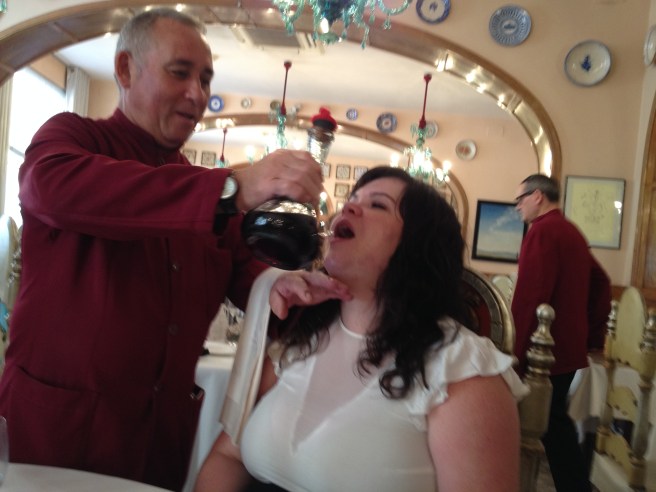
Our Catalan friend demonstrated his technique for us at a restaurant in Espolla.

We then had to take our friend and her daughter back down to Barcelona Airport to fly home, and once again we went prepared with baseball bat and camera! When we returned, early in the morning, we approached the border, and noticed signs posted announcing the closure of the border to trucks between 11 and 11:15 a.m. because of the solar eclipse. All trucks in France were required to stop during the eclipse! I can only surmise that this is a safety measure, as so many people would be trying to see the eclipse. We watched the beginning of the event from our balcony, using the pinhole method, then had our lunch. By then we noticed lots of people on the beach, but no one was swimming. I could see the reflection of their mirrored eclipse glasses as they gazed upward, so we rushed back to the balcony and viewed more of the event using our mirrored glasses, the pinhole method and binocular reflection. We had about 80% eclipse in Banyuls, so it was just a small crescent at its peak. It took about two and a half hours to go through the whole process. It did get darker, but the sun still shone through.
We have taken many short trips down to Barcelona for a bit of shopping at the large department store, El Corte Ingles, and have enjoyed having tapas in the early evening. We learned early on that Spaniards do not eat the evening meal until after 10 p.m., when the sun goes down and the air is cooler Before our daughter was born, this was fine with us, and we enjoyed many lovely evening meals at Renos, a wonderful restaurant where I remember eating stuffed quail for the first time. Our first visit to Renos was very memorable. My first meal at Renos was fettucini with truffles, quail stuffed with foie gras and truffle sauce, champagne sorbet and coffee. My husband had Catalan salad, duck in pear sauce, and fresh raspberries. Another time, we had goose liver pate, poached egg with truffles, fish and salmon in puff pastry, raspberry sorbet with eau de vie, beef sirloin with rice, ending with cream and fruit in a cookie basket with a lattice of drizzled sugar on top. What a meal! But in recent years, we enjoy tapas near the Placa Catalunya around 6 p.m. and skip a late dinner.
During one visit to Barcelona, my husband decided he wanted to visit a few art galleries. We had found two and were looking for the third on his list, but had trouble finding one of the streets. We were standing on a street corner, looking a map. This is something you always want to avoid doing—read the map and memorize it before leaving your hotel! A middle-aged couple stopped and asked us if we needed help. The man could speak a little English, and when we said we were looking for this particular art gallery, he said we should follow him. So off we trusting Americans went, following these strangers several blocks until we came to a store. It was a leather goods store, and the man and his wife were the owners! We ended up drinking glasses of sherry while my husband tried on leather jackets that made me laugh, as he is the last person you would expect to look like a motorcyclist! It took some doing to get out of there without buying anything! We never did find the other art gallery.
Of course most visitors to Barcelona want to see the Gaudi works. Every few years we have tried to visit the cathedral that Gaudi started so many years ago, to discover the progress that has been accomplished. The first time I saw it was in 1972 on my first trip to Europe. Since then they have added towers and elevators up the towers.

So that there are now twelve towers (one for each disciple), covered with pieces of tile.

They have installed an altar and finished more doors.

There is always something new to discover.
To visit Parque Guell, in Gaudi’s planned residential district, we always take a taxi as it’s a long way out of the city. Our daughter enjoyed many hours playing on the tire swings,
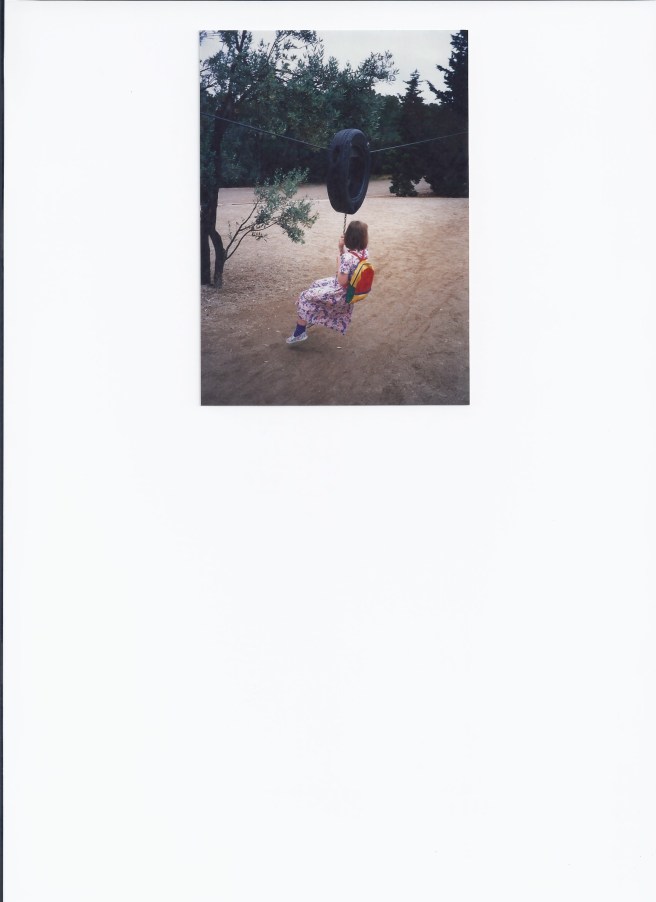
being lifted into the alcoves in the pocket wall,

visiting the serpentine-shaped tile bench up above

and always greeting the dragon at the entry.
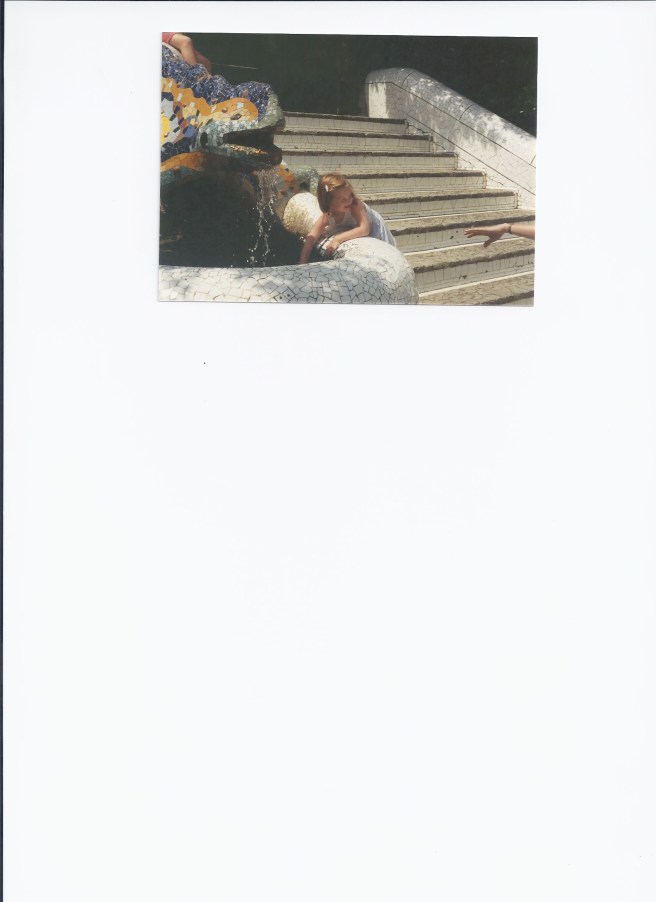
And, of course, we could not miss the opportunity to head down to Valencia several times to see the Lladro factory. The first time we went was by train and that took seven hours. We took a taxi to our hotel and found that the rates were double those quoted in our Michelin guide. Then we tried to get to the factory. The hotel told us to take bus 6 or 16, then we were told to take bus 10. Finally we walked to another hotel where we told it would cost less than 1000 pesetas to take a taxi, so that’s what we did. However the taxi took us to a seconds store where we were told we could not tour the factory. So we shopped and chose lots of figurines for our collection, then had to go to a bank to exchange money. The first one would not take a French check and exchanging the travelers checks would take all day. The next one had about 20 people waiting in line. The third one could change a French check and could change the French travelers checks, but the US travelers checks! By the time we got enough cash together, paid for the figurines and were ready to return to the hotel, we had two large boxes, two medium sized boxes and two small boxes. The clerk called us a taxi and off we went! In the midst of all this, our daughter’s stroller broke, so we ended up at yet another El Cortes Ingles department store, buying a wrench and nuts and bolts to repair the stroller. Then the seven hour train trip back up to France and then a long, difficult walk down from Banyuls train station, across town, and up our very steep hill to the apartment—with six boxes, a suitcase and a toddler in the stroller.
Two years later, we returned to Valencia, this time by car. We found it was 546 km from Banyuls. This time we stayed at the Expo Hotel where our room was air conditioned, had a telephone, TV , mini-bar, and lovely bath. And, best of all, there was a rooftop pool, which was great after the long, hot drive. The city was building a new metro system that year, so driving around the city was a bit tricky. It took us quite some time to get to a Lladro shop, where we found prices about half the US prices. After shopping there, the clerk sent us off to the factory, where we had scheduled a tour, but the factory was not where she said it was, so we wasted an hour wandering around lost. When we finally found the factory, we were 15 minutes late for our tour. However, we were given a personal tour, which was great for keeping our young daughter’s attention. We saw several new pieces in production and enjoyed watching how everything is put together with liquid porcelain. Then we made another stop at the seconds shop, before returning to the hotel with another five Lladros for the collection. So our second visit to Valencia was a bit more successful.
We always gave our daughter her choice of where to eat or what to do on her name day. Name days in France are determined by the saint with whom you share a name, and you celebrate that day. Everyone says “Bonne Anniversaire,” as if it’s your birthday. This was confusing to her the first time it happened at Centre Aere. In the Catholic calendar, every day in the year is dedicated to a saint, so when we are in France, we celebrate her name day, since it is during the summer when we are often there. Of course she often wanted to eat her dinner at Clos de Paulilles, but she would request a day at Canet Plage, the big sand beach north of us,

or a day at Aqualand, the water park.
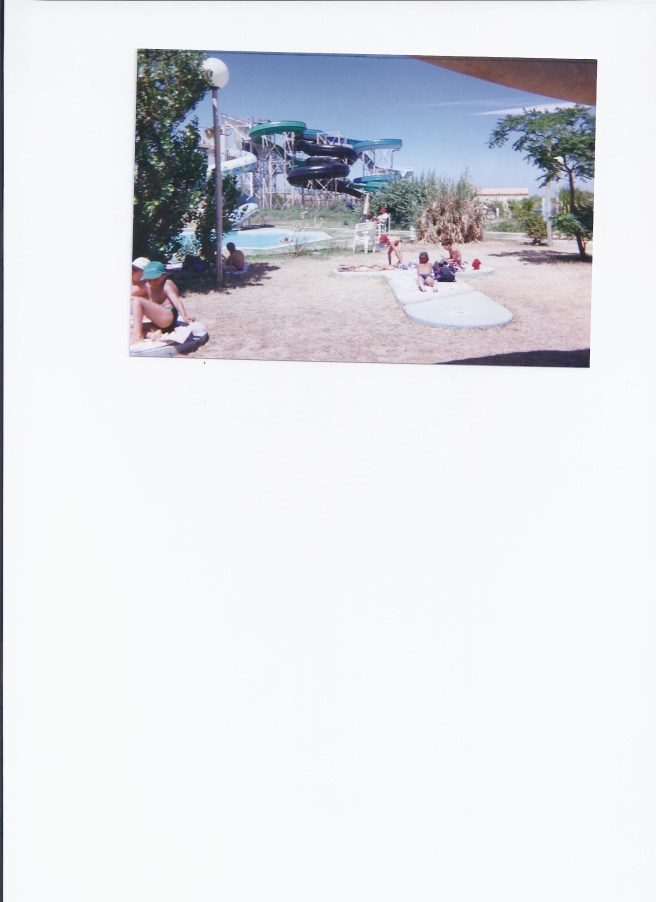
One year she decided she wanted to visit Dali’s home, two hours south of us along the Spanish coast, at Cadaques. So we called for ticket reservations and headed south.
We parked at a tiny church in Port Lligat and walked down to the Dali House. The house was wonderful! It was full of tiny rooms; we were allowed to stay in each area of rooms for 5-10 minutes, so the tour, done in English, was over in about 40 minutes. Metal bars kept us away from the original furniture. Dali’s wife, Gala, had a fondness for yellow dried flowers and put them everywhere. They’re called “Everlasting.” Their pool was also fabulous—long and narrow with fountains. Afterwards, we walked back to the car and had some cold water before heading back to Cadaques, where we had lunch at Es Truell, which was very good. We had mussels then zarzuela then dessert. Zarzuela is a sort of Catalan bouillabaisse, or fish stew. I have made is several times in the US, when I can find monkfish!

Several times we have traveled south to La Bisbal d’Amporda, a small town near Girona , well-known for its many tile and pottery stores. Our first visit to this area was prompted by a desire to tile the sunroom in our house in the US. We wanted to see what Spanish tiles were like. We went to a factory near Bisbal, which had been suggested by one of the pottery merchants. They only did wall tiles and sent us to Fabrico Blancos, which we found after stopping several times for more directions. They only sold through their stores and sent us to one of these on the outskirts of Bisbal,, which we found only after stopping at another huge pottery warehouse. There, the girl spoke only in Spanish, so we had quite a time communicating. She seemed quite taken aback at the idea of sending tiles to the US. So we just looked and measured and loved everything we saw. Finally we left, realizing it would take about 20 boxes of tile to floor the sunroom, which would be a lot to carry home!
After walking up and down the main street of Bisbal for several hours, we enjoy going to the tiny fortified medieval village of Peratallada, about 22 km east of Girona. The 1991 film, “Robin Hood: Prince of Thieves” was partly filmed here. There we wander through the tiny streets,
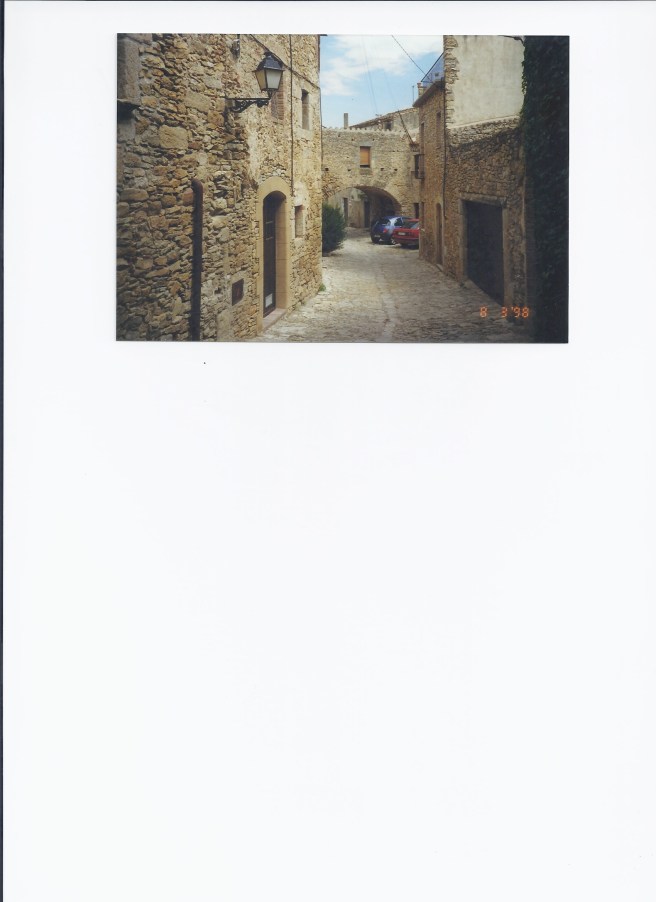
peer into shops and then eat a late lunch at a lovely Catalan restaurant, Can Nau.

We always look forward to a relaxing luncheon, which usually includes rabbit encrusted with almonds. The Catalan title of the dish translates as “the indentation in the grass where a rabbit has had his afternoon siesta.” What a lovely description!
Our most memorable meal in Spain was in Roses in 1998. We had heard about a restaurant called “Die Insel,” owned by a German-Spanish couple. Our daughter ordered the wienerschnitzel from the children’s menu, and my husband and I ordered the tapas menu. What followed was an unending list of small courses, including my favorite: sea urchin soup. We had two sorts of ham, foie gras, dilled smoked salmon, escargots, raw oysters, quail eggs fried on foie gras, shrimp in garlic, gambas, something that looked like dragon fingers and smelled of iodine, gambas, clams, sea urchin soup, and scallops in a cream sauce. Then dessert was crepes Suzettes for me, whisky coffee for my husband, and flambéed raspberries for our daughter. Everything was delicious!
One year we traveled by train to Italy to visit Venice, Pisa, Florence and Milan. For our return to Banyuls, we boarded the train in Milan to travel back to Perpignan, France, and were happy that we’d reserved a room in a sleeping car on a Spanish hotel train. The train came into the station early, before it was even posted on the board, so we boarded it and settled in quickly. By 10 p.m. we were beginning to go to sleep, when the conductor knocked on the door and told us we could not have a compartment for four people when we were only three people, and he insisted we pay another 9000 pesetas. When we argued with him, he said he would take away our rail pass. Then he saw that this was the last trip on the pass, so he said he would keep our passports and have us arrested in Barcelona! When we said we were not going to Spain, he said he’d have us arrested in Perpignan. My husband said, “FINE!” and slammed the door. But I was worried, so I paid the man $50 and he still wanted more, so I had to give him 8000 lire, too! I told him I was robbed in Barcelona the year before and I considered this a robbery as well. I also insisted on having back our passports immediately. He returned them to me, but we did not sleep much of the rest of the night.
The following morning we were up at 5 a.m., but the train was late. By 6 a.m. we still did not have our tickets or receipts returned to us. One of the conductors finally came with our railpasses and a receipt for 9100 pesetas. I insisted that I have the reservation ticket, too, which showed that I had already paid for the room, and she finally was able to get that to me. We were one and a half hours late arriving in Perpignan, and we were told that we could get reimboursed because the train was over an hour late. But, of course, that turned out wrong as it was late due to the fires near Marseilles, which was considered an act of God, not the fault of the French rail system, the Spanish rail system or the train.
I rewatch the “Alias” series and think, “Oh, if only I were young and bad-ass like Sydney Bristow!”


 2 Country Kitchen