10. Out and About

Out and About

We are often asked, “What do you do when you’re in France?” Frankly, we live! We eat and read and rest and visit with good friends. I spend a lot of time in the kitchen, creating, and my husband watches the boats going in and out of the harbor and the sailboat races on Sundays.
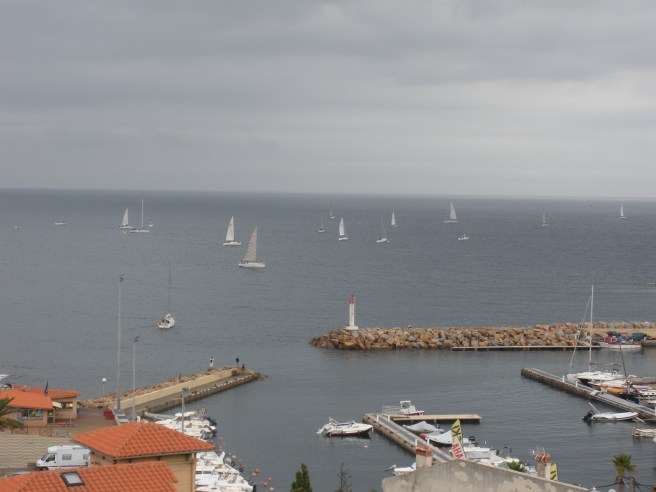
sailboat races

But occasionally, we also do some shopping and wine tasting and even some sight-seeing.

One of our favorite shopping stories is about the purchase of our wedding rings. We were in France for the week of Easter and, during that time, decided to look at wedding rings to see if we could find something beyond the usual band of gold. We had a lovely day in Perpignan, looking through the stores and eventually came upon the street filled with jewelers. Perpignan garnets are highly prized in the area and are now difficult to find as the synthetics flood the market. However, there is a guild of jewelers who are licensed to deal in garnets, and that day we found ourselves in one of those shops. While we were not looking at garnets, we did figure that this jeweler was very reputable, since he was a member of this prestigious guild. What we did find were gold rings that were round on the inside and square on the outside—very unusual, indeed! Getting a ring to fit my finger was no problem at all, but then the jeweler measured my husband’s finger and his eyes grew big. “Oh, la la!” he said. “I’m not sure I have enough gold to make a ring for monsieur!” We explained that we only a few days left of vacation and would need the rings before we left for the US. So the jeweler said to give him a day or so and he would call his colleagues to see if he could gather enough gold to make the ring. We were excited, but a little apprehensive. Would we get the ring in time?

The next day, the jeweler called to say he had the gold and could make the ring by Saturday. We were leaving by train to Paris on Saturday evening. “Well,” he said.   “The train stops in Perpignan for 20 minutes before going on to Paris, so I will have my associate meet you on the platform. Look for her when the train pulls into the station.”   So, with fingers crossed, we boarded the train in Banyuls and headed for Perpignan. When the train came into the station, I explained to the conductor that we were just getting off the train for a few minutes to meet someone and would return immediately. He watched us carefully as we left the train; I’m sure he thought it was a strange proceeding! Luckily, my husband is tall and very distinguished-looking, so the woman from the jewelry store saw us immediately and handed us the ring in a little box. I said: “Try it on and make sure it fits!” My husband chuckled as he put the ring on and said, “What am I going to do if it doesn’t fit?” What, indeed! But it did fit, and that is how we ended up with French wedding rings.   When our daughter was 12 years old, we took her to the same jeweler and bought her a garnet cross to wear for her confirmation at church.   I still look in the windows and salivate over their lovely garnet jewelry!

The other memorable shopping experience happened at Christmas when we were in Banyuls for the millennium. We had been looking for a small artificial Christmas tree all week, something not too big and not too small. Every store seemed to have sizes we did not want. Finally, on Christmas Eve, we stopped in a supermarket in Mas Guerido, on the outskirts of Perpignan. There they had a tree that was just the right size, but it was their display tree—no more boxed trees available. “But you can purchase the display tree, madame!” said a clerk when he saw my look of dismay. So with much excitement, I began to undecorate the tree, as it was covered with ornaments provided by different food companies. “Oh, no, Madame! You take the ornaments, too! No need to take them off the tree.” My goodness, I thought. This is wonderful! Then I asked the price and he said 25 francs—the equivalent of about $5. Good heavens! Then the clerk picked up the tree and carried to our car for us! Unheard of!   That tree still sits in our garage, covered with a tree bag, and the additional ornaments we made for it are carefully stored, ready for the next time we decide to spend Christmas in Banyuls.  We will never forget our $5 tree!

Every year I plan at least one shopping trip with my best friend, who now lives in Perpignan. Sometimes I drive up and sometimes I take the train, but always we meet for coffee and pastry at L’Espi, a delightful patisserie and restaurant.

L'Espi

We always spend a good 30 or 40 minutes of conversation over coffee and pastry before feeling well enough fortified to face a morning of shopping. Then we head for the shop where I purchase my annual santon. Santons are figurines of various sizes—the best are made by Claude Carbonel in Marseille. Each figure is a typical person from a French village and is dressed with provencal cloth.. Santons are placed around the crèche at Christmas time as if all have come to worship the Christ Child. It makes a nice display, and I enjoy choosing a new santon every year, a man one year and a woman, the next.

Santons

Then we head for Sephora, where I find products not found in the American Sephora stores. A stop in the tea shop to look at the unusual tea pots and a stop in the embroidery shop for supplies are usually on the list, as well as the required stop in the little Arab store on the edge of the Arab section of Perpignan. There I buy my pate de coing, which comes in a block. This is pate de fruit, which is the consistency of gum-drops. Coing is quince in English. A familiar Spanish dish is slices of manchego cheese topped with slices of pate de coing and drizzled with honey. This is served as either an appetizer or as a cheese course or dessert. At Christmas we purchase large boxes of pate de fruits, which are like rectangular gum-drops in all different flavors and are really delicious!

And then my friend and I head to a restaurant for lunch. We have tried many different ones over the years, but we still have our favorites. At Café de St. Jean, we sit in the open air under the ramparts of the cathedral. One of my favorite dishes served there over the years was a foie gras salad with strawberries, which I am always pleased to make at home.
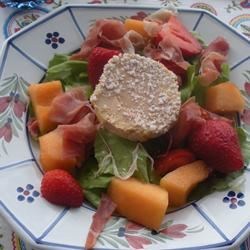
Salde de Foie Gras

Always there is a new restaurant to try, once a quiche café, once a seafood restaurant. Then there was Le Devil, the tapas restaurant we visited for a book-launch one night! Perpignan is full of restaurants to explore. I also squeeze in a quick look through the fabulous Catalan store, Maison de Quinta and a shopping spree at the department store, Nouvelle Gallerie. We wander through the little streets, visit an antique store where we sometimes find antique Quimper dishes, and, of course, peer into the windows of our jewelers’ shop—he who made our wedding rings. The last stop is always the Belgian chocolate shop for an assortment of candies to take home to my family.

Having a husband who likes to pour over the annual Guide Hachette des Vins means that we frequently have a list of local wineries to visit and prized wines to try. They might be wineries in Banyuls or they might be further afield north to Maury or Cases de Pene or Tautavel or even on to Tavel.
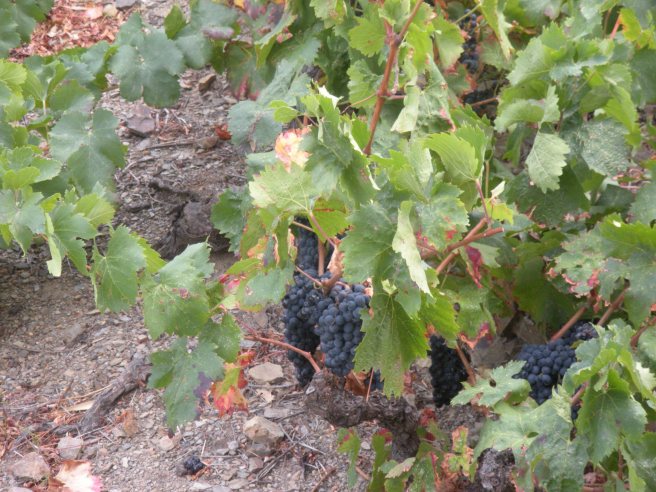
vineyard grapes.JPG

We have had several wonderful wine-tasting experiences. Of course the usual one is at Chateau de Jau, where we have the dejeuner degustation, which is a luncheon with about nine wines to taste throughout the courses, served under a very large, old tree on an open-air patio. When it’s cold or rainy, blankets are passed around! The menu stays basically the same: fougasse with olives or bacon, pain au tomate and Serrano ham, lamb chops,


lamb chops at Jau.jpg

Catalan sausage, Roquefort cheese,

Roquefort at Jau.jpg

ice cream and cake (except one year when they experimented with orange rice pudding) and then coffee. We have been eating this meal there for about 25 years. The meats are grilled on an open fire of sarments (grape vines), and we eat beside a pool full of carp, which have grown to mammoth sizes over the years (due to diners feeding them their bread, and sometimes the sausage, by mistake!).

feeding carp.JPG

We have enjoyed tasting many of their wines over the years, but particularly the new vintages from their vineyards in Chile. When our daughter was small, she would enjoy wandering around the pond while we lingered over the wine and her father enjoyed all the Roquefort cheese for himself. When our daughter was about 14, the one of the owners told us very seriously that our daughter should be tasting the wines so she would learn what a to taste in a wine and would learn to respect wine as a pairing with food, not as just another alcoholic beverage.   So whenever we were in France, we let her taste the wines, and she learned very quickly. We realized very quickly that she was a “nose,” someone who can smell all the different nuances in a wine (much like a perfume “nose” is used in the perfume industry).   This made her tasting experiences so much more meaningful.

For a few years, Chateau de Jau also hosted an evening concert and dinner during the Tour de France Music Festival. We enjoyed hearing some wonderful British singers, as well as pianist, Clive Lythgoe, who used to be on the faculty of our daughter’s institute in the States. The concerts began about 8:30 p.m., then there was a break for dinner at 10 p.m., then the other half of the concert, which ended about 1:15 a.m., so we would get home about 2:30 a.m.   It is over an hour drive for us to get up to Cases de Pene.

Beside the restaurant (Le Grill) is a large building which has become an art gallery for annual summer shows of very esoteric and eclectic art. One of my favorite works of art was a completely flattened Citroen car, hung vertically on the end wall. The title was “Citroen Presse,” which is a play on words or a double entendre, as a citron presse is lemon squash, or what we Americans call lemonade! Another wonderful piece was a piano set up to play wine glasses of water, like a glass harmonica, instead of strings.

Their sister winery, Clos de Paulilles, which is situated just outside Banyuls, , offered evening wine-tasting meals, which we also enjoyed. Their menu included foie gras, Catalan chicken, manchego cheese, and a chocolate dessert. It was one of daughter’s favorite restaurants and where she often chose to eat for her name-day celebration. When she was very small, she collected pine needles from the tile floor and had a great time pretending that these needles were a family, while my husband and I enjoyed tasting all the wines. Those pine needles came home with us, carefully wrapped in a yellow paper napkin, “because they were a family and had to stay together.” Several years ago, during a cleaning spree, I found them, and I hadn’t the heart to throw them away! Clos de Paulilles is now owned by Domaine de Caze, so the meals are not the same, but it is still lovely to sit on the patio and enjoy the views of the sea.

While our daughter was involved in her summer camp, my husband and I often took the opportunity to explore other wineries. One of my favorite adventures was visiting the tiny village of Calce. My husband had been researching local wines and found that the whites from Calce that year were very good. So he directed me through many small roads and lanes and fields, and I thought we’d never find this place!   But finally we came upon the village we sought. We passed the winery just as we entered the village, but it looked closed, so we drove through the village and saw only two people—they were sitting on chairs outside their house, watching us go by. It was siesta time, so of course everything was closed. We returned to the winery and, by waiting a bit, were able to call someone and arrange a tasting.   They were delighted to sell their wine to Americans!

Another time we’d had our usual lovely meal in Montner at L’Auberge du Cellier and had enjoyed a local wine. Pierre-Louis sent us home by way of the village the wine came from, so we could buy some. There we found some workers along one of the village streets and by mentioning the name of the wine, we were able to find the right vintner. He took us into his garage, and there we tasted the wine again and bought a few bottles. It’s always an adventure, as some wines are made in very small establishments, like personal garages, and others come from cooperatives or from very large wineries. However, there is never a tasting fee, as you find in Napa Valley!

Last year we headed to a new winery, La Toupie, near Perpignan. I dutifully turned on the GPS in our lease car, and we soon found ourselves lost in a maze of streets within a new housing development. We call our GPS lady “Mabl” (Most Annoying British Lady), and she really does annoy us when she gets us lost, often when we’re up in the mountains where she thinks there are not any roads! But this time, we finally did find a sign for the winery and proceeded down a narrow driveway to a large gate. I timidly opened the gate and entered the back garden of a very nice house! But nothing ventured, nothing gained, so I continued past the swimming pool and up to the open back doors of the house, calling out as I went. Two teen-aged girls and their mother arrived and explained to me that the winery was actually in another town. She gave me their card and took my phone number. That evening, her husband called and we arranged a tasting at his winery the next day. He met us in the center of that village and we followed him up the hill to his new building. He’d only been in business a few years but already had won acclimations for several of his wines. And he’d worked in Napa Valley for a while, so could speak to us in English. But the best part was that he had plates of fresh bread and cheeses ready for our wine-tasting at a tiny café table with chairs. It was so elegant and private and the wine really was very good. What an enjoyable experience! We saved a bottle for New Year’s Eve, and when I sent a photo of my husband with this wine to my friend in Banyuls, she responded with a photo of her husband with the same wine, which they also had for New Year’s Eve!

As our daughter grew, I decided that we needed to explore something different every year. It became a groaning joke of what would mother drag us to this year! Sometimes it was simply a drive up to the top of the mountain behind Banyuls to visit the Tour de Madeloc, the watchtower overlooking our part of the coast.
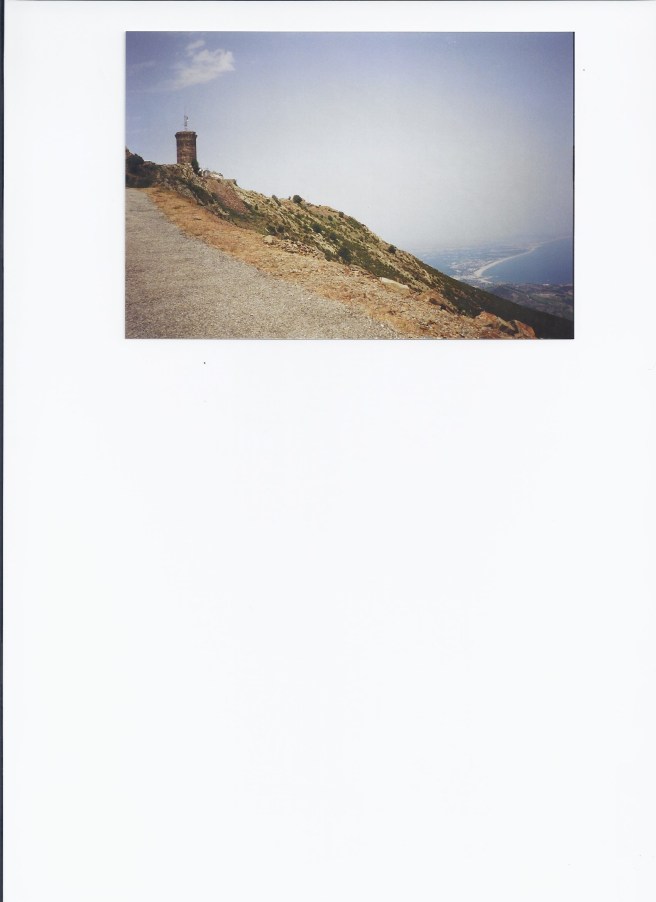
tour de madeloc.jpg

This is a one-lane winding road that is best driven after a wine tasting at the large Templiers winery on the way up! Meeting a car coming down when you are going up, with a stony hill on one side of the car and the steep cliff down on the other side (remember we’re talking ONE-lane here), takes a lot of Dutch courage!

road up to madeloc.jpg

But the views from on top are fantastic and well worth the nail-biting drive up the mountain.

We got to the butterfly exhibit in Elne when it first opened (before they realized that dogs should really NOT be permitted inside the butterfly house!), we visited the ramparts and caves of Villefranche de Conflent, where my daughter and I sang in one of the circular rooms of the towers to test the wonderful acoustics! We took a trip on Le Petit Train Jaune, a tourist train up to the edge of Andorra, and we went to Carcassone several times to visit the walled city, which can be seen from the autoroute as you travel north.

carcassone from autoroute.jpg

Carcassone is a rebuilt ancient city (rebuilt in the 19th century), which is often described by the French as very Disneyesque. It is full of boutiques and knight-themed exhibits. In the summer, it is quite a lively place, particular for children. One time we went to a restaurant for lunch and had a lovely luncheon on an open patio, where chickens wandered around our feet!
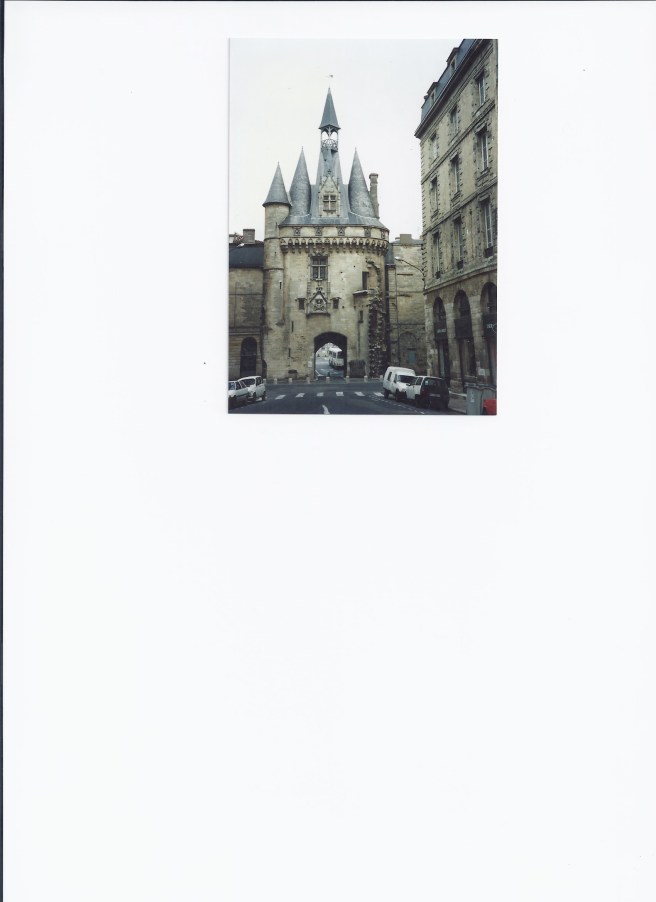
carcassone gate.jpg

In 2001 a leg of the Tour de France cycling race left Perpignan, headed to Ax les Termes, up in the mountains. We decided this was an opportunity not to be missed, even though the tramontane had been blowing all day, so we drove up toward Marquixanes, near Eus, which was along the route. But we got no further than Thuir, because the road was closed for the race. We finally found a place to park in Thuir, with difficulty, as hundreds of people were there to line the route. Then we stood for two hours in the wind, waiting and waiting, while the parade of sponsor cars came by, throwing gifts to the spectators: flags, coffee, candies, toys. At long last we saw the cyclists, all in a group, then “whoosh!” In 10 seconds they were past us and on their way. I’m not sure my family ever forgave me for having them stand in the tramontane wind for two hours, for ten seconds of “whoosh!,” but it’s an experience they have never forgotten!
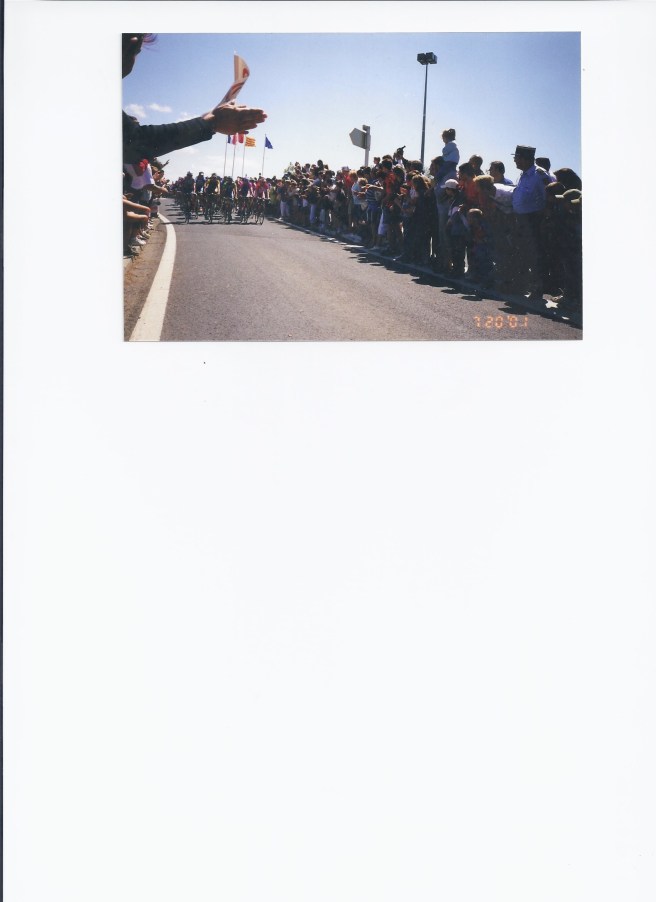
tour de france.jpg

This was the year I also dragged them to Peyrepetouse, a Cahors castle in the Aude. It had been a trip recommended by a friend, and since we’d not visited any of the many Cahors castles in the area, we decided this was a chance to see one. First we had a lovely lunch at Auberge du Vieux Moulin, where we ate under a huge weeping willow tree, then a visit to the source d’amoureux (a water spring with magical powers for lovers).

Moulin restaurant-Pyerepetouse.jpg

We then drove up toward the castle as far as we were permitted, paid an entrance fee, and then had a 20 minute climb of very hard walking over slippery rocks up to the fortification. Once we got there, it was all climbing up and down and, did I mention that it was an extremely hot day? We never did get to see the newer part of the castle as we were too hot and tired by then. Our plan for continuing on to Queribus, another Cathar castle, was quickly scrapped, and we returned home to a long rest.

Peyrepetouse.jpg

And then there were the trips up to Les Angles in the mountains. Les Angles, a twin village of Banyuls, is a small ski resort town of about 50 habitants. There is an ice skating rink there. and this was important at one stage of our daughter’s life, as she was taking skating lessons during junior and senior high school. We had tried a skating rink in Bompas, near Perpignan, but this had been a bit of a disaster. I should have realized something was odd when there was a fan going as we walked in. No need for our sweatshirts, as the “ice” was wax! “How do you skate on this stuff?” I asked the attendant.   “It will warm up after you skate on it for a while,” he answered. “Just tell her to keep skating around the rink!” Hah! No chance of practicing fancy footwork, then! So we took her up to Les Angles several years, spending the week-end to allow her a few days of skating on real ice. The first time we visited, I dragged the family to the nearby animal park. We trekked along the 3.5 km footpath to see the animals amongst the trees. It took two hours to complete the circuit. Unfortunately, it was very foggy that morning and we saw mostly only shadows through the trees!

Our other ritual trip was up to Andorra, the tiny country nestled in the Pyrenees between France and Spain. That is a four-hour trip up mountain roads, through very twisty roads, which we named the “small intestine” and the “big intestine,” because that is what they looked like on the map, then over the border at Pas de la Casa (a shopping mecca), and through the narrow valley of Andorra to the capital, Andorra la Vella. By 1999, they had built a long tunnel through the mountains in order to eliminate the “large intestine.” We were very happy this was done, but one year when we went through this tunnel, we arrived at the other end in a thick cloud where we could not see the road at all! It’s really scary when you can’t see the edge of the road as it winds it’s way up and down the mountains! They are not big on edge-of-road barriers! The cloud lasted all the way through Pas de la Casa, where we couldn’t see the town at all.

Because Andorra la Vella is squeezed between the mountains, we would drive in on one street, park the car in a garage, then take an elevator down several floors and exit on the adjacent street. We had fun shopping, mostly at a jewelers’ , which added Lladro figurines to our expanding collection. At the end of the week-end, we would return to Banyuls with our daughter smushed into a tiny corner of the back seat of the car, practically buried in Lladro boxes—one year she had, literally, 4 inches of space. That is what she remembers most about Andorra!

About ten years ago, our friends in Banyuls asked us what route we usually took to get to Spain. We had two alternate routes: one inland and across the frontier on the autoroute and the other one down the coast on the winding road along the cliffs above the sea. They asked, “Why not go through the Col de Banyuls?” I asked about the kind of road this was and where it went. “Oh, it’s very easy! In 20 minutes you are in Spain! Just follow on out this road and keep going. You’ll have one section of the road that is kind of rough, and then there are some sharp turns, but always you climb up to the top, which is the border between France and Spain. We do it all the time!”

It was through the Col de Banyuls that many refugees escaped France during World War II, some hiding in the bottom of carts full of manure that were being wheeled up the mountain for the vineyards. The Resistance was very active in Banyuls and many of the older generation still have stories to tell. The Col was also the sight of numerous battles between the French and Spanish over the centuries, and a very large painting of one such battle hangs in the town hall.

So one day we decided to give the Col de Banyuls a try. When we got to the “kind of rough” spot, we found that it was like a dry river bed covered with boulders of rock! I don’t know how the car survived going over that patch, but then we had the hairpin turns to look forward to! There are five hairpin turns on the French side, always climbing and often only one-lane until you arrive at the top, where many tourists stop for photos of the views (and often the customs officers are there to inspect the trunk of your car!).
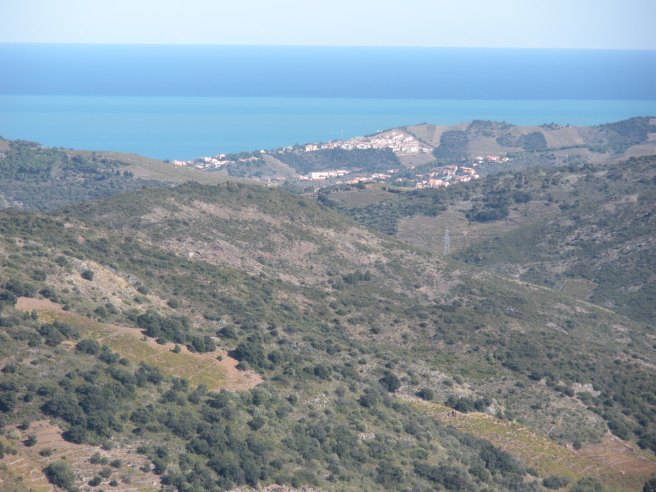
View from Col de Banyuls.JPG

Then one last hair-pin turn and down you go on the Spanish side, over five cattle grates until you arrive, going through a very narrow “luge-run,” into the village of Espolla. Whew! By the time we arrived back in Banyuls the following year, the road on the Spanish side had been resurfaced and the “rough patch” on the French side had been filled in. Since then, we have used this route into Spain whenever we go down for a bit of shopping or sight-seeing in Figueres, and even to head back to Barcelona, as we can pick up the autopista in Figueres.

Last year when we arrived in Barcelona, we picked up our lease car and headed north, as usual. When we got to the top of the Col and headed down into France and around the five hairpin turns, we suddenly realized that we’d forgotten that there had been torrential rains and floods the previous Fall. The road was almost completely washed out! It took a long time to drive over the rough surfaces at very slow speeds before we got into town. So we’ll forgo our shortcut to Spain until the road is all repaired again.

Because Spain is close to our village, we are often traveling over the border for shopping or for eating at favorite restaurants. The opening of the borders between countries in Europe, and the institution of the euro as a common currency, has made it easy to go back and forth, much as we do between States in the US. Although, I must note, that custom police still patrol NEAR the borders. Once, when returning from Andorra, we were stopped by customs just a few kilometers into France. I kept asking the officer if he wanted to see our passports, but no, he just wanted to see what was in our trunk. When he started fussing about the bottles of alcohol we were bringing into France, stating that only so many liters was allowed to be imported into the country, I asked him, yet again, if he didn’t want to see our passports. “No, madame, it’s not necessary, but you cannot bring all of this into France.” At this point, my husband jumped out of the car and explained in halting French that we were Americans and that it was all going to the US. “Oh, then, monsieur, no problem!” Apparently, (according to my husband) my French was too good—the officer didn’t realize we were Americans!

Our adventures in Spain have many and varied, and did not always turn out so delightfully, and for that reason they deserve a chapter all their own.

Salade de Foie Gras

Salade de Foie Gras

  • Prep 15 min.

“Source: Cafe St. Jean, Perpignan”

Ingredients

  • lettuce
  • melon or cantaloupe, cut in chunks
  • strawberries, halved
  • tomatoes, cut in chunks
  • foie gras, sliced
  • serrano ham, sliced
  • gros sel/kosher salt (or sea salt)
  • vinaigrette

Directions

  1. Tear lettuce into pieces and add vinaigrette.
  2. Place lettuce on each individual plate.
  3. Top with fruit and tomatoes.
  4. Add slices of ham.
  5. Top with a slice of foie gras encrusted in gros sel (Kosher salt).

9. Village Life

Village life during the year centers around major holidays, tourist season, the wine festival and annual fires.

Banyuls

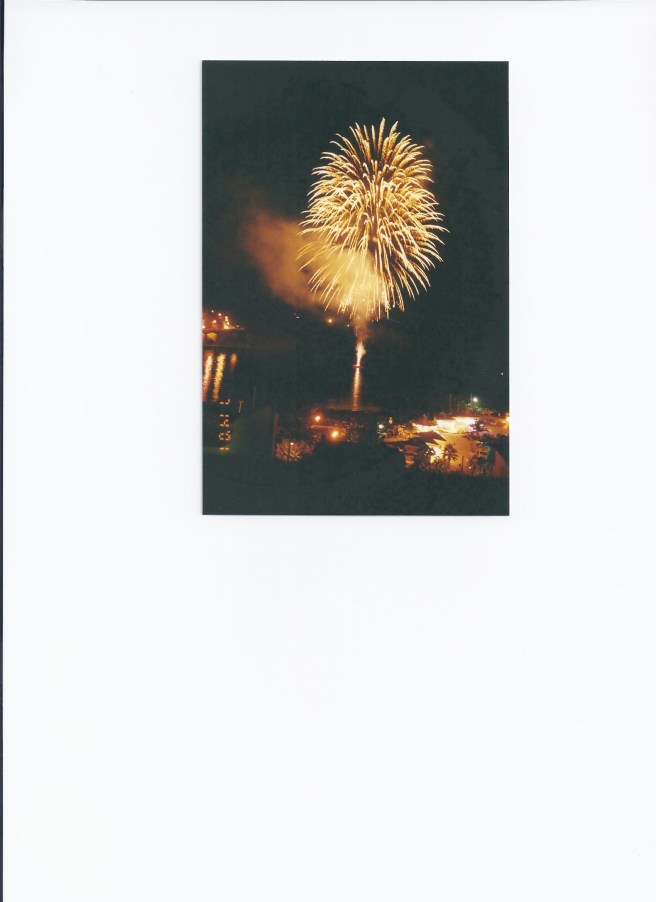
If the village’s mairie budget allows, we have fireworks for Fete de St. Jean (June 24), Fete Nationale (July 14) and Fete de Banyuls (August 15).   Luckily all of these holidays are during the summer tourist season, which is primarily June, July and August. If the budget is low, we get only one fireworks display during the summer, which is always a disappointment for the tourists.   This will then affect the amount of trade in the village. Since the village relies on tourist trade from March to October, most mayors try to attract as many tourists as possible during the season.

We have been in our apartment for many Fete de St. Jean holidays and always enjoy watching the torch come down from Canigou (the major mountain peak in the Alberes mountains, which overlooks the Perpignan plain). From the torch, the lanterns of the school children are lit, and then the children throw their lanterns on a huge pile of wood to make the traditional St. John’s Day bonfire on the beach.   Tradition states that lovers who hold hands and jump over the coals from the bonfire on St. Jean night will be in love forever (or some such belief).

bonfire

Some years there are the “fire walkers” (pyrotechniques) who spin long rods of fire around as they parade through town. Sparks fly everywhere and the fire engines are always nearby. We just enjoy sitting at our big window overlooking the beach and watching all the frivolity from there.

Fireworks.jpg

As the fireworks begin, we have a family tradition of eating chocolate bread pudding and having a cup of coffee. I don’t remember how this got started, but our daughter insists that, as a family tradition, it is now de rigueur.

The national holiday is, of course, Bastille Day, or 14 juillet. On this day there is always a parade through town with the laying of flower wreaths on all of the war memorials in the village.

14 juillet parade

There’s the revolutionary war memorial on the main square, the DeGaulle memorial on the way out of town towards the Col de Banyuls, and the Maillol war memorial behind the mairie, where speeches are made. This is also where other war memorial ceremonies take place, such as the June holiday that commemorates DeGaulle’s call to arms from London during WWII and the November 11 holiday, Armistice Day, when more speeches are made and the national anthem is sung.   Fireworks are scheduled either July 14 or the night before and the quality varies depending upon that year’s budget. We have seen some tremendously wonderful displays some years and pitiful ones on other years.

In addition to the French national independence day, there are also ceremonies at the war memorial in nearby Port Vendres on AMERICAN Independence Day, as the memorial there is also in honor of those Frenchmen who fought for our independence in 1776! Since Port Vendres is twinned with Yorktown, VA, we have attended several ceremonies and walked in parades in Port Vendres on the 4th of July, including the festivities for the visit of the USS Avenger.

4 July in PV

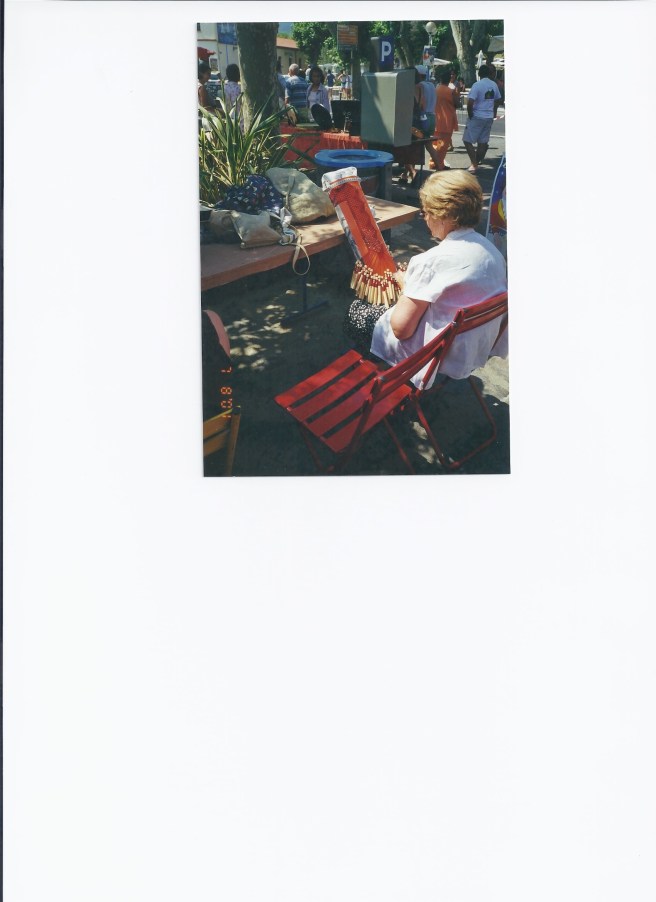
The Fete de Banyuls is a village celebration with local produce and crafts markets during the day. A parade with floats (very homemade) that carry some of the children (we cheered one year for our daughter’s Centre Aere friends on a float) is also part of the day’s festivities.

lace making

Two other major festivals occur during the year. One is the Fete Catalane, when sardana dancing groups come to Banyuls from both French Catalan and Spanish Catalan villages and dance on the square to the very unusual Cobla, a group of musicians playing Catalan instruments.


Several locals dress in Catalan costumes, there is a parade, with Castellars, and Geants, and lots of rifles being fired in the air. The Castellars are a troupe of tumblers that builds a tower by standing on each others’ shoulders, with a small child on top. They do this in the street—no mats or safety ropes. The Geants are huge giant papier- mache people, a king and a queen, etc. that are “danced” down the street, probably by someone inside on stilts. They cause a lot of excitement with the children.

The other really major festival in our village is the Fete de Vendange, which is the wine festival for our local wine and occurs the second week-end in October. October is a wonderful month to visit any wine district, as the air is full of the musk of the grapes that arrive throughout the day at the wineries in town.

Grapes.JPG

We have about twelve wineries in Banyuls, so making wine is an important industry of our village. Banyuls wine is aged in large barrels painted red on the ends and set out in the sun. It is drunk as an aperatif or as a degustif.   White Banyuls goes well with fruit desserts and custards. Red Banyuls wine marries perfectly with chocolate and cigars!

barrels of wine with Anne.jpg

During the Fete de Vendanges, about 10,000 visitors descend upon our tiny village, all on that Sunday to taste the many Banyuls wines available through the morning and afternoon. A barrel of wine is blessed by the bishop after Sunday mass, and then the fun begins.

Small musical combos play at various locations throughout the town as the visitors purchase a glass and then walk up and down the street near the church, pushing through the crowds, and tasting all the different wines there are to sample. My favorite musical group is called “Les Enjoliveurs”—the hubcaps!

The rest of the summer is filled with Kermesses, which are fun fairs for children to support the Red Cross, traveling circuses and Guignol (Punch and Judy) shows. At the kermesses, children play games like fishing for plastic ducks or fish, walking on stilts around a little course, etc. They win tickets, which are then exchanged for prizes. The prizes are, I believe, donations from people and are sometimes chipped or broken, but we have quite a few of these dog figurines, glass fish ornaments, and other such knickknacks that were highly prized by our little girl.

kermesse.jpg

Grillades, which usually include fried sardines or mussels and sausage cooked on large grills on the beach and pan o tomate with anchovies are also scheduled throughout the summer.

grilled sardines.jpg

Often they make giant paellas, made in huge paella pans on open fires on the beach.  Some people take large plastic containers with them to have them filled with paella, then take their dinner home to eat.

giant paella.jpg

The “discos” at night often keep us awake with their loud rock music, but after a week or so, we barely hear the noise and it always ends by 2 a.m. when the bars close. Then every Thursday evening there is a Sardana, when the village people and visitors dance the sardana, the traditional Catalan circle dance to the music of a cobla.

Sardana.jpg

Weather also plays an important part of village life. The main concern throughout the year is always the tramontane, a strong wind that whips across the Pyrenees mountains and hits the coast with gale-force winds. There is a Catalan saying that tells how long a tramontane will last—1, 3, or 7 days and another that says if the tramontane arrives at night, then rain will follow. During the summer, the wind is a wonderful friend, keeping our un-air conditioned apartment nice and cool.  Whether it’s playing with the blowing curtains,

playing with curtain.jpg

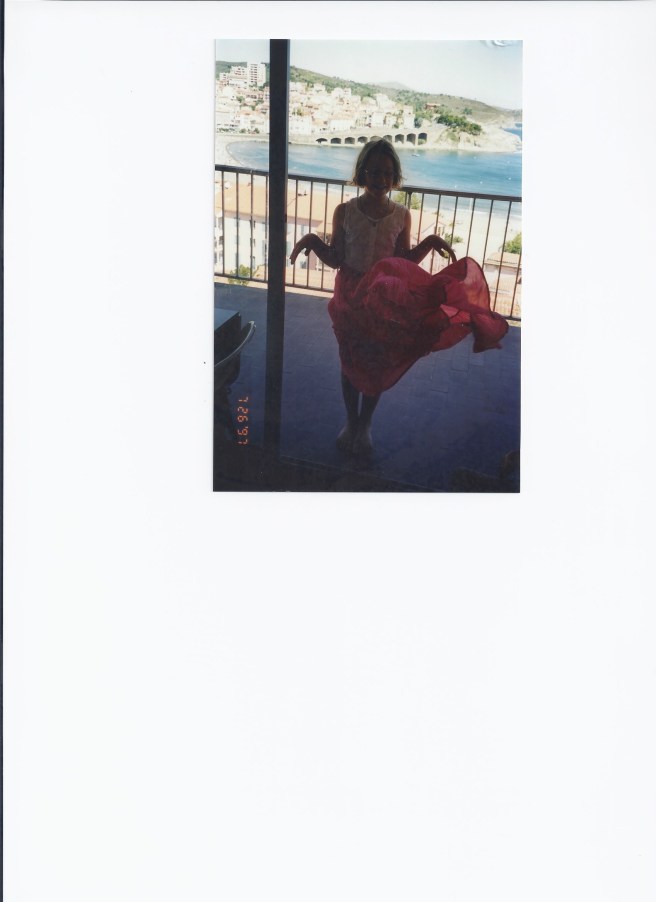
or just standing on the balcony, the tramontane during the summer is a welcome ally. But we learned to never go to the beautiful sand beach in Canet on a day when the tramontane is blowing as you will end up with sand-blasted legs! And full skirts are not a very good choice of clothing to wear when that lovely wind is blowing.

Anne and tramontane.jpg

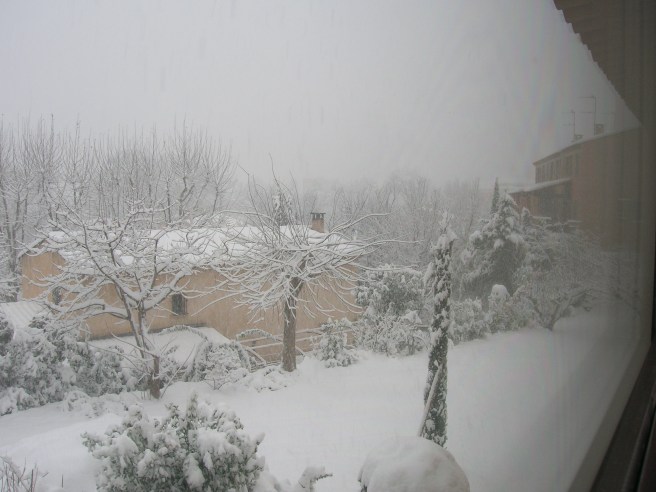
But in the winter it can be treacherous, bringing snow and ice down from the mountains, all of which paralyze our little tropical paradise.

Marie Claires2.JPG

One night, when our daughter was about 10 years old, she came into our bedroom at 3:45 a.m., frightened from a nightmare. I talked with her a few minutes to calm her down and then suddenly I noticed that the wind was blowing all sorts of leaves and debris into our bedroom. We quickly closed the window and went out to the living room to see what was happening. Rain was blowing around so hard that we had white-out conditions! The storm was fierce and we soon discovered that a mini-tornado had descended upon the village. We sat on the sofa bed with our daughter, sipping tea, watching the storm develop and the sea turn quite ugly. Then CRASH! The lightening hit something big very near to us and we lost our electricity! An hour later we heard the chain saws busy at work. Apparently, a huge tree had been struck in the street below us, uprooting it and landing on the electric lines. We saw the results the next day. We also saw that a catamaran had sunk in the bay; it was recovered, but the mast was bent. Then we found that a downspout had been blown down off our building and the new balustrade along the fourth floor of our building had been blown in! The streets and walks were littered with branches, leaves and flowers, so the clean-up process went on all day long. Villagers still talk about that “mini-tornado” of ’97.

tree down in tornado.jpg

Winter storms along the coast are pretty frequent. The tramontane blows so fiercely that it is often difficult to stand or walk.   The sea swells up and enters the village streets, looking at first like huge soap suds, until all is flooded up to four feet or more.


OLYMPUS DIGITAL CAMERA

Boats from the harbor sometimes end up either on top of each other or floating up and down the village streets. Our friends’ hotel in Cerbere has been flooded more times than we can count, necessitating a lot of mud shoveling and washing up. Hopefully the new breakwater they built in Cerbere a few years ago is protecting the village now.

Almost every year, there is a fire in the vineyards up and down our coast.   Sometimes it stays north of us, sometimes it devastates the vineyards just over the border in Spain, and sometimes it rages through the local vineyards, blackening the hills around the village. One summer many years ago, I rented our apartment to a professor and his family for five weeks.   It was a summer of such a fire, so I got a phone call at my office one morning, asking me what they should save from the apartment if the fire came down into the village! Having had no news of France, I had had no idea that there was any danger to our village. The campgrounds on the edge of the village were burning and Canadairs (fire-fighting planes) were dipping into the bay then swooping up just above our balcony as they hurriedly dumped their load of seawater onto the fires in the hills behind our building.

Several years ago there was a huge fire on the Spanish border. When we arrived that year, the hills were all black. It was a stunning picture.

Fire raging on Spanish border 2012.jpg

But actually I need to tell you about the “fruit sellers” first. In our many trips over the border to shop in Spain, we often noticed around the La Jonquera area, that there were often young ladies standing along the side of the road, sometimes with a small table. I always assumed they were manning small fruit stands, until one day my best friend was bemoaning increase of the prostitute rings in Spain. “What prostitutes?” I asked.   “Didn’t you ever see the young girls standing on the side of the road down around La Junquera?” she asked me. “Oh!” The penny dropped! She had quite a laugh at me when I exclaimed, “But I thought they were fruit sellers!” Apparently young girls come from Eastern Europe and then work several years in order to get their legal papers and a passport for Spain. Their work entails standing in skimpy clothing along the side of the roads frequented by truckers, then going off into the fields for a “quick transaction.”   So the day we arrived after the devastating fire that year, the hills were absolutely black, but standing on the road in the foreground, against the absolute black hills, was a prostitute with long black hair and a bright red outfit. It was, indeed, a very striking picture!

During the summer there are always lots of activities going on in the village and we try to make sure we have a monthly schedule on hand for our guests when they arrive. Friday mornings are flea markets/antique markets next to the harbor, Thursday and Sunday mornings are market days at Place de marche. Evenings are often what we call “night market” when there are stands of Indian and African wares, jewelry, and, at one time, garnet jewelry from local artisans, paintings, and other artisanal crafts. There are concerts scheduled throughout the summer by visiting artists or local musical groups. Some are better than others.

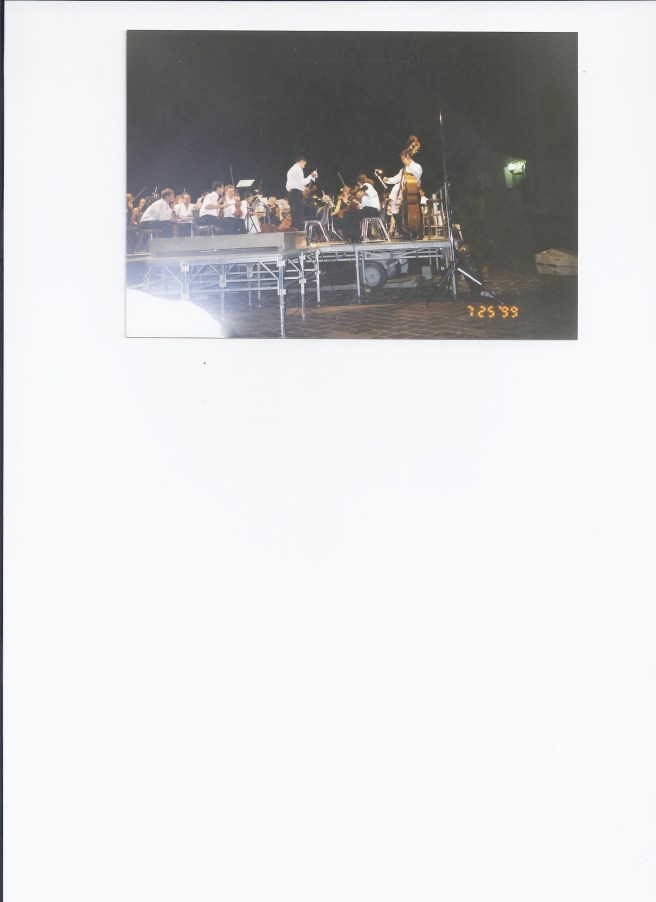
One summer quite a few years ago, we attended a concert given in our village by the summer festival orchestra of North Carolina School of the Arts. It was made up of students from music schools and conservatories all over the US and we were pleased to find a few familiar faces from our daughter’s music institute. So when they turned up a year or so later for a concert in Collioure, we decided to go see them again. This was, of course, a different group of students, but we still found a cellist who studied with a professor we knew quite well. I proceeded to tell him about my father’s gold frog bow, which I had sold to the professor and suggested that the student ask to see it when he got home.   He brought out his hand from behind his back, and there was my father’s bow! He’d bought it from his professor and was using it for the concert that night. I was so stunned that I could hardly speak the rest of the evening. I still get chills down my back remembering that sensation, knowing that the cello bow had made it to the Roussillon even though my father did not live long enough to come visit himself.

Jacob and Dad's bow.jpg

And so the summers are filled with swimming in the sea, riding on the merry-go-round, visiting the various markets and fairs, watching the men (and women, now!) play petanque every evening, going for long walks up the hill and through all the narrow, twisting streets of our village, and spending long evenings of reading through our private, and by now, very extensive library.   Not having a TV in France for the first 15 years, was a wonderful thing! But now we say our new TV is a great excuse for learning more French. And the cooking shows are quite fantastic, too!

Our daughter kept busy during those summers of her youth, reading or practicing her music lessons, going to the beach for churros

churros.jpg

or huge croque-monsieurs

croque monsieur making-1.jpg

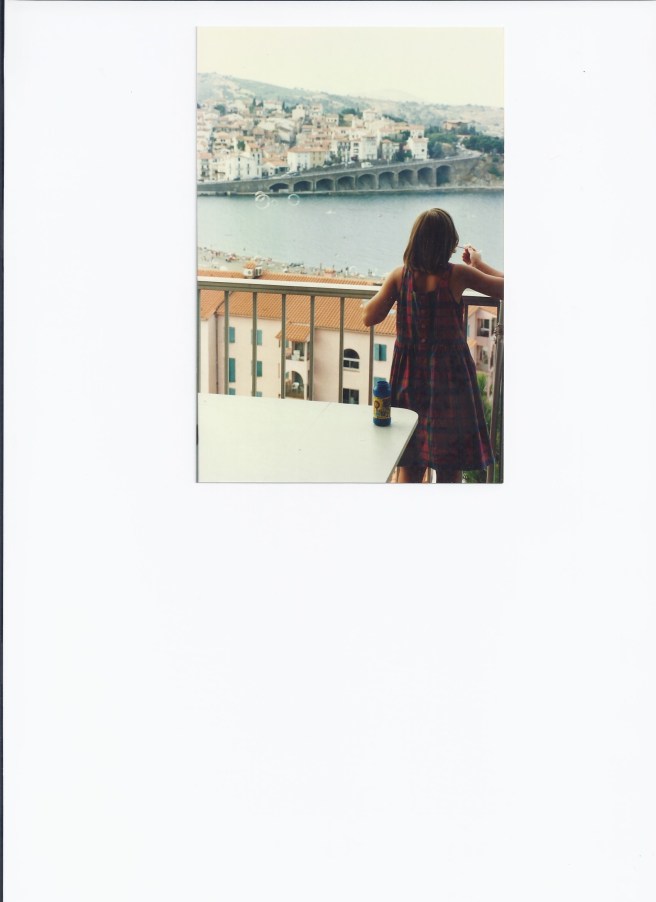
or just blowing bubbles on the balcony.

Anne and bubbles.jpg

We played Checkers and Uno and Chess and invented new recipes. Every day was a new adventure.

As the summer winds down and the tourists go home, the village settles down to its winter pace, knowing that the stores will close for two weeks at Tous-Saints (All Saints’ Day), then gear up for the Christmas season. Shops will be filled with santons and lots of chocolates. We will load up on fresh foie gras and nuts and pears and Roquefort cheese, as the Fall and winter season arrives. People will begin to bundle up against the tramontane and the plane trees will be trimmed of their branches (this always reminds me of how we “murder” crepe myrtle trees in the South). Most hotels close on October 1 and the owners will plan their winter vacations in warmer climes. But on Christmas Eve, the children of the village will don their Catalan dress and dance during midnight mass and Catalan music will continue to sound through the winter season, waiting for spring flowers to arrive and the busy tourist season to once again bring in the much needed annual revenue.

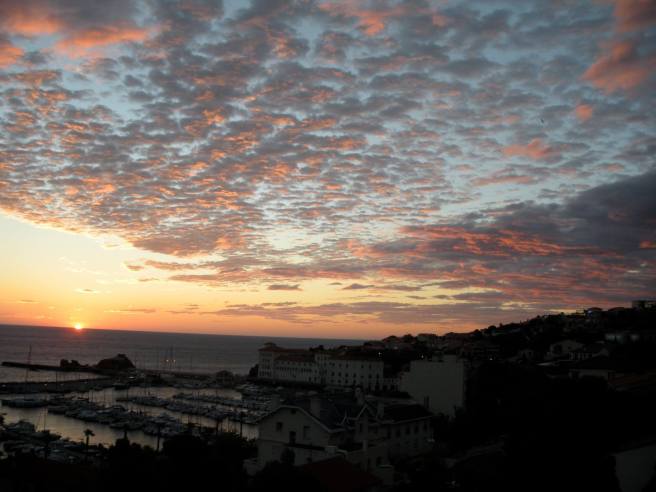
Sunrise


Croque-Monsieur

Croque-Monsieur

  • Prep 5 min.

  • Cook 10 min.

  • Ready In  15-20 min.

“The kind you get at a bar or cafe in France.”

Ingredients

  • 1 T. unsalted butter, plus soft butter
  • 1 T. flour
  • 1/2 c. milk
  • 1/4 c. gruyere cheese, grated
  • salt and white pepper
  • freshly grated nutmeg
  • cayenne pepper
  • 8 slices white bread
  • 8 oz. sliced gruyere
  • 6 oz. sliced ham

Directions

  1. In small pan,melt 1 T. butter.
  2. Add flour and cook, stirring constantly, until nutty, 1-2 min.
  3. In another pan over med., warm milk until bubbles form on edge.
  4. Whisk slowly into butter mixture until smooth.
  5. Bring to boil; reduce to low and cook 2 min.
  6. Stir in grated cheese and season.
  7. Cook sauce until thickened, 2-3 min.
  8. Transfer to a bowl and cool.
  9. Brush one side of each slice of bread with butter (outside).
  10. Spread sauce on inside; top sauce with cheese, ham, cheese, then bread.
  11. Season tops of bread with salt and pepper.
  12. Fry sandwiches.

Seafood Paella

Seafood Paella

  • Prep 20 min.

  • Cook 35 min.

“Paella without the chicken or meat”

Ingredients

  • 2-1/4 c. seafood broth
  • large pinch of saffron threads, slightly ground in mortar
  • 1 T. Pastis
  • 3 T. olive oil (2+1)
  • 12 raw, peeled and deveined shrimp
  • 2 calamar tubes (encornets), sliced crosswise into rings
  • 2 T. chopped tentacles from the squid
  • 1/2 onion, minced
  • 4 mini red bell peppers, sliced crosswise in rings (or 1/2 large red bell pepper, diced)
  • 2 cloves garlic, minced
  • 2 fresh tomatoes, diced
  • 1/2 t. dried thyme
  • 1 T. fresh parsley, chopped
  • 1 T. fennel fronds, chopped
  • sea salt and fresh ground pepper to taste
  • 1 c. Arborio rice
  • 8 ou. fresh cod, cut in 1/2″ slices
  • 12 clams
  • 12 mussels
  • 1/2 c. frozen peas (optional)

Directions

  1. Preheat oven to 400 F.
  2. Heat broth in large saucepan. Add saffron and boil for 5 min. Add pastis. Set aside and keep warm.
  3. In paella pan, heat 2 T. oil. Add shrimp and calamar rings and saute until shrimp are golden. Remove from pan.
  4. Add onion to the paella pan and cook 3 min.
  5. Add 1 T. oil to the pan and saute bell peppers, 2 min.
  6. Add garlic and tomato and cook, 3 min.
  7. Add thyme, parsley and fennel, salt and pepper to taste and stir to blend.
  8. Stir in the rice and cook until juices are absorbed.
  9. Add broth and stir evenly. (Add peas, if using.) Boil 10 min. on the stove, until broth is half absorbed into the rice.
  10. Without stirring, tuck fish pieces, clams and mussels into the rice.
  11. On top, add tentacles, shrimp, and cod.
  12. Put into oven, uncovered, 25 min. until liquid is all absorbed.
  13. Rest, covered with a linen kitchen towel for 5 min. before serving.

Bread Custard Pudding

Bread Custard Pudding

  • Prep 20 min.

  • Cook 60 min.

Ingredients

  • 1 1/2 c. crumbled dry bread
  • 1 T. butter
  • 2/3 c. sugar
  • 1/2 t. vanilla extract
  • 1 egg
  • 3 c. scalded milk

Directions

  1. Combine crumbs and milk; bring to boiling point.
  2. Add butter and stir into the egg and sugar beaten lightly in the pudding dish.
  3. Flavor with vanilla.
  4. Surround the dish with hot water and bake in a moderate oven (350 F) until knife comes out clean when inserted (about 45 min.+).  To make Chocolate Bread Pudding, increase sugar to 1 cup and add 2 ounces chocolate, melted (or 2 T. cocoa).   Source:  Ida Bailey Allen’s “Modern Cook Book” (1924, pp. 588-589)

8. Filling the Gaps in 2 Kitchens


By the time our daughter turned 12, we had decided that it was time to purchase a larger apartment, so she could move out of the living room and into a bedroom of her own. We wanted to stay in the same residence, although the local realtor tried to get us to purchase a new two-story condo at the edge of town. In time this new complex would become known as the Danish Ghetto, as that is where most of the Danes settled when they came to our area of France. Now it is a mixture of Brits and French and other nationalities. They are very nice apartments, but we knew that as we grew older, we would not be able to climb the steps from the garage to the kitchen with bags of groceries, nor be able to navigate the staircase for the middle of the night bathroom visits. So we were determined to stay in our building.
The only two-bedroom apartments were on the corner of the building, with a picture window overlooking the sea, like our current balcony, and a long balcony overlooking the boat harbor and aquarium. So at the annual property owners’ meeting I timidly stood up and announced that we were looking for a 2-bedroom apartment and asked the four owners of these apartments to contact me. As I left the meeting, an elderly woman approached me and said that they had decided to sell their apartment as her husband could no longer manage to come down for vacations. This was a Godsend! We once again went through all the legal machinations, this time with the help of my best friend. To sign the sous-signe prive, we met the couple in their home in Perpignan, discussed the price (no negotiation), then signed the papers. As soon as all was accomplished, Madame walked into her kitchen and returned with a tray holding a bottle of champagne and five glasses. This sealed the bargain!

When all the final papers were signed at the notaire’s office, we picked up the previous owners and took them to the apartment so that they could explain some things to us. Among other information was the announcement that they would leave us the twin beds, a double bed, lots of dishes and pans and glasses, two living room chairs, two wicker chairs and a heavy balcony table. Eventually we would give the beds to our friend who was starting up a B&B, but we are still using the chairs and table and kitchenware. It took another year to sell the small apartment, but in the meanwhile, we used it for guests, putting mattresses on the floor.

So now I had a larger kitchen and it had a window over the sink with a view of the sea!

new kitchen2

Of course it had only 3 cabinets, so a trip back up to Ikea was put quickly on the agenda. By adding four base cabinets with a wooden countertop and four wall cabinets along one side and adding two wall cabinets and a set of drawers along the other wall, I felt a little better about this new kitchen. Over the years, we have replaced the electric oven and the clothes washer. Next on the schedule is to replace the window so it opens in two directions and the gas cooktop, so that all burners actually work for me!

Once again, the little fridge was located under the oven. No room for a tall fridge, so that went into the hallway. Then we had to have four outlets installed, as there were NO outlets except one at the door into the kitchen. We Americans do love our electric gadgets! And that meant the electric company had to come and increase our power again. Once again my husband told the electrician that it was an “American kitchen,” and the response was rapid: increase the power!

There are always ingredients that are not available in one country or the other, and that is where we try to “fill the gaps.”

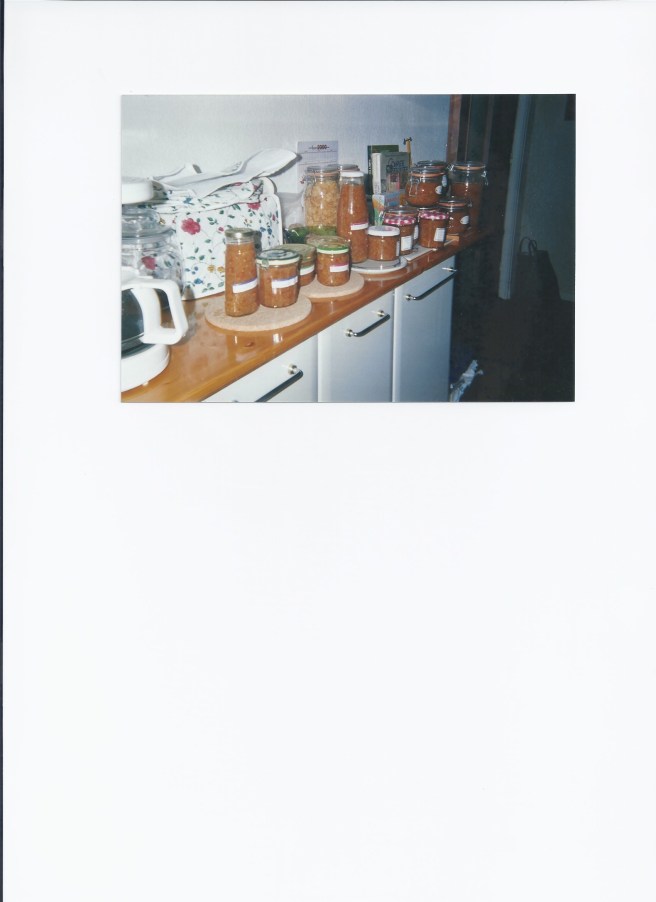
Over the years, we have made our own relish, as that is still not available in France, using my mother’s recipe for green tomato relish.

relish making

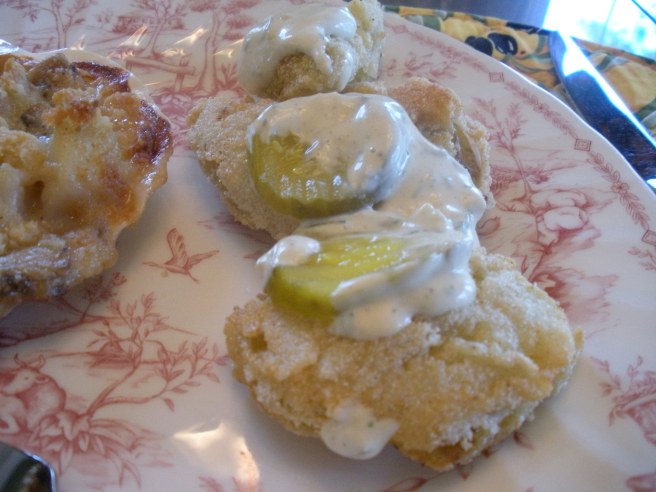
We would each take turns grinding the tomatoes and onions, cranking the handle of the meat grinder that I screwed onto the table in the living room.   We found that we have to go into Spain to find green tomatoes in the markets. I remembered to do this when, several years ago, I began to share southern cuisine by making fried green tomatoes for my friends in France.

fried green tomatoes and relmoulade

The only time I was able to purchase green tomatoes in France was when I did so directly from the uncle of a friend who had a garden and agreed to sell me some green tomatoes from his vines.

I have also made quite a few jars of bread and butter pickles and dill pickles, as the only pickles available in France are the tiny cornichons, traditionally served with pate. I like real dill pickles with my wienerschnitzel!

One year my French friend gave me a huge bag of kumquats! I had to research that fruit quickly and made a kumquat compote, then kumquat and orange marmalade. Kumquats are not a fruit I find often in my American supermarkets!

Making French recipes in the US and making American recipes in France often present challenges, which I relish!   Last year I wanted to make sorrel sauce when I was in the US. The only sorrel I found was at Fresh Market in a tiny “herb-sized” packet, at quite a high price. I needed a pound! I’ll wait until I’m back in France to make that recipe.

Looking for peanut butter in France for our young toddler, was impossible, so we ended up importing a fresh jar each year. Now they have a sort of peanut butter that tastes quite awful, so Jif is still on the packing list. Decent cinnamon was also difficult to find when we first arrived in France, as was vanilla extract, so they have remained on the packing list.   I thought a few years ago that France had finally discovered shortening, as a product called “Vegeline“ appeared in the supermarches. Sadly, it’s just solid oil for frying purposes and doesn’t replace my Crisco.

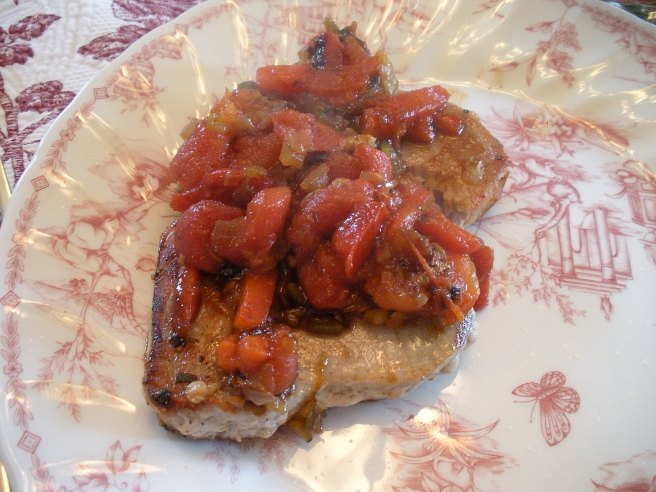
When we return to the US, we miss the fresh sardines and the fresh white anchovies from Collioure. If you’ve never tasted a white anchovy, then you really do not know what anchovies taste like. We miss the thon catalan, but I’ve made my own from fresh tuna steaks.

thon catalan, served

We miss the numerous pates and cheeses; we miss the veal and Catalan chicken on Sundays. But mostly, we miss the fresh fish.   And when we are in France, we miss the good beef and wonderful lobster that we have in the US.   In France we use crème fraiche and I make my own sour cream. In the US we use sour cream and I make my own crème faiche.

Shopping for meals on a daily basis has long been part of the French culture, so those tiny refrigerators that are so common in French kitchens are just the right size.   I learned early on that, as an American, I would need a much larger fridge! But then, of course, it did not fit into the tiny kitchen, so it stood in the living room.

When in France, we have learned to shop by the season. In the US, we are used to obtaining produce year-round, but in the villages of France, this is not the case. Fresh cherries come from Ceret in the spring. Strawberries appear in June, with peaches and apricots throughout the summer. I quickly learned not to ask for walnuts or hazelnuts in the summer—nuts come in the Fall. So if I want to make something with walnuts when I am there in the summer, I must remember to bring them from the US. Lately that has meant taking along pecans, so I can make Southern pecan pie for our French friends. Pecans have just begun to appear in the French markets in recent years, but only in the Fall. Pears and packages of fresh foie gras appear in the Fall. And, of course, Roquefort cheese is best in October with a glass of sauterne.

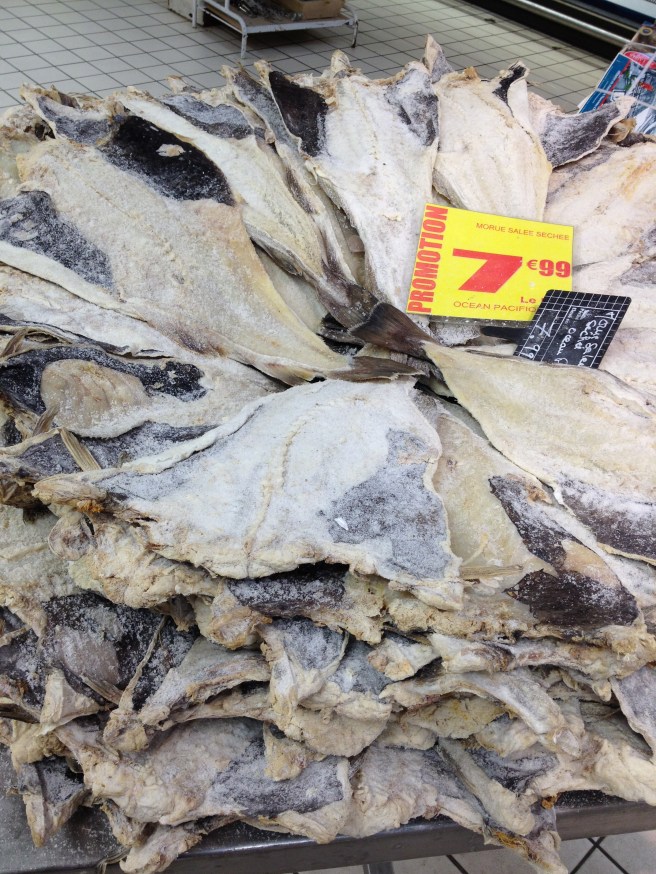
In the Fall, we also see piles of dried cod in the markets.

dried cod

I have made morue several times. The trick is to soak the fish at least 3 or 4 days and change the soaking water several times each day. I don’t think I will ever get to the point of making Swedish lutfisk, but I don’t mind the French recipes for morue!

Every day in France, we purchase the local paper for our daily French lesson, and every day there is a new recipe on the back page. From time to time there is something interesting to try and then the fun begins translating not only the ingredients but also the directions. The Sunday paper also includes a magazine and TV guide, both with additional recipes. One recipe for scallops required that I “snacker” the scallops. Well, what the heck is THAT? I asked both of my friends, and they put their heads together and puzzled over this obviously English word turned into a French word. I was confident that the author did not want me to take tiny bites out of the raw scallops before sautéing them! We finally decided that they simply meant that the scallops were to be sautéed very quickly “hwtt, hwtt,” as my friend says while turning her hand over quickly.

When our British friends visited for a meal a few years ago, I made a new recipe that I seem to remember was presented in a stack, with magret de canard (duck breast) and foie gras. While I was cooking the foie gras, I remember thinking that it didn’t seem the right consistency, but it wasn’t until I took my first bite at the table that I realized I had purchased magret de foie gras, not foie gras de canard. It was a duck breast from a duck raised for its foie gras, but it was not the foie gras! So I ended up with duck breast topped with duck breast! We learn from our mistakes!

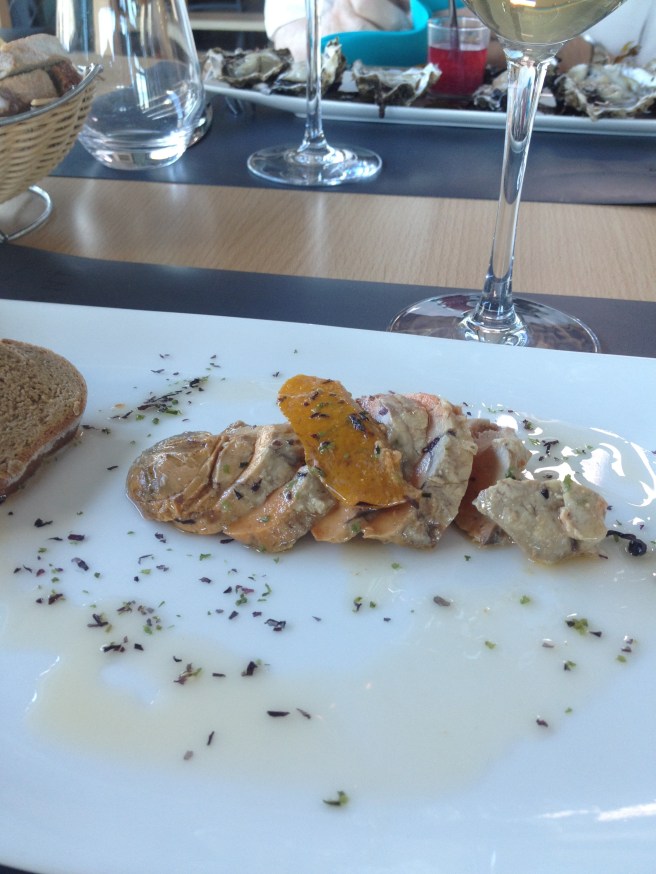
Another foie (liver) that I had for the first time two years ago, was foie de lotte (monkfish liver). This was served at a wonderful seafood restaurant 7ieme Vague on the outskirts of Perpignan. It was served as an entrée and was delicious.

Foie de Lotte

It has now been added to my list of things I would like to learn how to prepare. When I ordered monkfish in my local US supermarket this past year, the clerk looked at me like I was nuts when I asked if it would come with the liver. Guess I will have to wait until we are back in France to explore this recipe.

Last week I received the Valentine Menu from our favorite chef at L’Auberge du Cellier in Montner. Since we cannot be there to eat the meal prepared by Pierre-Louis Morin, I decided to try to make it here in the US, just for the two of us. The ingredients include Thai bouillon, coriander, eggs, mussels, saffron, monkfish, fresh pasta, thyme, parmesan, pigeon, spice bread, fresh foie gras, Jerusalem artichokes, macarroons, and raspberries. I decided I could find something close to the Thai bouillon; there are several oriental restaurants near us and surely one of them would have something similar, so that’s one thing I wouldn’t even have to prepare. Monkfish would be a problem; I ordered some last summer from Publix and it cost “an arm and a leg,” but we ate the last pound two weeks ago, so I decided to substitute lobster (a backwards substitution!). Pigeon….hmm…I thought a substitution of quail, which is very prevalent in this area, would be a good choice. I know the area restaurants serve fresh foie gras from Hudson Valley, but was not sure if I could purchase a small piece in a supermarket. And Jerusalem artichokes are probably unheard of in this area. But, joy of joy, I know I saw French macarons at Sam’s Club! But the puzzling part was that the eggs are served “embeurre de chou.” According to my French friend, embeurre de chou is simply cabbage that is parboiled, then chiffonnee (sliced in shreds with a knife) and quickly sautéed in butter. Then do I put the egg on top, or will I do something different, like bake the egg in a puff pastry shell? Decisions, decisions, decisions! Then there were to be mussels on the same plate!   I know Pierre-Louis will be very innovative in designing the plate to look fabulous, but could I come up with something equally exciting?

A search through our supermarkets turned up very small and mushy Jerusalem artichokes (called “sunchokes” in this area) in one store, so they stayed in the store. Sam’s Club no longer had macarons; apparently they are a “seasonal item.” No foie gras available at any store and the Publix was even out of quail. So here’s the menu I ended up with:

St. Valentin, 14 Fevrier 2015 (chez nous)

Pate Feuillete a la tapenade

…………………

Bouillon Thai aux shiitakes et coriander fraiche

……………………

Un oeuf au four dans un vol au vent sur

un lit de l’embeuree de chou et les moules saffranees

……………………

L’homard et crevettes en raviole, jus de cuisson au thym et au parmesan

…………………..

Pintadeau saupoudre de Speculoos, puree de pommes de terre

…………………..

Crème Catalane aux framboises et Macarons aux framboises et Chantilly


Using Pepperidge Farm puff pastry sheets, I cut strips and covered one side with homemade tapenade. This is a common appetizer at L’Auberge du Cellier. Since I didn’t find a jar of tapenade in my local supermarket, I made my own, using a David Lebovitz recipe. The result was delicious, but I think next time I will not triple the thickness of the dough.

Feuillete with tapenade

The bouillon was an instant Thai soup, “Tom Yum,” from which I removed the noodles and the tofu before mixing it; it was quite spicy, but easy to make.

Thai bouillon

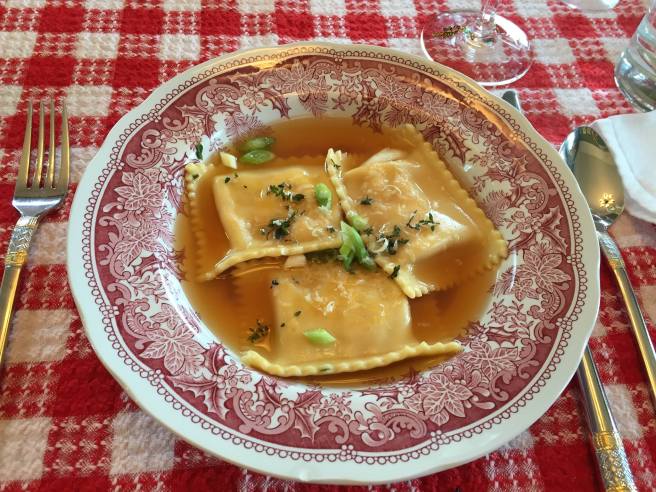
The raviolis were frozen and I boiled them in seafood broth, adding fresh thyme, scallions, and grated parmesan at the end.

lobster:shrimp ravioli

The two original courses were created after much thought and consideration. Although it was Pierre-Louis who created the combination of flavors for the egg course, I was in a complete puzzlement as to how he planned to accomplish this. All I knew for sure was that there would be an egg, some mussels, and embeuree de chou. So after much thought, I decided to bake the egg in puff pastry. I baked the puff pastry shells for about 15 minutes, until almost completely cooked, then removed the center “lid” and carefully poured an egg into each pastry shell. They were then returned to the oven and baked for about 10 minutes, melted butter added, and baked for another 5 minutes. I then added ground pink pepper on top. L’embeuree de chou is simply parboiled cabbage leaves which are then thinly sliced and sautéed in butter.  Then I used my usual recipe for the mussels in saffron sauce and added some chopped red bell peppers for color.

Baked egg en vol a vent

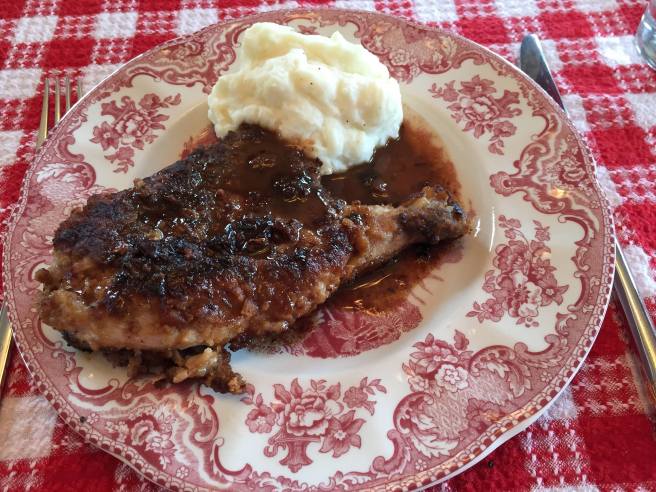
Morin’s next course combined pidgeon and spice cake, foie gras and sunchoke puree. I had to forgo the foie gras and sunchokes, as they were unavailable. So then I decided to use ground-up ginger cookies with a small Cornish hen. I combined a recipe of Jacques Pepin, my fried chicken recipe, and Pierre-Louis’ idea of using spice cake with his pidgeon. After dredging each half hen in flour, egg and ground pepparkakor (ginger cookies), I fried the inside of each hen in butter, then turned them over and added a heavy iron skillet to weigh the hen down. Pepin uses foiled-wrapped bricks as weights, but I opted for my iron skillet and a hamburger press for good measure. The meat cooked in about 30 minutes and was tender and delicious. Adding a wine sauce made from the drippings was simple.

cornish hen pane with pepperkakor

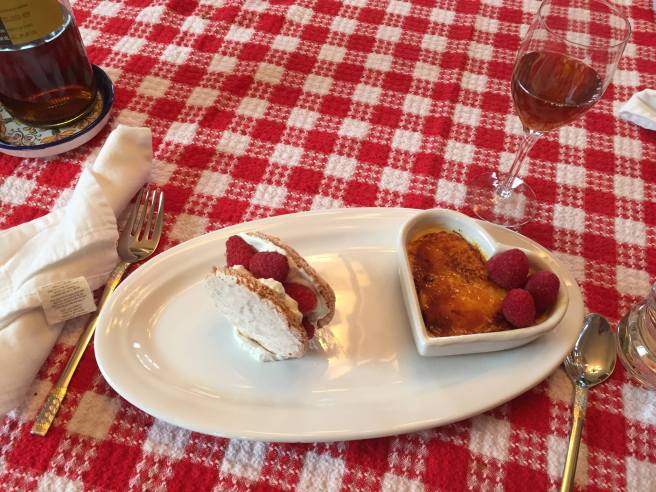
For dessert, I ended up trying to make my own macarons, and that was a bit of a disaster. But they were tasty anyway. The idea for the “macaron sandwiches” is from Pierre-Louis’ original Valentine menu. They are stuffed with whipped cream and fresh raspberries and very delicious.   Crème Catalan is always a treat to make and common in our area of France, so I added that second dessert.

valentine dessert

And so we learn to combine and adapt and use the ingredients available wherever we are residing. We learn new recipes from our friends and the chefs around us. We pick up ideas in magazines and newspapers and just sitting down with a new cookbook on our laps. I am always ecstatic when my daughter calls to say she has tried a new recipe. She is exploring the art of food science in her kitchen much earlier in life than I ever did. My mother taught me how to make mashed potatoes, meatloaf and jello. My father taught me how to make Swedish gravy and bif a la Lindstrom. The rest I have had to learn on my own, and I will never stop learning!


Good Relish

Good Relish

  • Prep 30 min.
  • Cook 30 min.
“Source: Mother”

Ingredients

  • 1/2 peck (8#) green tomatoes
  • 12 sweet red and green peppers
  • 12 large yellow onions
  • 1 quart white vinegar
  • 2 sticks cinnamon
  • 2 T. whole cloves
  • 2 T. whole allspice
  • 2 # white sugar
  • 2 T. salt
  • 2 T. celery seed
  • 2 T. mustard seed

Directions

  1. Grind together tomatoes, peppers, and onions.
  2. Boil vegetables in juices for 15 minutes, then drain.
  3. Heat together vinegar, cinnamon, cloves, allspice, sugar, bringing to a boil, then strain out the spices.
  4. Add this liquid to the vegetables.
  5. Add salt, celery seed, mustard seed.
  6. Bring all to a boil and put in hot sterile jars and seal at once.

Fried Green Tomatoes

Fried Green Tomatoes

  • Prep 15 min.

  • Cook 20 min.

“Southern Living, June 2009, p. 113”

Ingredients

  • 4 large green tomatoes
  • 2 t. salt
  • 1 t. pepper
  • 1 1/2 c. buttermilk
  • 1 c. plain white cornmeal
  • 1 T. creole seasoning
  • 2 c. flour, divided
  • peanut oil

Directions

  1. Preheat oven to 200 F.
  2. Cut tomatoes into 1/4″ thick slices; sprinkle both sides with salt and pepper.
  3. Put 1 c. flour into 1st dish.
  4. Pour buttermilk into 2nd dish.
  5. Stir together cornmeal, seasoning and 1 c. flour in 3rd dish.
  6. Dredge tomatoes in flour, then milk, then cornmeal mixture.
  7. Pour oil to a depth of 2″ in large cast-iron skillet; heat over medium to 350 F.
  8. Fry tomatoes, in batches, 2-3 min. on each side or until golden.
  9. Drain on paper towels; transfer to wire rack and keep warm in oven.
  10. Sprinkle with salt to taste.

Thon Catalane a la Maison

Thon Catalane a la Maison

  • Prep 5 min.

  • Cook 8 min.

“An original recipe”

Ingredients

  • fresh tuna steaks
  • 2 T. olive oil
  • 2 shallots, sliced
  • 1/2 roasted red pepper, sliced
  • 2 T. pickle relish
  • 1/4 c. tomato, crushed or diced
  • salt and pepper

Directions

  1. Saute tuna in hot oil until golden.
  2. Turn and add shallots.
  3. When shallots are soft, add red peppers, relish and tomato.
  4. Season.
  5. Serve steaks topped with sauce.