I first saw the little village of Cerbere on the southern border of France in 1972 and was completely bowled over by the sight. I’d taken myself on my own “grand tour” of Europe that summer, visiting Amsterdam, Paris, Karlsruhe, Barcelona, Rome, Copenhagen, and Sweden. By the time I’d spent my few days in Barcelona, I was ready to return to France where I could once again have a passing understanding of the language around me. At the border, we all had to change trains, as was obligatory due the difference in track gauge, and this was at the small village of Cerbere.
SNCF had set up a special counter in the station for summer travelers that year, to assist in finding connecting trains. An energetic curly-haired man was busy helping traveling students and coping with bewildered seniors. He quickly found trains for me, then tried to convince me that I should visit his village as I had a six hour wait until my train to Arles, a short stop on the way to Rome. But I was so happy to be back in France, that staying in the train station for six hours did not seem a chore at all. I was there and I wanted to stay put!
When the train pulled into the station that afternoon, my curly-haired friend kindly helped me into an empty compartment, with my luggage and a dinner box of roast chicken from the station restaurant, then handed me a paperback book in English, which he’d found at the station kiosk! “I don’t understand the title,” he said, “but I thought you might enjoy it because it’s in English!” I looked at the title, “Fly Girls,” and at the provocative cover, and simply explained that it was about airline stewardesses. It was a kind gesture, particularly since I continued to refuse his suggestion that I stay the night in Cerbere. And so he left the train after repeatedly making sure no one else would try to come into my compartment (“C’est complet, monsieur! C’est complet, Mesdames!”), and as the train pulled out of the station, I looked out my window and saw the village, glaring white in the afternoon sun, nestled up against the foothills of the Pyrenees as the blue Mediterranean Sea splashed to its shore. And I was smitten! I vowed then and there that I would return to visit this lovely village perched on the French-Spanish border.
It took me 8 years to fulfill that promise, but finally in 1980, I was once more free to travel to Europe and planned a week at a cookery course in Dieppe and a week in Cerbere, with several days in Paris in between. One of my colleagues at the university agreed to accompany me, then at the last moment announced that her mother would also be joining us. As things turned out, my colleague decided to go to Brussels to visit her new boyfriend and I found myself on the day train, traveling south from Paris, with her mother spending most of her time in the club car.
We arrived in Cerbere at 10 in the evening and there at the station was my curly-haired friend from 1972! Of course he did not know me from Adam, as I’m sure there were many young ladies traveling across the border in the past eight years, and perhaps several were more agreeable to “spending time” with him in Cerbere. But he was his usual helpful self. My calls to get a taxi did not work, so my friend called the hotel for us, and the patron of the hotel came to the station in a car. We loaded the luggage in the back, then tried to get the front seats to move forward so we two ladies could sit in the back, but none of us could figure out how to accomplish this! It turned out that this car belonged to the chef at the hotel’s restaurant! So we squeezed through the narrow gap between the seats and had a good laugh over our adventure. Once we arrived at the hotel, the patron took our luggage to our room in the annex, located across the square, while we had dinner. Unfortunately, we had to share a room that first night. “No, no!” I said to the patron. “I cannot sleep in the same room with her!” “Tomorrow,” he assured me. “We will have another room ready tomorrow.” And so my first night in Cerbere, which I hadn’t seen properly yet because it was dark when we arrived, was spent dealing with my roommate’s radio and her drinking and loud snoring.
However, as life teaches us, everything looks better in the morning and so it was as I had breakfast at the hotel, then wandered about the village, doing a little shopping for spices, magazines and post cards. That first day of exploration was my first step in a love affair with this village that will never die.
The weather was gorgeous, although the wind kept us cool. It was April and the tramontane wind still had several months to blow itself out. I found a bank to exchange money and discovered it was open only two days a week for an hour and a half in the morning and the afternoon. This was, indeed, a small village! I quickly found the tunnel that takes one directly from the train station to the beach, then the church, which had unusual doors, one opening one way and the next opening the other.
That afternoon, I did manage to move into another room and I told my friend’s mother that I would be pleased to meet her for meals at the hotel, but that I had come to Cerbere to be alone. That seemed to work for her as she was a bit perturbed that her daughter had gone off to Brussels. So she decided to leave the next day, when her friend from Barcelona arrived in her limousine to whisk her off to city life for a few days. Now I had Cerbere to myself!
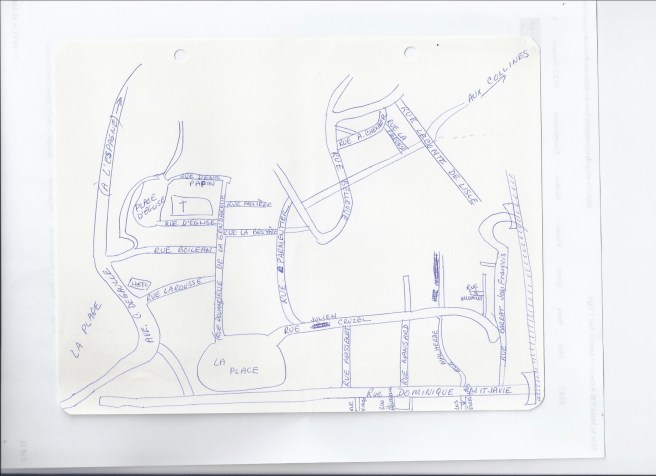
I discovered calamar for the first time, finding it later at the poissonerie on the hill above the hotel, and I came to appreciate the simple meal of cheese omelet, green salad, and a glass of wine. The next day I began to make my map of Cerbere. As I walked around the village and tried to visit all the little winding streets, I drew my map.
My favorite spot was up on the hill above the village. There were about four cement steps set into the hill, with a drawing of a reclining woman and a date from the early 1940s set into one of the steps. I climbed these steps and up the hill to sit in solitude, looking down over the village and out to sea, and wondered about the woman in the steps. It was peaceful at my spot on the hill, and I often found myself there, reading or writing in my journal while the village had its siesta. And it was invigorating in the wind, although at times it was strong enough to almost blow me off the hill.
After several hours of walking around that first day, I returned to the hotel where I found the patron having a cup of tea. I asked him if I might also have a cup of tea and he explained to me that the café was actually not open during siesta, but he reluctantly brought me a cup anyway and I sat down to chat with him. “Why do you come to Cerbere at this time of year? What are you doing here? “ he asked me. I guess I was a strange duck to him, coming to this little village all the way from the US, just to walk all day and to be alone for a week. And so I told him the story of my very first almost-visit to Cerbere eight years ago and how I had promised myself that I would return as soon as I was free to do so. He wanted to know about my job at the university and I wanted to know about the tourist season on the French coast. We discussed marriage and the role of the French woman of today. Then I told him about visiting the church and how delighted I was to find a statue of Jeanne d’Arc in their village church. “You know,” he said,” the French only go to church four times in their lifetimes: to be baptized, to be confirmed, to be married, and to be buried!” We sipped our tea and lemon water, discussing life in general and thus began what was to be a long and warm friendship of more than 35 years.
My colleague arrived the next day on an early train. I had two hours to show her around my beloved village before putting her on another train on to Barcelona to join her mother.
That afternoon I finished my map of the village and then took all my courage in my hands and approached the patron with a very important question.
“Please, monsieur, would it be possible for me to sit in the kitchen and watch the chef work?” His eyes opened and he tried to keep from laughing. “You want to watch the chef in the kitchen?!” “Yes,” I replied. “Please?” In the corner of the dining room I could see the patron’s elderly mother, sitting in her usual seat, mending the sheets. Her ears perked up and she quickly came over to see what the fuss was all about. “She wants to watch the chef in the kitchen!” he explained to his mother. Turning to me, his mother asked, “Are you interesting in the cooking?” What could I say but “YES!” “Well,” the patron answered at last, “then you will have to ask my chef!” And so I very carefully approached the chef at the door of his kitchen and asked if I could sit and watch him work tomorrow. He looked at me sternly and said, “You must be very quiet and watch only!” “Oh, yes!” I replied. “I will be as quiet as a mouse!”
I was so excited as I sat down to dinner that night. Two Americans came into the hotel looking for a place to stay between trains and I talked them into staying at the hotel, telling them how wonderful a place it was. Then I assisted a young British boy order his dinner. I felt I could do anything!
The following day was the best day of my life thus far, and I will always be grateful to that young chef who allowed me to enter his kingdom for a day. Immediately after breakfast, I took a chair into the kitchen and sat along the wall, out of the way, and I watched everything until noon, when it was time for lunch. I was back in my chair by 12:30 and stayed until 2 p.m. Then siesta until 5 p.m. and back to the kitchen until 9 p.m. I watched the chef make fish dishes, the coating for pork, pastry, soupe de poissons, and many other dishes I no longer remember. He gave me a very large and heavy cookbook to look at (I have since purchased both the French and the English edition of “L’Art Culinaire Francais”). After a while, he became a bit curious, I guess, because he asked me about food in the US and in Sweden. And then he began to explain all sorts of things to me. His sous-chef showed me how to make vinaigrette, and the chef showed me how to make several different kinds of omelets. It was really wonderful.
The following day was my last day in Cerbere. My colleague and her mother arrived from Barcelona in time for lunch at the hotel. I had the dorade au l’aioli, made especially beautiful for me by the chef. In the afternoon, there was a wedding at the mairie.
I followed the procession to the church for the religious ceremony. The church was packed and I stood in the back with many others. When the collection bag came past me, I added some money and heard a gasp from my neighbors in the back of the church. Had I given too much? I suppose I had as they were smiling kindly at me. But I didn’t care because I had fallen in love with their village and all was right with the world.
Back at the hotel, I paid my bill and gave extra tips to the servers, then said a sad farewell to the chef, promising to send recipes from the US. A final farewell to the patron’s mother in the annex followed, then the last few minutes waiting outside the restaurant for the taxi that would take us to the station. The patron gave us a bottle of wine for the train, and, as we pulled away, he stood at the window with the other men at the bar and waved to us. It was very difficult to leave this village that I had grown to love so much.
Over the years, I have visited Cerbere many times, accompanying the patron and his friends to their secret mushroom spots on the mountains for a day of hunting the elusive cepes, spending an afternoon with the patron’s son at his grand piano as we shared our love of music, and many years later taking my husband to Cerbere for a week ,as we searched for an apartment to purchase in the Roussillon. We didn’t end up buying property in Cerbere, but in the neighboring village of Banyuls sur Mer, and therein lies another tale!
I have rejoiced over the years of looking in guidebooks and finding very little mention of Cerbere, as it was a secret place I cherished and which I did not want to be spoiled. But times change and roads change, so perhaps it’s time for Cerbere to come out of the shadows and become someone else’s best-kept secret! The hotel is still there and now run by the third generation of the family. The chef trained his brother to succeed him, then went off to work in the kitchens of Air France. So I still have my good friends to look after me when I appear on their doorstep, and I know that in Cerbere I will always find my solace in the winding streets and steep hillside, the blue of the sea, and the white buildings in the afternoon sun.
November 23, 2015

