By the time our daughter turned 12, we had decided that it was time to purchase a larger apartment, so she could move out of the living room and into a bedroom of her own. We wanted to stay in the same residence, although the local realtor tried to get us to purchase a new two-story condo at the edge of town. In time this new complex would become known as the Danish Ghetto, as that is where most of the Danes settled when they came to our area of France. Now it is a mixture of Brits and French and other nationalities. They are very nice apartments, but we knew that as we grew older, we would not be able to climb the steps from the garage to the kitchen with bags of groceries, nor be able to navigate the staircase for the middle of the night bathroom visits. So we were determined to stay in our building.
The only two-bedroom apartments were on the corner of the building, with a picture window overlooking the sea, like our current balcony, and a long balcony overlooking the boat harbor and aquarium. So at the annual property owners’ meeting I timidly stood up and announced that we were looking for a 2-bedroom apartment and asked the four owners of these apartments to contact me. As I left the meeting, an elderly woman approached me and said that they had decided to sell their apartment as her husband could no longer manage to come down for vacations. This was a Godsend! We once again went through all the legal machinations, this time with the help of my best friend. To sign the sous-signe prive, we met the couple in their home in Perpignan, discussed the price (no negotiation), then signed the papers. As soon as all was accomplished, Madame walked into her kitchen and returned with a tray holding a bottle of champagne and five glasses. This sealed the bargain!
When all the final papers were signed at the notaire’s office, we picked up the previous owners and took them to the apartment so that they could explain some things to us. Among other information was the announcement that they would leave us the twin beds, a double bed, lots of dishes and pans and glasses, two living room chairs, two wicker chairs and a heavy balcony table. Eventually we would give the beds to our friend who was starting up a B&B, but we are still using the chairs and table and kitchenware. It took another year to sell the small apartment, but in the meanwhile, we used it for guests, putting mattresses on the floor.
So now I had a larger kitchen and it had a window over the sink with a view of the sea!

Of course it had only 3 cabinets, so a trip back up to Ikea was put quickly on the agenda. By adding four base cabinets with a wooden countertop and four wall cabinets along one side and adding two wall cabinets and a set of drawers along the other wall, I felt a little better about this new kitchen. Over the years, we have replaced the electric oven and the clothes washer. Next on the schedule is to replace the window so it opens in two directions and the gas cooktop, so that all burners actually work for me!
Once again, the little fridge was located under the oven. No room for a tall fridge, so that went into the hallway. Then we had to have four outlets installed, as there were NO outlets except one at the door into the kitchen. We Americans do love our electric gadgets! And that meant the electric company had to come and increase our power again. Once again my husband told the electrician that it was an “American kitchen,” and the response was rapid: increase the power!
There are always ingredients that are not available in one country or the other, and that is where we try to “fill the gaps.”
Over the years, we have made our own relish, as that is still not available in France, using my mother’s recipe for green tomato relish.
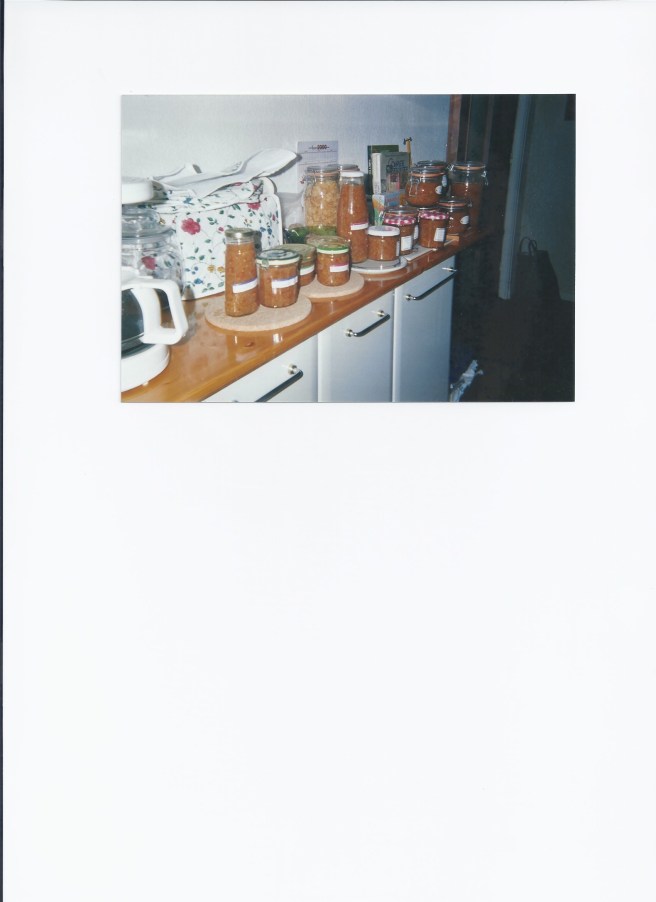
We would each take turns grinding the tomatoes and onions, cranking the handle of the meat grinder that I screwed onto the table in the living room. We found that we have to go into Spain to find green tomatoes in the markets. I remembered to do this when, several years ago, I began to share southern cuisine by making fried green tomatoes for my friends in France.
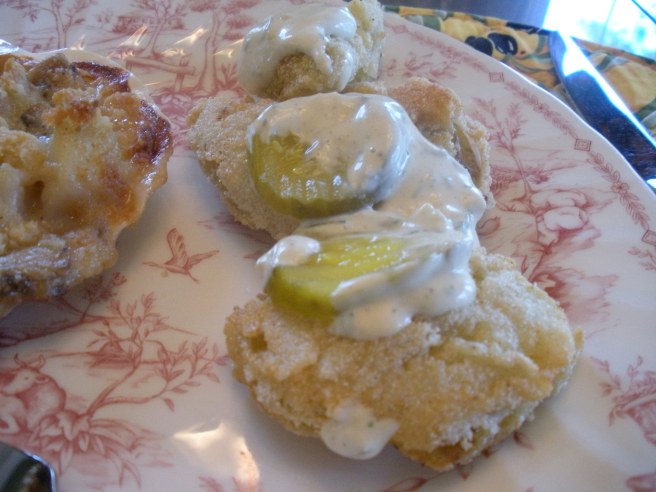
The only time I was able to purchase green tomatoes in France was when I did so directly from the uncle of a friend who had a garden and agreed to sell me some green tomatoes from his vines.
I have also made quite a few jars of bread and butter pickles and dill pickles, as the only pickles available in France are the tiny cornichons, traditionally served with pate. I like real dill pickles with my wienerschnitzel!
One year my French friend gave me a huge bag of kumquats! I had to research that fruit quickly and made a kumquat compote, then kumquat and orange marmalade. Kumquats are not a fruit I find often in my American supermarkets!
Making French recipes in the US and making American recipes in France often present challenges, which I relish! Last year I wanted to make sorrel sauce when I was in the US. The only sorrel I found was at Fresh Market in a tiny “herb-sized” packet, at quite a high price. I needed a pound! I’ll wait until I’m back in France to make that recipe.
Looking for peanut butter in France for our young toddler, was impossible, so we ended up importing a fresh jar each year. Now they have a sort of peanut butter that tastes quite awful, so Jif is still on the packing list. Decent cinnamon was also difficult to find when we first arrived in France, as was vanilla extract, so they have remained on the packing list. I thought a few years ago that France had finally discovered shortening, as a product called “Vegeline“ appeared in the supermarches. Sadly, it’s just solid oil for frying purposes and doesn’t replace my Crisco.
When we return to the US, we miss the fresh sardines and the fresh white anchovies from Collioure. If you’ve never tasted a white anchovy, then you really do not know what anchovies taste like. We miss the thon catalan, but I’ve made my own from fresh tuna steaks.
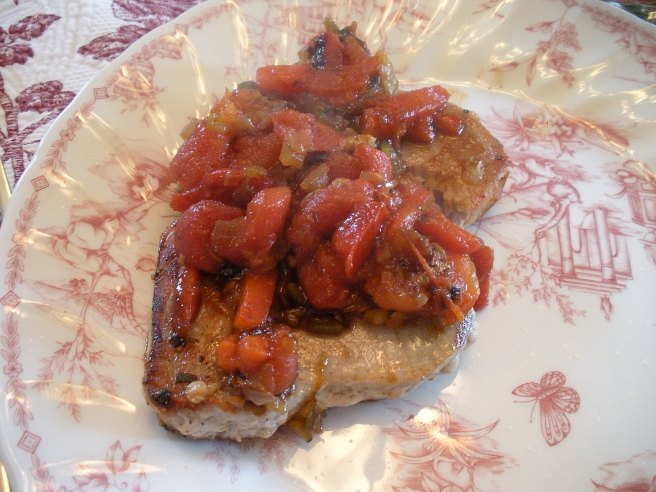
We miss the numerous pates and cheeses; we miss the veal and Catalan chicken on Sundays. But mostly, we miss the fresh fish. And when we are in France, we miss the good beef and wonderful lobster that we have in the US. In France we use crème fraiche and I make my own sour cream. In the US we use sour cream and I make my own crème faiche.
Shopping for meals on a daily basis has long been part of the French culture, so those tiny refrigerators that are so common in French kitchens are just the right size. I learned early on that, as an American, I would need a much larger fridge! But then, of course, it did not fit into the tiny kitchen, so it stood in the living room.
When in France, we have learned to shop by the season. In the US, we are used to obtaining produce year-round, but in the villages of France, this is not the case. Fresh cherries come from Ceret in the spring. Strawberries appear in June, with peaches and apricots throughout the summer. I quickly learned not to ask for walnuts or hazelnuts in the summer—nuts come in the Fall. So if I want to make something with walnuts when I am there in the summer, I must remember to bring them from the US. Lately that has meant taking along pecans, so I can make Southern pecan pie for our French friends. Pecans have just begun to appear in the French markets in recent years, but only in the Fall. Pears and packages of fresh foie gras appear in the Fall. And, of course, Roquefort cheese is best in October with a glass of sauterne.
In the Fall, we also see piles of dried cod in the markets.
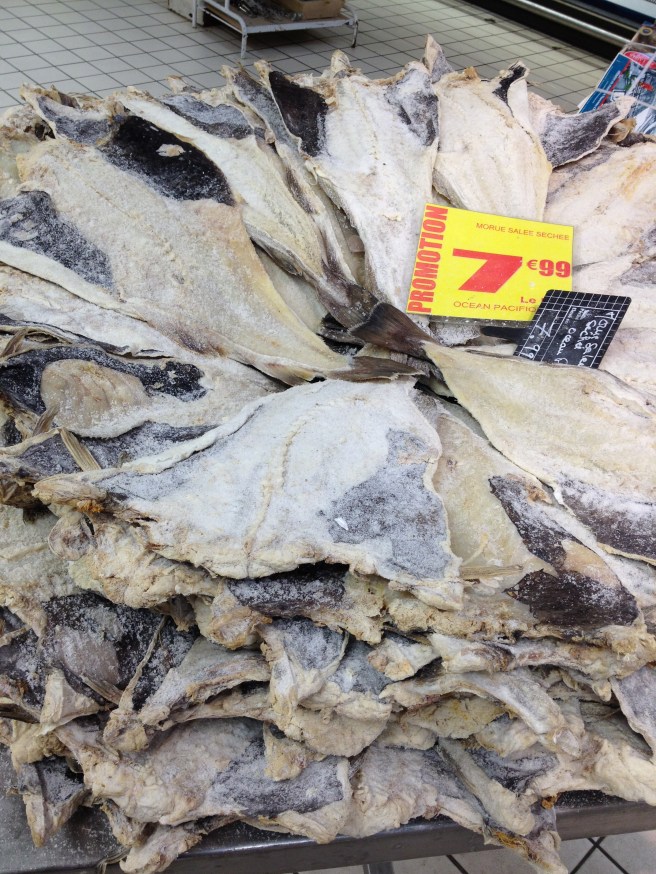
I have made morue several times. The trick is to soak the fish at least 3 or 4 days and change the soaking water several times each day. I don’t think I will ever get to the point of making Swedish lutfisk, but I don’t mind the French recipes for morue!
Every day in France, we purchase the local paper for our daily French lesson, and every day there is a new recipe on the back page. From time to time there is something interesting to try and then the fun begins translating not only the ingredients but also the directions. The Sunday paper also includes a magazine and TV guide, both with additional recipes. One recipe for scallops required that I “snacker” the scallops. Well, what the heck is THAT? I asked both of my friends, and they put their heads together and puzzled over this obviously English word turned into a French word. I was confident that the author did not want me to take tiny bites out of the raw scallops before sautéing them! We finally decided that they simply meant that the scallops were to be sautéed very quickly “hwtt, hwtt,” as my friend says while turning her hand over quickly.
When our British friends visited for a meal a few years ago, I made a new recipe that I seem to remember was presented in a stack, with magret de canard (duck breast) and foie gras. While I was cooking the foie gras, I remember thinking that it didn’t seem the right consistency, but it wasn’t until I took my first bite at the table that I realized I had purchased magret de foie gras, not foie gras de canard. It was a duck breast from a duck raised for its foie gras, but it was not the foie gras! So I ended up with duck breast topped with duck breast! We learn from our mistakes!
Another foie (liver) that I had for the first time two years ago, was foie de lotte (monkfish liver). This was served at a wonderful seafood restaurant 7ieme Vague on the outskirts of Perpignan. It was served as an entrée and was delicious.
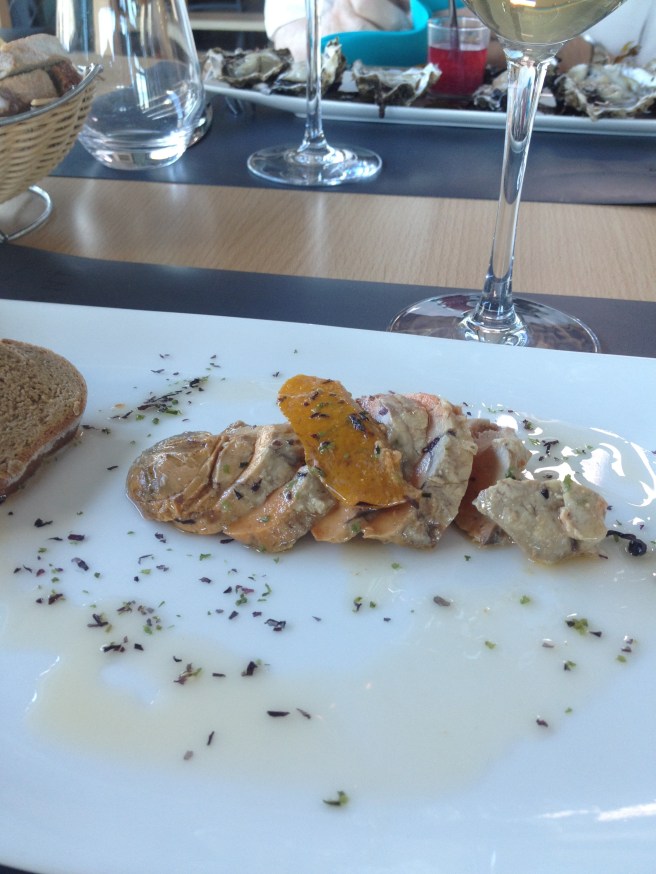
It has now been added to my list of things I would like to learn how to prepare. When I ordered monkfish in my local US supermarket this past year, the clerk looked at me like I was nuts when I asked if it would come with the liver. Guess I will have to wait until we are back in France to explore this recipe.
Last week I received the Valentine Menu from our favorite chef at L’Auberge du Cellier in Montner. Since we cannot be there to eat the meal prepared by Pierre-Louis Morin, I decided to try to make it here in the US, just for the two of us. The ingredients include Thai bouillon, coriander, eggs, mussels, saffron, monkfish, fresh pasta, thyme, parmesan, pigeon, spice bread, fresh foie gras, Jerusalem artichokes, macarroons, and raspberries. I decided I could find something close to the Thai bouillon; there are several oriental restaurants near us and surely one of them would have something similar, so that’s one thing I wouldn’t even have to prepare. Monkfish would be a problem; I ordered some last summer from Publix and it cost “an arm and a leg,” but we ate the last pound two weeks ago, so I decided to substitute lobster (a backwards substitution!). Pigeon….hmm…I thought a substitution of quail, which is very prevalent in this area, would be a good choice. I know the area restaurants serve fresh foie gras from Hudson Valley, but was not sure if I could purchase a small piece in a supermarket. And Jerusalem artichokes are probably unheard of in this area. But, joy of joy, I know I saw French macarons at Sam’s Club! But the puzzling part was that the eggs are served “embeurre de chou.” According to my French friend, embeurre de chou is simply cabbage that is parboiled, then chiffonnee (sliced in shreds with a knife) and quickly sautéed in butter. Then do I put the egg on top, or will I do something different, like bake the egg in a puff pastry shell? Decisions, decisions, decisions! Then there were to be mussels on the same plate! I know Pierre-Louis will be very innovative in designing the plate to look fabulous, but could I come up with something equally exciting?
A search through our supermarkets turned up very small and mushy Jerusalem artichokes (called “sunchokes” in this area) in one store, so they stayed in the store. Sam’s Club no longer had macarons; apparently they are a “seasonal item.” No foie gras available at any store and the Publix was even out of quail. So here’s the menu I ended up with:
St. Valentin, 14 Fevrier 2015 (chez nous)
Pate Feuillete a la tapenade
…………………
Bouillon Thai aux shiitakes et coriander fraiche
……………………
Un oeuf au four dans un vol au vent sur
un lit de l’embeuree de chou et les moules saffranees
……………………
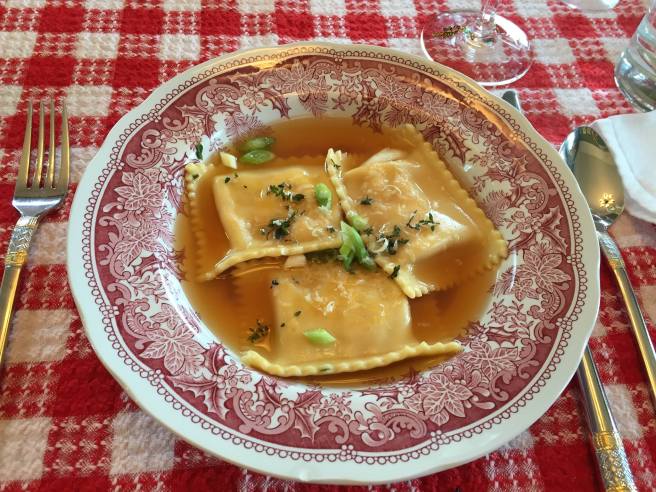
L’homard et crevettes en raviole, jus de cuisson au thym et au parmesan
…………………..
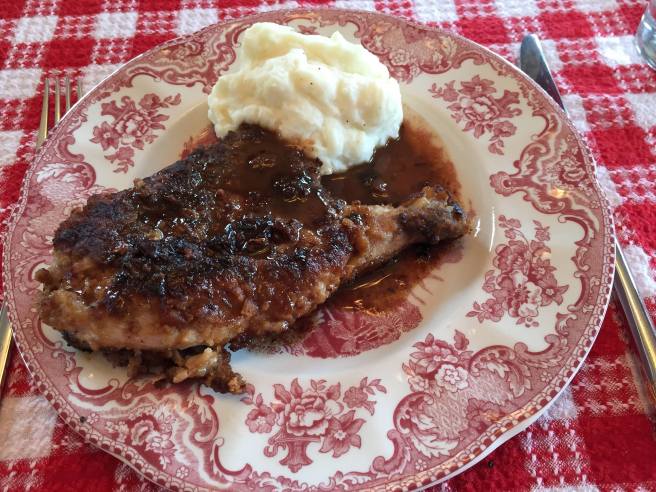
Pintadeau saupoudre de Speculoos, puree de pommes de terre
…………………..
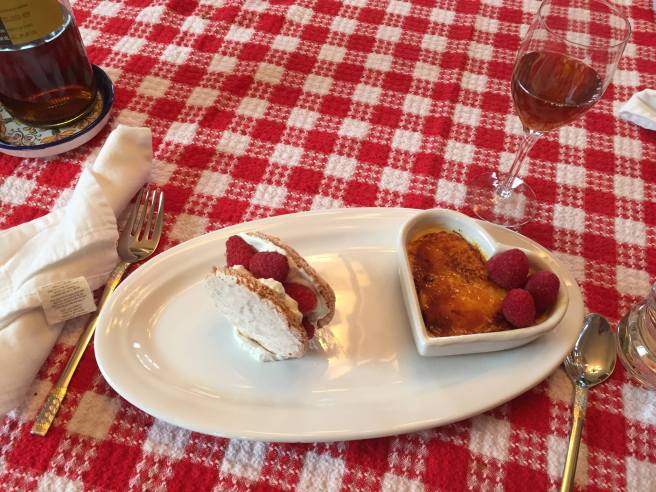
Crème Catalane aux framboises et Macarons aux framboises et Chantilly
Using Pepperidge Farm puff pastry sheets, I cut strips and covered one side with homemade tapenade. This is a common appetizer at L’Auberge du Cellier. Since I didn’t find a jar of tapenade in my local supermarket, I made my own, using a David Lebovitz recipe. The result was delicious, but I think next time I will not triple the thickness of the dough.

The bouillon was an instant Thai soup, “Tom Yum,” from which I removed the noodles and the tofu before mixing it; it was quite spicy, but easy to make.

The raviolis were frozen and I boiled them in seafood broth, adding fresh thyme, scallions, and grated parmesan at the end.
The two original courses were created after much thought and consideration. Although it was Pierre-Louis who created the combination of flavors for the egg course, I was in a complete puzzlement as to how he planned to accomplish this. All I knew for sure was that there would be an egg, some mussels, and embeuree de chou. So after much thought, I decided to bake the egg in puff pastry. I baked the puff pastry shells for about 15 minutes, until almost completely cooked, then removed the center “lid” and carefully poured an egg into each pastry shell. They were then returned to the oven and baked for about 10 minutes, melted butter added, and baked for another 5 minutes. I then added ground pink pepper on top. L’embeuree de chou is simply parboiled cabbage leaves which are then thinly sliced and sautéed in butter. Then I used my usual recipe for the mussels in saffron sauce and added some chopped red bell peppers for color.

Morin’s next course combined pidgeon and spice cake, foie gras and sunchoke puree. I had to forgo the foie gras and sunchokes, as they were unavailable. So then I decided to use ground-up ginger cookies with a small Cornish hen. I combined a recipe of Jacques Pepin, my fried chicken recipe, and Pierre-Louis’ idea of using spice cake with his pidgeon. After dredging each half hen in flour, egg and ground pepparkakor (ginger cookies), I fried the inside of each hen in butter, then turned them over and added a heavy iron skillet to weigh the hen down. Pepin uses foiled-wrapped bricks as weights, but I opted for my iron skillet and a hamburger press for good measure. The meat cooked in about 30 minutes and was tender and delicious. Adding a wine sauce made from the drippings was simple.
For dessert, I ended up trying to make my own macarons, and that was a bit of a disaster. But they were tasty anyway. The idea for the “macaron sandwiches” is from Pierre-Louis’ original Valentine menu. They are stuffed with whipped cream and fresh raspberries and very delicious. Crème Catalan is always a treat to make and common in our area of France, so I added that second dessert.
And so we learn to combine and adapt and use the ingredients available wherever we are residing. We learn new recipes from our friends and the chefs around us. We pick up ideas in magazines and newspapers and just sitting down with a new cookbook on our laps. I am always ecstatic when my daughter calls to say she has tried a new recipe. She is exploring the art of food science in her kitchen much earlier in life than I ever did. My mother taught me how to make mashed potatoes, meatloaf and jello. My father taught me how to make Swedish gravy and bif a la Lindstrom. The rest I have had to learn on my own, and I will never stop learning!
 2 Country Kitchen
I love reading your entries! Thanks for sharing! I was wondering how you did the eggs in puff pastry. That looks delicious and I think I will try that at some point! Love, Helen Martin
LikeLike
Thank you, Helen. I means a lot to me that you are enjoying my stories! You can find the very simple recipe for my “Baked eggs in puff pastry” on the blog site. All you need to make them is a puff pastry shell (Pepperidge Farm), some melted butter and an egg. I followed my “Women’s Encyclopedia” cookbook recipe for baked eggs, but used the puff pastry instead of a dish! Simple! I think you’re grand-nieces and nephews will enjoy making it. Basically you want the white of the egg to set, but to keep the yellow partially runny. It’s the result the French look for in a soft-boiled egg.
LikeLike
After I saw your menu yesterday, I went online looking for ways to do it. Thanks for the advice that you gave today and just now. These days, the little ones live about 2 hours away and so I do not get to bake with them as much as I would like. We shall see. I think that they have requested pizza on the next visit – but they may want to go back to the cookies!
LikeLike
OMG YOU’VE BEEN BUSY!! D
LikeLike
very exciting post! loved the adventure d
LikeLike