The other day, I made poulet aux pruneaux (chicken with prunes), a Catalan recipe. I know it is Catalan because it includes ham! Travel anywhere just over the border in Spain, and you will smell the pig farms. Pork and ham are favorite meats of the Catalans, and so you will find chopped ham included in many of their recipes. After Christmas, I freeze pint-sized zip-loc bags of ham slices from the Christmas ham, so I always have some on hand to throw into the skillet, as needed. At stores in Spain, we see large hams (smoked and dried) hanging on strings, waiting for customers. They even sell canvas cases for them; they look like covers for tennis rackets!
Several years ago, my best friend turned her creative talents from watercolors to writing and wrote a book about the artichoke, including recipes from grande toque chefs in the area. Villelongue de la Salanque is a village just north of Perpignan and is well-known for its artichokes, much as Castroville, California, is in the US. This is when I learned about violets, the young artichokes that are eaten whole.
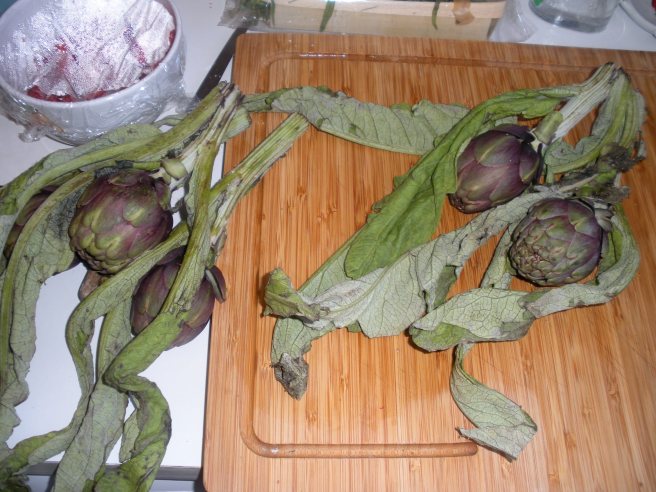
When an American friend visited us a few years ago, I showed her how to prepare these delicacies for artichoke risotto. The process is rather labor intensive, but I think they are well worth the effort.

They can also be prepared with other vegetables for Pierre-Louis Marin’s Legumes a la Grecque.

The main problem I face when returning to our small town in the US south, is finding really fresh fish. We have a fishmonger who is open only four days a week, but brings fish from the markets on the coast, so his fish are fresher than can be found in the grocery stores. One year I decided to make soupe de poissons (fish soup), so got my best friend’s recipe from her, and off I went to find fish heads. All the grocery stores had were filets. How do you know a fish is fresh if you cannot look it in the eye? I once asked the clerk at a fish counter how fresh the filets were that she was selling. She went to her card file and said “They came in on Thursday.” This was the following Tuesday! What happened to the expression: ”Guests, like fish, smell after 3 days”?
I had to ask the fishmonger to bring me some fish heads from the coast, as he only brought filets with him to sell. So he brought me two salmon heads and a few mullet heads. The salmon heads were too big to grind up in the food mill, but the resulting soup was delicious.
To understand the problem of getting fresh fish in our small US town, here is the experience I had a year ago. I had been on the look-out for mackerel to make some of my favorite Banyuls recipes here in the US. Our local fish monger had told me that the mackerel would be coming in around mid-March, but when I was there in March, he didn’t have any mackerel yet.
Meanwhile, I was in Krogers supermarket one morning and glanced at the fish counter—always full of nameless filets on display. BUT that morning I saw–lo and behold!– three kinds of WHOLE fish! That’s right—with heads and tails! And one sort was mackerel. I was so excited! So I picked out just one, as they were really LONG and when I asked the young man if it was cleaned, he said, “Oh, I’m sure it is; they always come in cleaned.” Then he kept feeling its belly and discovered that it was NOT cleaned, so of course I asked him to clean it (a mistake). It took FOREVER for him to clean that one skinny fish! He said at one point, “Wow, this is really hard!” Finally I said “Oh, it’s okay; I’ll clean it out again when I get home.” When he brought it to me on a styrofoam tray (with head and tail flopping over the ends), he said it was the first time he’d ever cleaned a fish. “I used to go fishin’ with my dad, but he always cleaned the fish.” I said I figured that was the case. When he asked why, I said because it took so long! Then he decided to transfer the fish to a humongous ziploc (2 gallon, at least) bag because that little styrofoam tray just wasn’t cutting it! THEN he took $1 off the price because I’d had to wait so long for him to clean the fish.
I asked him what the other whole fish were—looked like a pageot, but pink with yellow stripes. He didn’t know. He asked a colleague who said he thought they were snapper, but he didn’t really know. The only other whole fish was a huge red snapper that was more a decoration than food. Is it any wonder that we head for the Poissonnerie for fresh fish as soon as we arrive in Banyuls?!

After having mackerel steamed with vegetables in foil packets one day, we often have leftover fish, which I then prepare cold with curry served on a bed of sautéed leeks and zucchini the next day. This latter is a recipe I copied from the restaurant at Clos de Paullilles.

Of course, in France I can get lovely fresh sardines every day, and enjoy trying different recipes with them. They are nothing like the canned sardines I grew up with in the US!

I set myself two recipes to master this year. One was joues de porc a la sauce de Banyuls (pork cheeks in Banyuls sauce), such as I first had at La Pardalere. The second was foie de lotte (monkfish liver), such I first had a 7ieme Vague, in the suburbs of Perpignan. I will have to tackle the latter in France, as there is no way I will ever get a monkfish liver where I live in the US. We do find pork cheeks (jowls, they are called) here in the South, so this month I will do my first trial.
Last week I tried a new recipe from our local Roussillon newspaper, L’independent, which daily has a recipe for its readers to try. I often clip them and bring them back to the US to try, if they include ingredients that are readily available here. Today was Tagliatelle a la ratatouille. Luckily I still had some ground veal left from another dish I’d made recently.
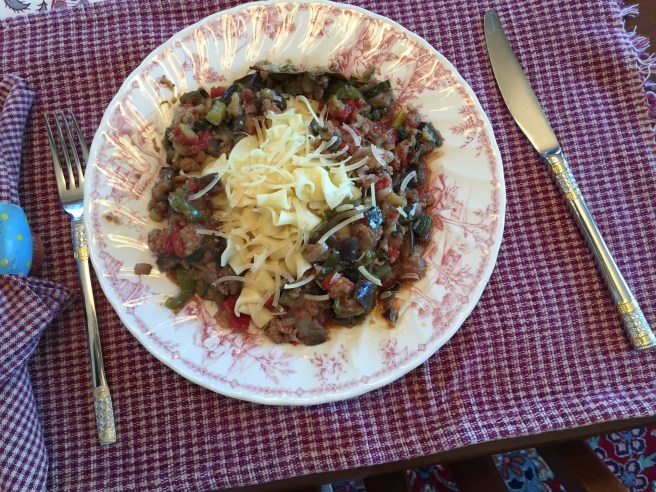
Reading through the recipe reminded me that emince does not mean “to mince.” It means “to thinly slice.” It’s one of those French words, which my colleague calls “false friends,” when teaching her French classes. They look like an English word, so we assume that is their meaning. My very young French teacher in high school told us a story about one of her faut pas when visiting France. She’d been out with a group of young French people and had enjoyed herself very much. She wanted to tell the guy she was with that she envied him, living in France. So she used the verb envier. When she said to him, “je vous envie,” she thought she was saying, “I envy you.” She didn’t realize she was actually saying, “I desire you.” A false friend, indeed! As a teen, I often wondered how she got out of that situation.
We have had many fabulous and interesting meals over the years. I always get ideas from the restaurants, other chefs, and my friends. The three of us (my best friend, my French friend and I), with our husbands, often get together for meals, and, I must admit, often vie with each other for the most interesting dishes to present. I have served French friends elaborate salad bars, where they had quite a lot of difficulty piling various ingredients onto their plates, as one does in an American salad bar. The French like their salad foods separated. I have introduced them to barbequed ribs, cole slaw and fried green tomatoes with remoulade sauce.
And I have reproduced our Swedish Christmas smorgasbord and English Christmas dinner, and 4th of July picnics. Then I return to the US and invite friends in for a Catalan dinner or Spanish tapas. Our daughter’s favorite, escalivada, is always on the menu. This is a combination of roasted vegetables, served cold with a vinaigrette—all ingredients are easy to find in the US.
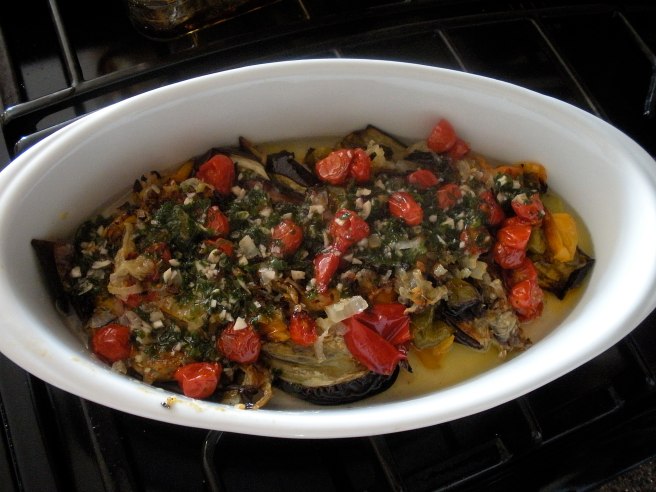
The trick to making meals outside of the regional cuisine where I happen to be is to find the proper ingredients on either side of the pond!
Our friends in France have made frog legs for us, tuna-avocado salad on a Pringle chip, smoked trout on toasts,

salade aux geziers,

grilled bananas, boar stew, appetizer cake,

and Tupperware tuna mold!

The tuna mold was quite a surprise for me when my French friend served it to us. I found it delicious and asked her what it was. “Oh!” she said. “It is a recipe from Tooperwar!” What? “You know. The plastique mold? Tooperwar.” Ohhhh….Tupperware! Yes, it’s in France, too! I was happy to add the Tupperware recipe, coming to me via France, to my repertoire.
My French friend said one day, “Come for luncheon this week. It’ll just be a simple meal, nothing fancy.” After years of her wonderful meals, we have become skeptical when she says the meal will be “simple.” This was a meal for the six of us, so we knew it would be anything but simple!
We started with champagne and with this were Pringle chips topped with tuna and avocado salad. She had served us this appetizer several times before and have never seen this idea anywhere else. What an interesting way to use Pringles! Another easy appetizer she uses is pinwheels of puff pastry filled with tapenade.
Verrines have become very popular in France in recent years. They even sell the tiny glasses or dishes that are used for these mise en bouches in plastic! They are lovely little bites of fish and vegetables or anything that looks lovely layered, as you want to see the layers through the sides of the glass. They are also used as desserts with layers of fruit and custard and crumble. This particular day, my friend served us verrines of salmon mousse, pureed watercress and toasted squash seeds.

then shredded celery root and apple topped with smoked salmon,

then grilled gambas, calamar and monkfish
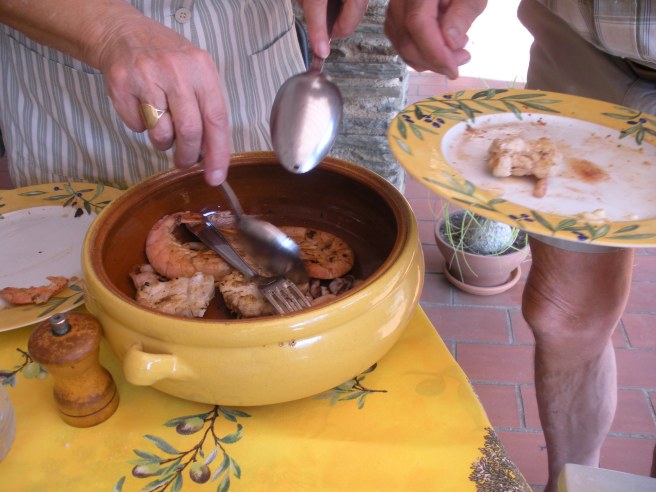
with grilled vegetables,
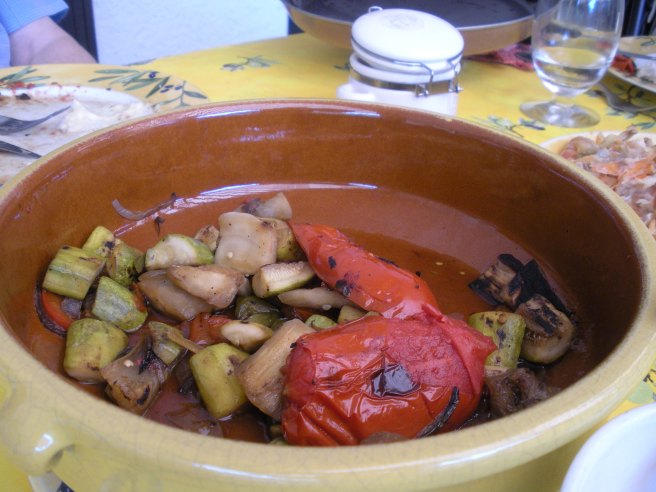
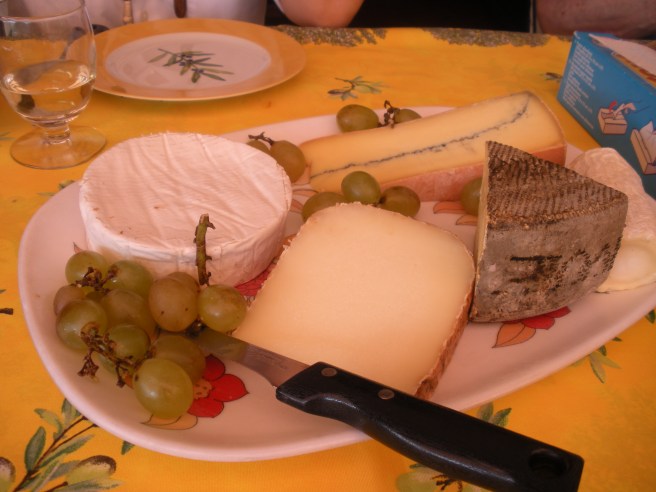
then cheeses,
then tarte aux pommes,

then coffee and pots de creme!
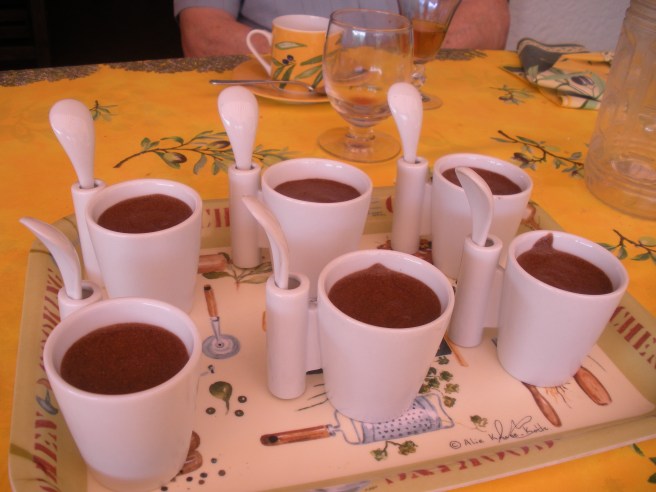
This is considered a simple luncheon! We also had a fabulous meal at her house one January, when she served us anchovies and butter on bread, foie gras and magret de canard (sliced duck breast) on a leaf of endive, pheasant in cream and cider sauce with fried apples and rice, then cheese, then cherry tart. Another day her meal for us included a salad with dried maigret de canard (duck breast), which she prepared herself. She buries the duck breast in coarse salt for 24 hours, then peppers it and puts it in the fridge for 20 days! These meals last about six hours from champagne to coffee. Nothing is really simple at a French home.
My best friend, who is native French, but grew up in the US, rivals these meals with those she creates for us, adding her own artistic touches. One we particularly remember started with rillettes on bread and lady bug creations made of tapenade and tomatoes! Then seafood salad stuffed into lemons with long spears of olives and grape tomatoes stuck into them. Then potatoes and frog legs, followed by fresh fruit and whipped cream. She is always introducing us to something new!
Another year she served us three different canapés, which included ham and cheese, heart-shaped bread topped with omelet and anchovy and bread topped with herring. Next course was tarte aux feves with salad. Then cold salmon stuffed with spinach and carrots, rocket and three sauces: béarnaise, tartar and aoli. Then blueberry crumble.
Feves are a lima bean-like vegetable that are quite delicious. However, you must plan well ahead of time when cooking them. First you take them out of their pods, like shelling peas. Then you parboil them to loosen their skins. Then you slip them out of their skins. You may start with two pounds of feves from the market but will end up with half of cup of beans! They are very labor-intensive to prepare. After having prepared them myself several times, I am always very appreciative of receiving them in a restaurant or at a friend’s home!
When the six of us got together at my best friend’s home in Pia several years ago, she served us a variety of appetizers: caperberries, garlic cloves, pain au tomates, bread sticks, and egg-salmon-caper canapés. Then we had vichyssoise, then grape-stuffed quail with vegetable omelet on lettuce. Then cheese, then grilled bananas and grilled pineapple with strawberries. This was another six-hour luncheon!
In return, I have served our friends many interesting meals. The menu for our British friends one year began with seven different appetizers with Perelada (a cava, bubbly Spanish wine) then Collette’s Cucumber Salad (from the Ratatouille cookbook for children), stuffed squid with carrots and potatoes, served with Albarino white wine, then melon au Banyuls and red currants served with white Banyuls wine. We always share our favorite recipes. Last year, I learned a lovely recipe of melon and cucumber salad from them.
When the six of us got together at our apartment one year, I served six different appetizers with Perelada in the living room. Then we sat at the table on the balcony and had our meal: spring roll, fried sardines and vegetable terrine with accompanying sauces,
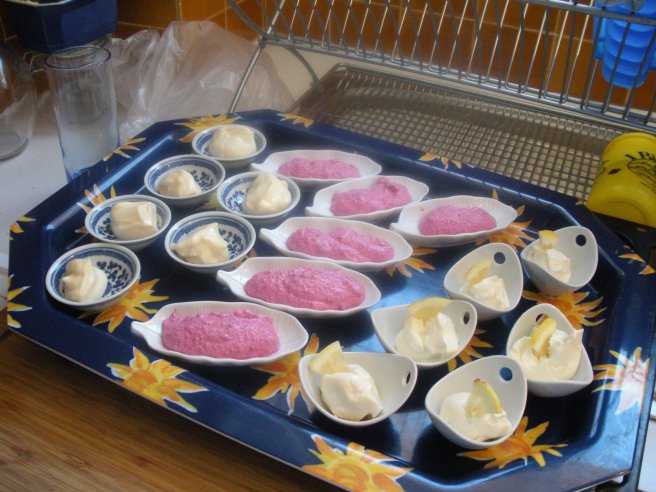
then veal chops and potatoes, then cheese, then panna cotta and kumquat cake with our coffee.
One other year I wove strips of cod and salmon together, then poached them, for our main course.

Another time I fried squash blossoms to put on top of stuffed artichokes for our entrée. Last year I tried a new recipe, which was a seafood lasagna with safran sauce—both elegant and delicious!

One year we took fresh corn, from our local farm in Ohio, in our suitcase. Twenty-four hours later I had it cooking for my best friend who was longing for real corn on the cob. Her Spanish husband would not eat it, but my friend really enjoyed every bite! Then we had veal in tarragon with potatoes and spinach soufflé, then palmiers and Junior Mints (also arriving in the suitcase) with coffee. Yet another day, I made her Manhattan Clam Chowder, chicken with chestnut stuffing, sauced turnips and carrots, then Tarte aux Pommes Alsacienne. I try to remember what foods she might be missing from her childhood in the States, and include them on my menus for her. She teases me because I keep a card file on what I serve to our friends, so that I do not repeat the menu for them. But this is also helpful when it comes to remembering that one friend likes only white wine, someone else likes only red wine, another likes whisky and orange juice, another doesn’t eat chocolate, one can’t eat lettuce or cabbage, and another is left-handed and likes her silverware at her place setting reversed.
It takes a long time to prepare these meals for each other, but we so very much enjoy that time in the kitchen, creating, thinking up new ways to present our chosen courses, that it is always a pleasure. Sometimes it takes me a up to a whole week to find the ingredients, then another day to start the preparation, and then all morning to do the cooking so that we are ready to enjoy our guests by the time they arrive at noon. Yes, it’s a lot of work, but I’m happiest in the kitchen, working with food and creating; I know that the meal will last four to six hours with lots of wonderful conversation and camaraderie, so that all that hard work is worth it!

Restaurants also inspire me to try new recipes in my kitchen. When I eat a particular dish that I think I can duplicate, I can’t wait to get into my kitchen for a bit of creative fun! At Restaurant Le Vauban in Perpignan, I ate a salad with Serrano ham and manchego, which is very simple to make. In the US, I use prosciutto ham. It is, quite simply, greens, dressed with vinaigrette, then topped with sliced ham and thin-sliced manchego cheese. This is then put under the broiler (or in the microwave) for a few seconds to melt the cheese!

And, of course, our favorite meal we always look forward to is the luncheon we traditionally have at our friends’ hotel in Cerbere. Over the years, the mussel dishes have changed a bit, from the time of my chef friend’s Moules Sang et D’Or

(mussels in a saffron sauce with red peppers) to his brother’s moules gratinee et citronee; both recipes are equally fabulous.
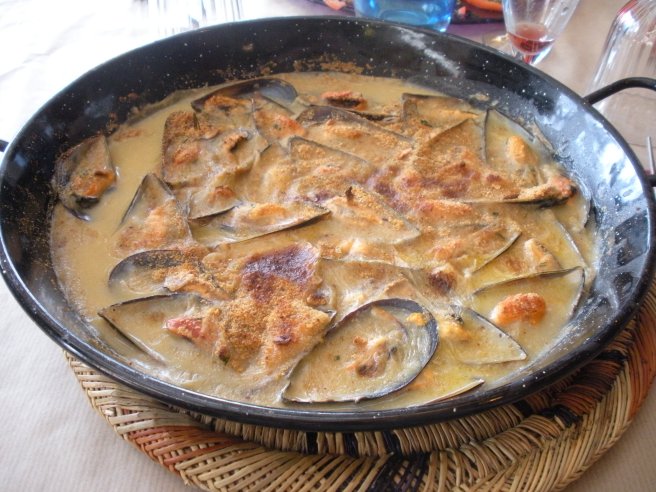
I have spent many years trying to recreate these recipes, which have remained firmly locked in the kitchen of the hotel in Cerbere. Chefs do not readily share their recipes!
For several years, our daughter attended music festivals in France, including a piano camp located in Castelfranc, near Albi. One year, we took my best friend and her husband to attend the students’ final concert, staying in a B&B in Albi to extend our visit over the week-end. The day after her concert, we all went to luncheon at L’Esprit du Vin, a wonderful restaurant in Albi. There we began with kir and appetizers of fried favettes, fried olives with parmesan, and fried cod balls. Mise en bouche was melon soup with fried sage leaf and chevre and flowers. The next course was anchovy wrapped in the shredded-wheat-like dough seen in Greek pastries, after which we were served another mise-en-bouche of shrimp and cod and flowers. Then my husband and I had gambas and langoustine, while our daughter had fried foie gras on melon balls. Entremet was campari and lemonade granite. Then we had fried apricots on pain perdu. Then, of course, coffee and more tiny chocolate desserts—almonds, raisins, orange peel, hazelnut cakes.
For special occasions, we go to Pierre-Louis Marin’s restaurant in Montner, a small hill village west of Perpignan. Our first visit was with my best friend and her husband. We started that meal with a mise en bouche of beet gazpacho served in a leaning shot glass and salmon sushi. The entrée was two soft-boiled eggs with toast points topped with anchovies and red pepper strips. The main course was bourade de morue (cod) on scalloped potatoes and toasts. Then a dessert of touron ice cream and wet rousquilles (traditional Catalan anise-flavored “dry doughnuts”). We ended with coffee and tiny pots de creme with small glasses of Maury wine.
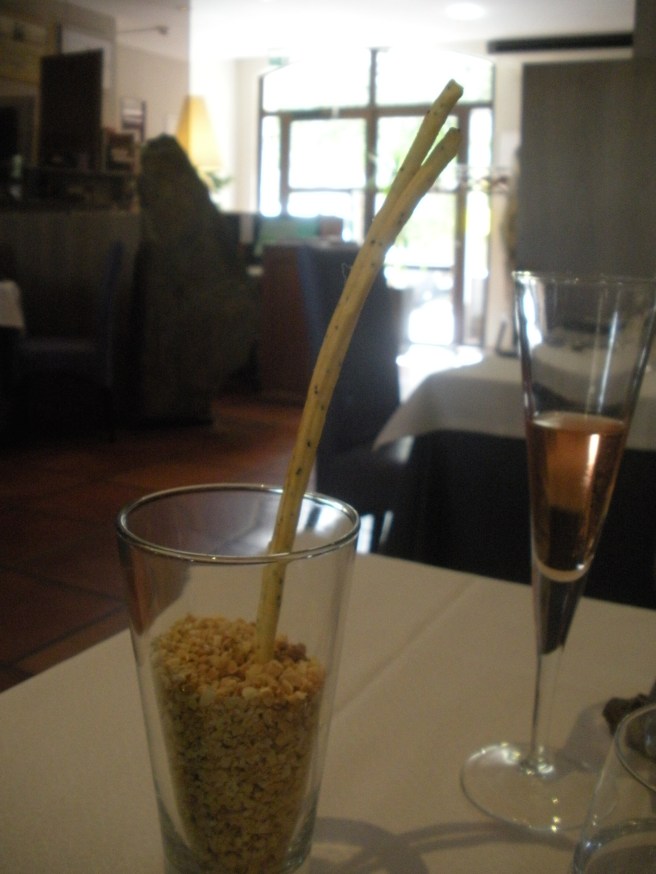
For our anniversary a few years ago, we ordered his Mena i Calla menu, with wine pairings. This is a menu completely at the discretion of the chef, so we did not know exactly what we were going to get for our meal, but we knew it would be absolutely fabulous. We were asked if we were allergic to anything or really could not eat any particular food, and then we were in for a treat! We began with Charpentier pink champagne with very thin bread sticks stuck into a glass of chopped nuts (or bread crumbs?).
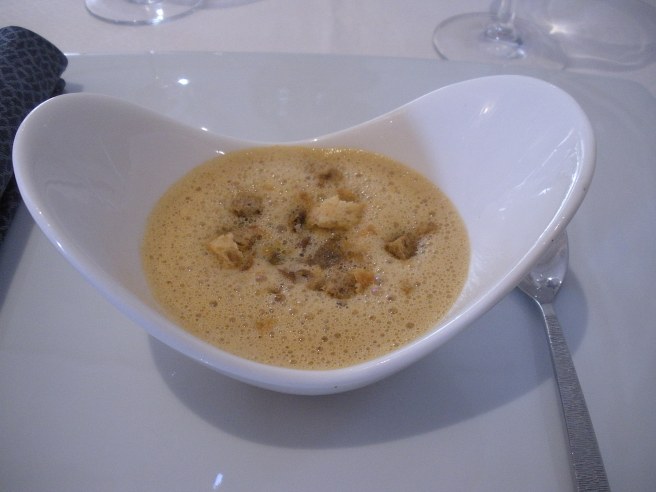
Pierre-Louis brought us the first course of soupe de poissons (fish soup), all frothy and with tiny croutons in it.
The second course was foie gras with caramelized onion and delicious oblong purple radishes served with Domaine Comelade white from Espira de l’Agly.

The third course was a variety of vegetables, including tiny artichokes, carrot and beet shavings, white asparagus, dots of sauces, dill and mint, on a bed of crumble with feta brebis cheese (made locally), served with Mont Noir Rose, Cote de Roussillon.

The fourth course was bonite (a fish) on a bed of Chinese pea pods, white asparagus and onion with a lovely coriander sauce, served with a Domaine Deveza white, Cotes Catalane.

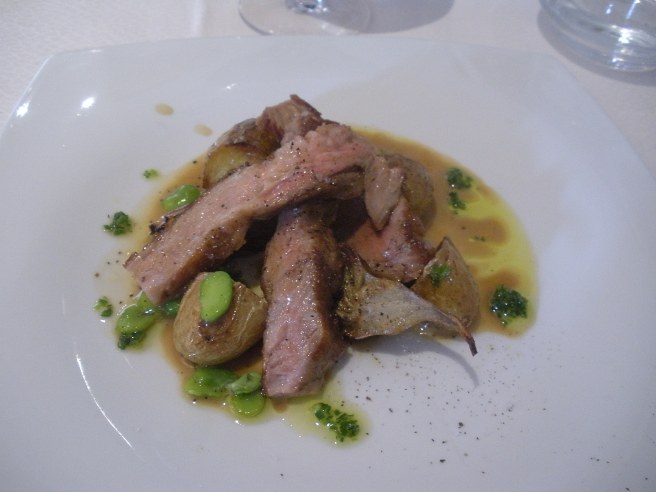
The fifth course was Catalan lamb with feves, artichokes, and new potatoes, served with Mont Noir 2009, Cotes Villages.
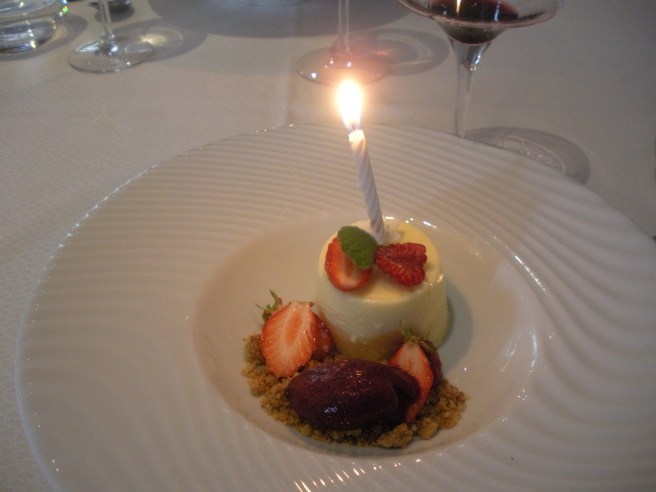
The sixth course was brebis flan, strawberries and sorbet cassis (black currant) on a crumble bed—with a candle lit for our anniversary!—served with Mas Amiel Blanc.
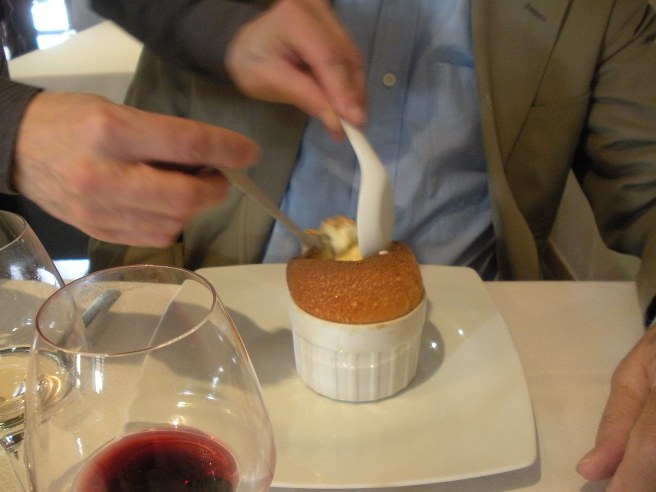
The final course was hot rhubarb souffle, into which our waiter put a small scoop of vanilla ice cream!
This was followed by the inevitable coffee with orange-flavored chocolates. Yes, that’s a luncheon! Perhaps this explains why we have given up eating in the evenings!
Not all the restaurants we have visited in France are this fabulous, but who wants to talk about the ones that are not?
For our anniversary a few years ago, we ordered his Mena i Calla menu, with wine pairings. This is a menu completely at the discretion of the chef, so we did not know exactly what we were going to get for our meal, but we knew it would be absolutely fabulous. We were asked if we were allergic to anything or really could not eat any particular food, and then we were in for a treat! We began with Charpentier pink champagne with very thin bread sticks stuck into a glass of chopped nuts (or bread crumbs?).
Pierre-Louis brought us the first course of soupe de poissons (fish soup), all frothy and with tiny croutons in it.
The second course was foie gras with caramelized onion and delicious oblong purple radishes served with Domaine Comelade white from Espira de l’Agly.
The third course was a variety of vegetables, including tiny artichokes, carrot and beet shavings, white asparagus, dots of sauces, dill and mint, on a bed of crumble with feta brebis cheese (made locally), served with Mont Noir Rose, Cote de Roussillon.
The fourth course was bonite (a fish) on a bed of Chinese pea pods, white asparagus and onion with a lovely coriander sauce, served with a Domaine Deveza white, Cotes Catalane.
The fifth course was Catalan lamb with feves, artichokes, and new potatoes, served with Mont Noir 2009, Cotes Villages.
The sixth course was brebis flan, strawberries and sorbet cassis (black currant) on a crumble bed—with a candle lit for our anniversary!—served with Mas Amiel Blanc.
The final course was hot rhubarb souffle, into which our waiter put a small scoop of vanilla ice cream!
This was followed by the inevitable coffee with orange-flavored chocolates. Yes, that’s a luncheon! Perhaps this explains why we have given up eating in the evenings!
Not all the restaurants we have visited in France are this fabulous, but who wants to talk about the ones that are not?
 2 Country Kitchen
MON DIEU!! D
LikeLike